
Key takeaway
Deciding you need help can take months. You assume the hard part is saying it out loud. Then you discover the second problem: finding a GP, working out the referral rules, learning which acronym applies to you, calling psychologists who are full, explaining yourself again, searching in a language you half speak, and waiting. This article walks through what actually happens when you try to access depression treatment in the UK, Germany, France, the Netherlands and Spain, and what to do when the official route stalls.
Let us be clear about the argument, because it is not the obvious one.
All five of these countries have legitimate, evidence-based mental health systems. Treatment for depression exists, it works, and in most cases some route to it is publicly funded.
The problem is different. Having treatment inside a healthcare system is not the same as being able to reach it quickly, simply, and in a language you can actually think in.
And the gap between those two things is where most expats get stuck.
If you are still working out whether what you are experiencing is depression at all, our guide to depression abroad covers that ground. This article assumes you have decided to look for help.
The Five Countries at a Glance
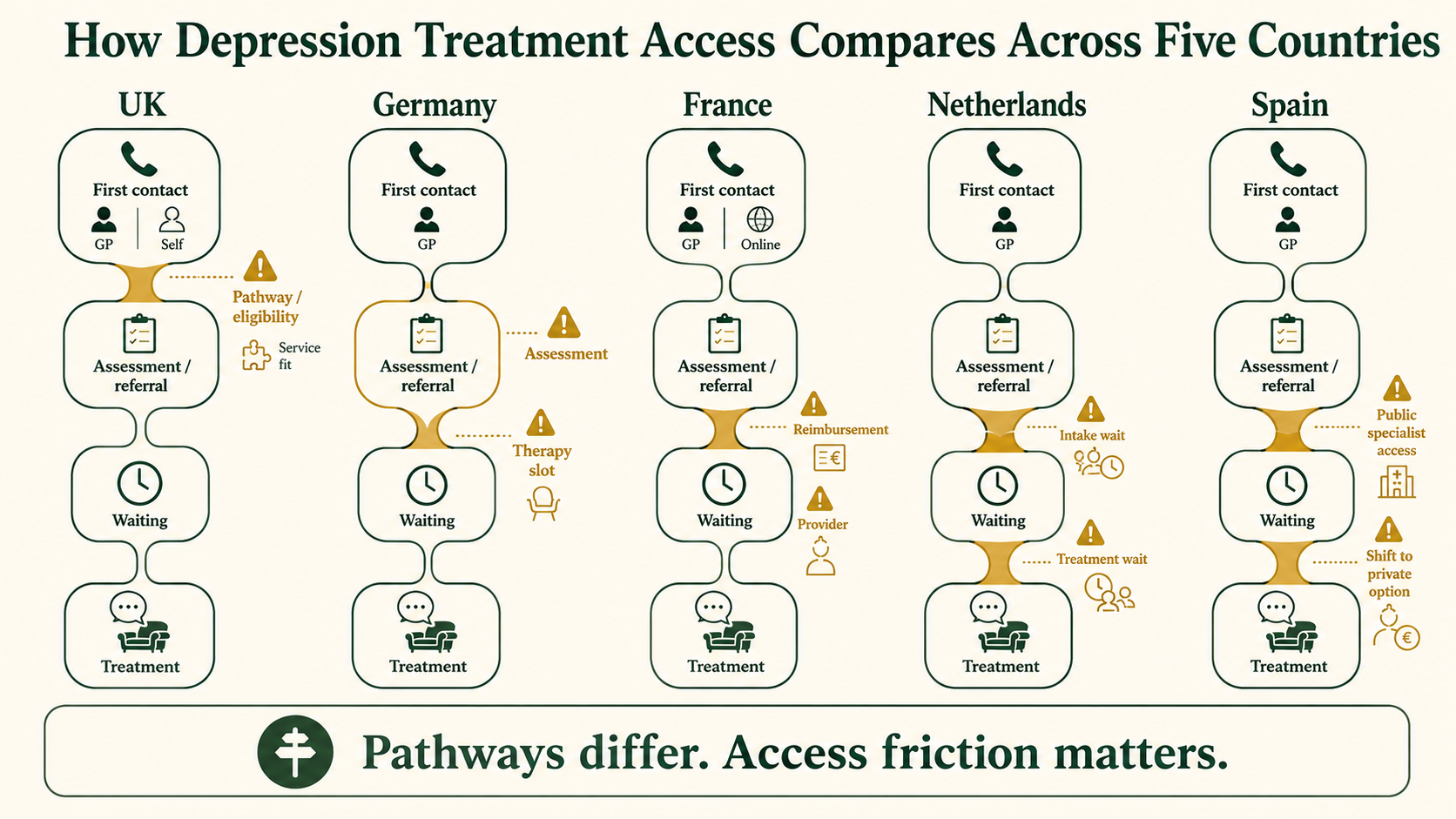
Here is the practical shape of each system before we go into detail. The single most useful thing to know is where each pathway tends to jam, because that is what determines how long you actually wait and what your alternatives are.
| Country | Usual first step | Direct access to a psychologist? | Public route | Where it tends to get stuck |
|---|---|---|---|---|
| England | GP, or self-refer to NHS Talking Therapies | Yes, via self-referral to Talking Therapies | NHS Talking Therapies for depression and anxiety; other pathways for more complex needs | Eligibility fit, local variation, and what happens if Talking Therapies is not the right service |
| Germany | Contact psychotherapists directly, or 116117 | Yes, for an initial consultation | Statutory insurance covers approved psychotherapy | Getting assessed is not the same as getting an ongoing therapy place |
| France | Doctor, or book directly under Mon soutien psy | Yes, with participating psychologists | Up to 12 reimbursed sessions per year | Scheme is aimed at mild to moderate difficulty; beyond that you need a different route |
| Netherlands | Huisarts, usually with the POH-GGZ | No, referral needed for specialist care | Basic insurance covers GGZ after referral | Waiting for intake, before treatment has even started |
| Spain | Primary care doctor, then referral | Only privately | Public specialist mental health care, varying by region | Specialist capacity, and how few people reach a psychologist rather than a doctor |
Why You Cannot Rank These Countries by Waiting Time
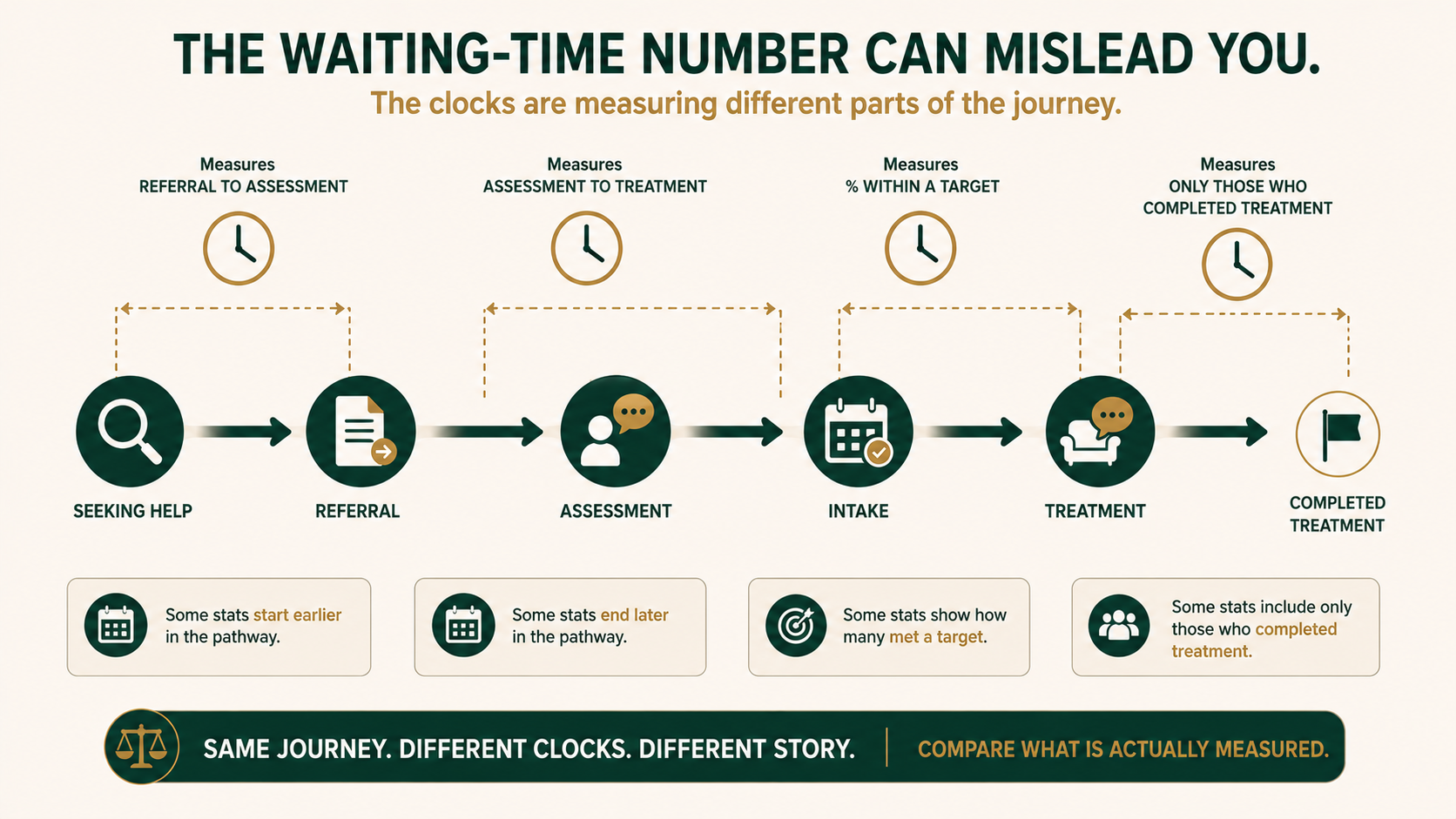
This is the most important methodological point in the article, and almost every comparison you will read online gets it wrong. Each country measures a different part of the journey, so the numbers are not comparable. Putting them in a league table produces a ranking that means nothing.
Look at what is actually being counted.
England reports the share of people who completed a course of treatment and started it within six weeks. Germany's strongest national figure measures the gap from the first consultation to therapy beginning. The Netherlands measures whether intake happened within an agreed national standard. Spain's headline figure is self-reported waiting for a first specialist appointment.
"Six weeks in England" and "fourteen weeks in the Netherlands" are not the same measurement. They are different stages of different journeys, counted in different ways.
So this article does not rank them. It compares friction points, which is the thing that actually affects you.
Depression Treatment in the UK: Can You Get NHS Therapy Without a GP?
In England, yes. You can self-refer to NHS Talking Therapies without going through your GP, which makes it one of the more accessible entry points in Europe for mild to moderate depression. But the UK does not have one system, and Talking Therapies does not cover every level of need.
First, the structural point most articles miss: England, Scotland, Wales and Northern Ireland run separate health services. The detailed national data below is England only. Do not assume it describes Glasgow or Belfast.
Where you start. Either your GP, or a direct self-referral to your local NHS Talking Therapies service. Talking Therapies is specifically for depression and anxiety, and offers NICE-approved treatments.
What the official numbers show, and what they do not. NHS England publishes monthly Talking Therapies statistics, and around nine in ten referrals start treatment within six weeks. That sounds excellent, and the denominator matters enormously.
NHS England states plainly that this measure is based on referrals completing a course of treatment. In one published month the calculation was 51,656 out of 56,781 people who finished a course of treatment. It is not the share of everyone who asked for help.
So the more useful question is what happens to people who never reach that cohort. Those who drop out during the wait. Those whose needs turn out to be too complex for Talking Therapies and who get referred onward into community mental health services, which is an entirely different queue. Those in an area where local capacity is poor, because provision varies significantly by locality.
If you need English is not the issue here, but language may still be. Talking Therapies services can often arrange interpreters, though availability varies, and being able to choose a therapist who shares your first language is not something the pathway is built around.
If it stalls: go back to your GP and describe what has changed, ask whether your needs fit a different service, and ask what the local wait actually is rather than the national figure.
Depression Treatment in Germany: Why Assessment Is Not the Same as Therapy
Germany's system contains the single most frustrating distinction of the five. You can usually get an initial psychotherapeutic consultation reasonably quickly, and that does not mean you have a therapy place. Those are two separate things, and a great many people abroad find this out the hard way.
Where you start. You do not need a GP referral to seek an initial psychotherapeutic consultation, the Psychotherapeutische Sprechstunde. You can contact practices directly, or use the 116117 appointment service, which can help arrange that first consultation and, following assessment, may issue documentation and a code used to obtain further appointments.
What that consultation does. It establishes whether psychotherapy is indicated and what kind. It is genuinely useful. It is also not treatment.
Then the real wait begins. Germany's Federal Chamber of Psychotherapists analysed statutory insurance billing records and reported an average of 142.4 days between the first consultation and the start of therapy. The BPtK figures are based on roughly 300,000 insured people who attended a consultation in the first quarter of 2019, and more than one in ten did not begin treatment until a full year later.
Two honest caveats. That data is from 2019 and was published in 2022, so treat it as the best national picture of the gap rather than a current live figure. And statutory insurers have published shorter estimates using different definitions, which is exactly the measurement problem described above.
What this means in practice. You will likely be calling many practices, leaving messages, and hearing that lists are closed. A system that requires this much persistence is a hard system to face while depressed, and that is not a small point.
Private practice is a genuine alternative if you can pay, and English-speaking private therapists are relatively available in the larger cities. Statutory insurance may in some circumstances reimburse private treatment where no place can be found, but the rules are strict and the process is administrative.
If it stalls: keep a written record of the practices you contacted and when, since that documentation matters if you pursue a reimbursement route.
Depression Treatment in France: What Mon soutien psy Actually Covers
France has the most straightforward direct-access route of the five, within limits. Mon soutien psy allows eligible people to book directly with a participating psychologist, without first getting a doctor's referral, for up to 12 reimbursed sessions per year. Sessions are set at €50 and reimbursed through the Assurance Maladie system.
That is genuinely useful and it is not "free therapy for everyone."
What it is designed for. The official Assurance Maladie information frames the scheme around mild to moderate psychological difficulty. It is not a replacement for comprehensive care for severe or complex depression.
The practical constraints. You must find a participating psychologist, and not all psychologists take part. Reimbursement runs through the standard system, with complementary insurance typically covering the remainder. And twelve sessions per year is a defined course, not open-ended treatment.
If your needs exceed the scheme, the route is through a doctor into psychiatric care, which is a different pathway with different availability. Reliable national waiting-time data for broader public psychiatry in France is not straightforward to obtain, and rather than invent a number, the honest statement is that availability varies considerably by region.
English-speaking psychologists are findable in Paris and other large cities, less so elsewhere, and whether a participating Mon soutien psy psychologist also works in your language is a separate search from finding one at all.
Depression Treatment in the Netherlands: Where the Waiting Starts Before Treatment
The Dutch system is clear on paper and slow in practice. You start with your huisarts, who may involve the POH-GGZ for lighter complaints and refers moderate or serious problems into specialist mental healthcare. The referral is not the difficult part. What follows it is.
How it works. The GP is the gatekeeper. For milder difficulty, the practice-based mental health worker may be able to help directly and relatively quickly. For anything more substantial, you are referred into the GGZ, covered by basic insurance, with your own risk applying.
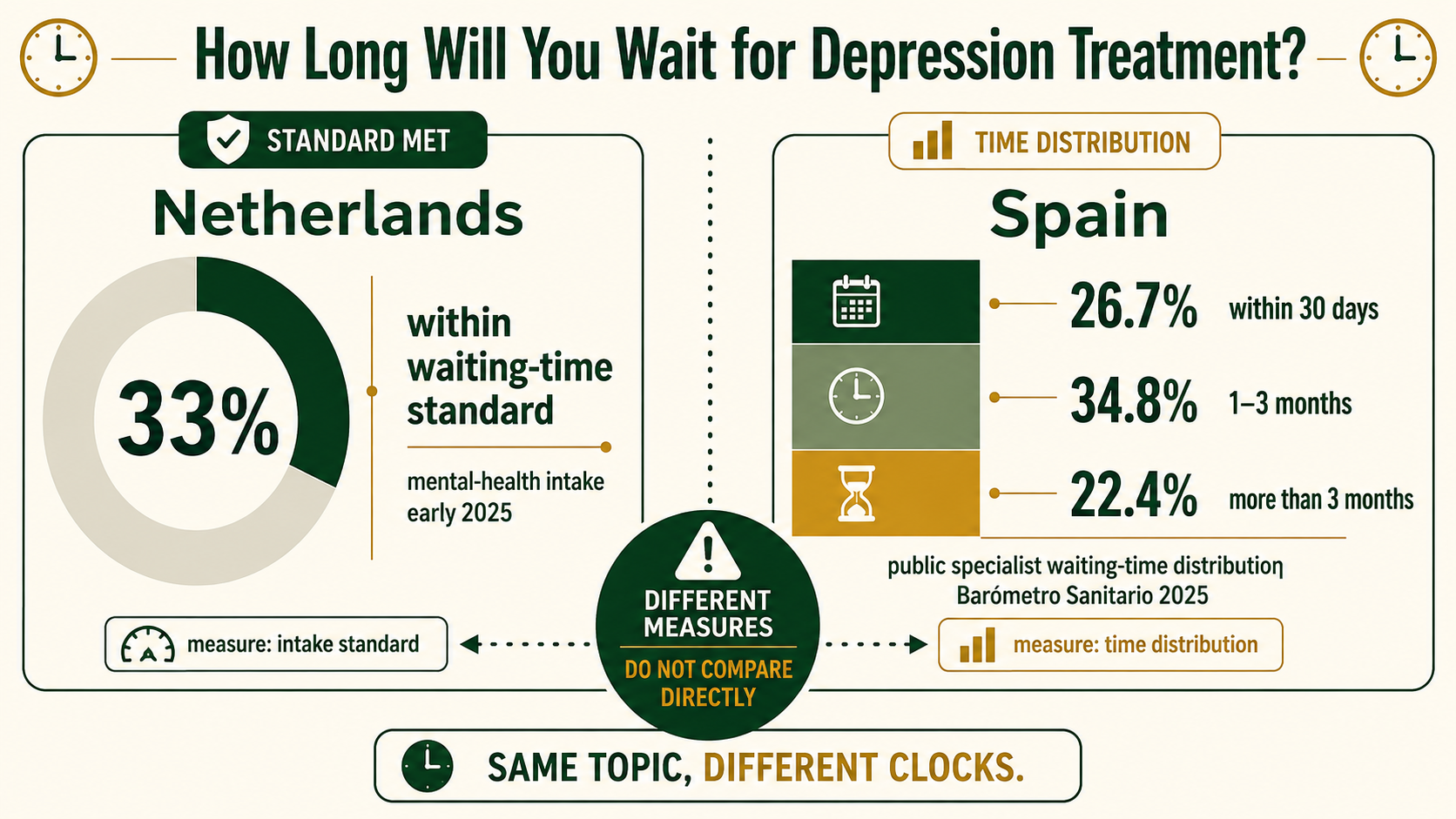
Then you wait, often twice. The Netherlands has nationally agreed acceptable waiting standards, the Treeknorm, of four weeks to intake and ten weeks to treatment. In February 2025 the Dutch Healthcare Authority reported that only 33% of people were getting their intake within that standard, while 61% started treatment within the standard after intake.
Read that carefully. For two out of three people, the very first formal step was already taking longer than the country's own agreed acceptable limit.
By July 2025 the NZa reported that average waiting times exceeded the Treeknorm across all major diagnostic groups, and stated directly that access had not improved.
This is a stronger criticism than "Dutch mental health care is slow," because it uses the system's own standard. The Netherlands defined what an acceptable wait looks like, then measured itself failing to meet it.
If it stalls: ask your health insurer about zorgbemiddeling, care mediation. Insurers have an obligation to help you find care and can sometimes identify a contracted provider with capacity you would not have found alone. Ask whether reimbursement changes if you go to a non-contracted provider. And keep talking to your huisarts or POH-GGZ about interim support rather than treating the waiting list as your only option.
Depression Treatment in Spain: Public System or Private Psychologist?
Spain's public system covers mental health care, and the data show a striking pattern: a large share of people who need help end up paying privately anyway. Healthcare is also decentralised across the autonomous communities, so your experience in Madrid, Andalusia or Catalonia can differ substantially.
Where you start. Your primary care doctor, who can treat directly or refer you into specialist mental health services.
What the national data show. The Barómetro Sanitario 2025, produced by the Ministry of Health with the CIS, found that 21.2% of adults had needed help for a mental health or emotional problem in the previous twelve months.
Of those, roughly half used the public system, while about a third paid a private professional out of pocket and around one in ten used private insurance.
Then the detail that tells you most about access. Among people treated in the public system, about 38% were seen by their family doctor and around 37% by a psychiatrist, while only around 20% saw a psychologist. For people referred on from primary care, the average self-reported wait to a first specialist appointment was around 109 days.
Translate that. If you go through the Spanish public system for depression, the most likely outcome is being managed by a GP or a psychiatrist rather than receiving psychotherapy from a psychologist, and if you are referred onward, the average reported wait is roughly three and a half months.
That explains, without needing to speculate much, why so many people in a country with universal healthcare are paying privately.
This is a recognised policy priority rather than a hidden problem. Spain's national Mental Health Action Plan for 2025 to 2027 includes increasing specialist training places and strengthening community mental health care, which is an official acknowledgement that capacity and access need work.
Private psychologists are widely available and directly accessible without referral, with English-speaking practitioners concentrated in Madrid, Barcelona and coastal areas with large international populations. Costs are generally lower than in northern Europe.
Why Waiting Is Harder When You Are Already Depressed
This is the part health system comparisons never mention, and it is the reason access design matters so much for this specific condition. Depression reduces motivation, concentration, energy and tolerance for rejection, which are precisely the capacities these systems demand of you.
Consider what the process actually requires. Making phone calls. Explaining your situation to a stranger, repeatedly. Comparing providers. Filling in forms. Understanding insurance terminology in a second language. Being told no, and calling the next one. Doing this over weeks without knowing whether it will work.
A system that rewards persistence is a poor fit for a condition that removes it.
Two practical implications. First, if you have any capacity at all right now, use it, because the version of you in six weeks may have less. Second, this is a reasonable thing to delegate. Asking a partner or friend to make three phone calls is not helplessness. It is using support for the specific task that is hardest for you.
Public or Private: When Does Paying Make Sense?
Neither is automatically better, and private does not mean higher quality. The real trade-off is between cost on one side, and speed, choice and language options on the other. Which matters more depends on your severity, finances and how long the public route will realistically take.
The public or insured route costs less directly, sits inside a medical pathway that can escalate to psychiatric care if needed, and is usually the appropriate route for more severe depression. The cost is bureaucracy, limited choice of therapist, capacity constraints and language availability that you do not control.
Private or self-pay can be faster, gives you a much wider choice of therapist, generally offers far more language options, and is easier to arrange online. The cost is the cost, plus uncertain reimbursement, and the fact that you have to check credentials yourself.
One important limit: private outpatient therapy is not a substitute for psychiatric care where that is what is needed. If your symptoms are severe or worsening quickly, the medical pathway matters.
Many people abroad end up doing both: starting privately to get moving, while staying in the public queue.
Joining the public waiting list and paying for a few private sessions are not competing decisions. You are allowed to do both at once, and most people who get help quickly did exactly that.
Why Finding an English-Speaking Therapist Is So Difficult
Because you are effectively running two separate searches at the same time. Finding "a psychologist" and finding "a psychologist you can actually speak to properly" are two different problems, and the public systems in all five of these countries are built around solving the first one only.
The friction is specific. Public directories are usually in the national language. Referral pathways assign you to a service rather than to a person. Therapist language is rarely a filter you can apply. Interpreter availability varies. And in the country with the shortest waiting list, the English-speaking subset may still be full.
There is also a quieter problem: the emotional vocabulary you need for therapy is not the vocabulary you learned for work and bureaucracy. You may function well professionally in your second language and still find that describing shame, numbness or hopelessness in it is slow and approximate.
Whether therapy is better in your first language is a genuine clinical question, and not the point here. The access point is simpler: if you cannot find anyone you can speak to comfortably, the pathway has failed regardless of how good the system is on paper.
What Changes If You Are an Expat, Specifically
Your insurance situation may put you on a completely different route from the locals around you. Employer schemes, private international policies, supplementary insurance and local statutory cover all behave differently, and the advice your colleagues give you may not apply to your policy.
Before assuming you know your route, check these directly with your insurer:
- Whether outpatient psychotherapy is covered at all
- Any session limit per year
- Deductible or excess, and how it applies
- Whether a referral or pre-authorisation is required
- Whether you must use a network provider
- What happens with an out-of-network therapist
- Whether teletherapy is covered, including across borders
Ask for it in writing. Verbal reassurance from a call centre is worth very little when a claim is refused four months later.
Also check whether your employer offers mental health support directly, and whether occupational health can help. In several of these countries that is a faster route than the public system.
"I Cannot Wait Three Months." What Can You Actually Do?
You almost certainly have more options than the waiting list in front of you suggests, though none of them comes with a guarantee. The goal is to work several routes at the same time rather than sitting behind a single referral and hoping it moves. Parallel effort beats patience here.
Realistic steps, depending on where you are:
Go back to primary care and describe deterioration specifically. Not "still not great," but what has changed. Urgency can change the pathway.
Ask your insurer for help finding a provider. In the Netherlands this is care mediation and it is an obligation, not a favour. Other insurers have similar functions.
Widen the geography. Neighbouring towns often have shorter lists than city centres, and teletherapy removes the travel problem entirely.
Ask whether interim support exists. Guided self-help, group programmes, or the POH-GGZ in the Netherlands can be available much sooner than full therapy.
Check what you can afford privately, even temporarily. A handful of private sessions while the public route moves is a legitimate strategy.
Check employer benefits. They are frequently underused and can bypass the queue entirely.
Hand the admin to someone. Calls, comparisons, forms. This is the single most useful thing a partner or friend can do for you right now.
When You Should Not Be Managing a Waiting List at All
One clear exception to everything above. If you are having thoughts of harming yourself, if you cannot keep yourself safe, or if your symptoms are worsening rapidly, that is not a routine access problem. Use the urgent or emergency pathway in the country you are in.
Contact your local emergency number, your country's crisis line, or go to the nearest emergency department. Contact your doctor urgently if you have one. Tell someone you trust.
Private online therapy is not a substitute for emergency psychiatric care, and no article about access should imply otherwise. Being far from home makes this harder and not impossible.
Where a Route Like Expathy Fits
The problem this article describes is mostly not about the quality of treatment. It is about the distance between deciding to get help and actually having a therapy conversation, and for internationally mobile people that distance is longer than for anyone else in the queue.
Expathy connects people abroad with psychologists who work with international clients, have lived abroad themselves, and can be matched around native language and cultural background. That is not a claim to be clinically better than a national health system, and it is not a replacement for psychiatric or emergency care.
What it can remove is the search and language friction, which for many people is the part of this process that actually stops them.
If that is useful to you, depression therapy for expats is the direct route, and online therapy for expats covers the wider picture. If the waiting has started making you question whether to stay in the country at all, our article on whether to move home when you are depressed abroad is worth reading before deciding anything.
Final Thought
None of these five countries has solved this. England has an accessible front door that does not fit everyone. Germany can assess you quickly and then leave you waiting months for a place. France offers direct access within defined limits. The Netherlands has agreed standards it is not meeting. Spain has universal coverage that many people bypass privately.
What they share is that the official route is rarely the only route, and that nobody in the system is going to tell you that.
A long waiting list is information about capacity. It is not a verdict on whether you can get help.
Work more than one route. Ask directly what your local wait actually is. Hand the phone calls to someone if you can. And if things get worse while you are waiting, say so loudly rather than staying politely in the queue.
Sources and Further Reading
- NHS England Digital, NHS Talking Therapies monthly statistics, including the definition of the six-week measure as based on referrals completing a course of treatment: https://digital.nhs.uk/data-and-information/publications/statistical/nhs-talking-therapies-monthly-statistics-including-employment-advisors
- Bundespsychotherapeutenkammer, analysis of statutory insurance billing data on the gap between initial consultation and treatment start, average 142.4 days: https://www.bptk.de/pressemitteilungen/psychisch-kranke-warten-142-tage-auf-eine-psychotherapeutische-behandlung/
- Assurance Maladie, official information on Mon soutien psy, reimbursement and the 12-session limit: https://www.ameli.fr/assure/remboursements/rembourse/remboursement-seance-psychologue-mon-soutien-psy
- Nederlandse Zorgautoriteit, 2025 reporting on access to mental health care and Treeknorm performance: https://www.nza.nl/actueel/nieuws/2025/07/22/toegang-tot-geestelijke-gezondheidszorg-verder-onder-druk
- Barómetro Sanitario 2025, Ministerio de Sanidad and Centro de Investigaciones Sociológicas, on mental health care use, professional seen and reported waiting times: https://consaludmental.org/centro-documentacion/barometro-sanitario-cis-2025/
Frequently Asked Questions
How do I get treatment for depression in England?
Either through your GP or by self-referring directly to NHS Talking Therapies, which offers NICE-approved treatment for depression and anxiety without needing a referral. If your needs are more complex than that service covers, your GP can refer you into community mental health services, which is a separate pathway with different waiting times.
Can I self-refer for NHS therapy?
In England, yes, for NHS Talking Therapies. Scotland, Wales and Northern Ireland operate separate health systems with different arrangements, so check your nation's own pathway rather than assuming English rules apply. Private therapy is also available without any referral anywhere in the UK.
How long does it take to get psychotherapy in Germany?
Getting an initial psychotherapeutic consultation is often relatively quick. Getting an ongoing therapy place is the slow part. Germany's Federal Chamber of Psychotherapists, analysing statutory insurance billing records, reported an average of about 142 days between the first consultation and treatment starting, with more than one in ten waiting a full year.
Do I need a GP referral for therapy in Germany?
Not for an initial psychotherapeutic consultation. You can contact psychotherapy practices directly or use the 116117 appointment service, which can help arrange that first consultation. Following assessment, further appointments generally involve documentation issued after that consultation.
Is therapy free in France?
Not free, but reimbursed within limits. Mon soutien psy allows eligible people to book directly with a participating psychologist for up to 12 sessions per year, priced at €50 and reimbursed through Assurance Maladie with complementary insurance typically covering the rest. It is aimed at mild to moderate difficulty rather than severe depression.
Can I see a psychologist without a doctor's referral in France?
Under Mon soutien psy you can book directly with a participating psychologist without a prior doctor's referral. You can also see any private psychologist without a referral if you are paying yourself. Access to psychiatric care for more severe depression generally runs through a doctor.
How long are mental health waiting lists in the Netherlands?
Longer than the country's own agreed standard. The Treeknorm allows four weeks to intake and ten weeks to treatment. In February 2025 the Dutch Healthcare Authority reported only 33% of people received intake within that standard, and by July 2025 said average waits exceeded the norm across all major diagnostic groups.
Does Dutch health insurance cover therapy for depression?
Specialist mental health care is covered by basic insurance following a referral from your huisarts, with your own risk applying. Whether a specific provider is contracted by your insurer affects reimbursement, so check before starting with a non-contracted provider. Your insurer can also help find care through zorgbemiddeling.
How long do you wait for a psychologist in Spain?
For people referred from primary care to a public mental health specialist, the Barómetro Sanitario 2025 reported an average self-reported wait of around 109 days. Note also that only around one in five people treated in the public system saw a psychologist, with most seen by a family doctor or psychiatrist.
Is mental health care free in Spain?
Public mental health care is covered, but access shapes what that means in practice. In 2025 roughly half of people needing help used the public system, while around a third paid a private professional directly. Private psychologists are directly accessible without referral and generally cost less than in northern Europe.
Is private therapy faster than public therapy?
Usually yes, and speed is not the only consideration. Private care typically offers quicker access, wider therapist choice and far more language options, at your own cost and with uncertain reimbursement. Public routes cost less and sit inside a medical pathway that can escalate to psychiatric care, which matters for more severe depression.
Can I start online therapy while waiting for public treatment?
Many people do, and it does not require leaving the public queue. Treat it as a way to reduce the gap rather than as a replacement for the medical pathway, particularly if your symptoms are severe. If you are in crisis or deteriorating quickly, use the urgent or emergency route in your country instead.
Need support? We're here.
Book a free 15-min consultation with our expat-specialized therapists.