
Key takeaway
You are looking at flights again. Not for Christmas, not for a visit. One way. Six months ago you were telling people you loved it here, and now every hard day ends with the same thought: I should just go home. Then the second thought arrives, the one that keeps you scrolling instead of booking. What if I go home and still feel exactly like this? This article is about how to tell those two things apart before you decide.
Here is the honest shape of the problem.
Some of what is wrong with your life abroad is genuinely about your life abroad. The job, the isolation, the visa, the apartment, the winter, the fact that nobody here really knows you. Those are real, and moving would change some of them.
And some of what is wrong may be depression, which does not check your boarding pass.
The difficulty is that from inside a depressive episode, those two feel identical. Both produce the same conclusion: if I could just get out of here, this would stop.
You are not being irrational. You are trying to solve a problem while holding an instrument that is currently miscalibrated.
Will Moving Home Fix Depression?
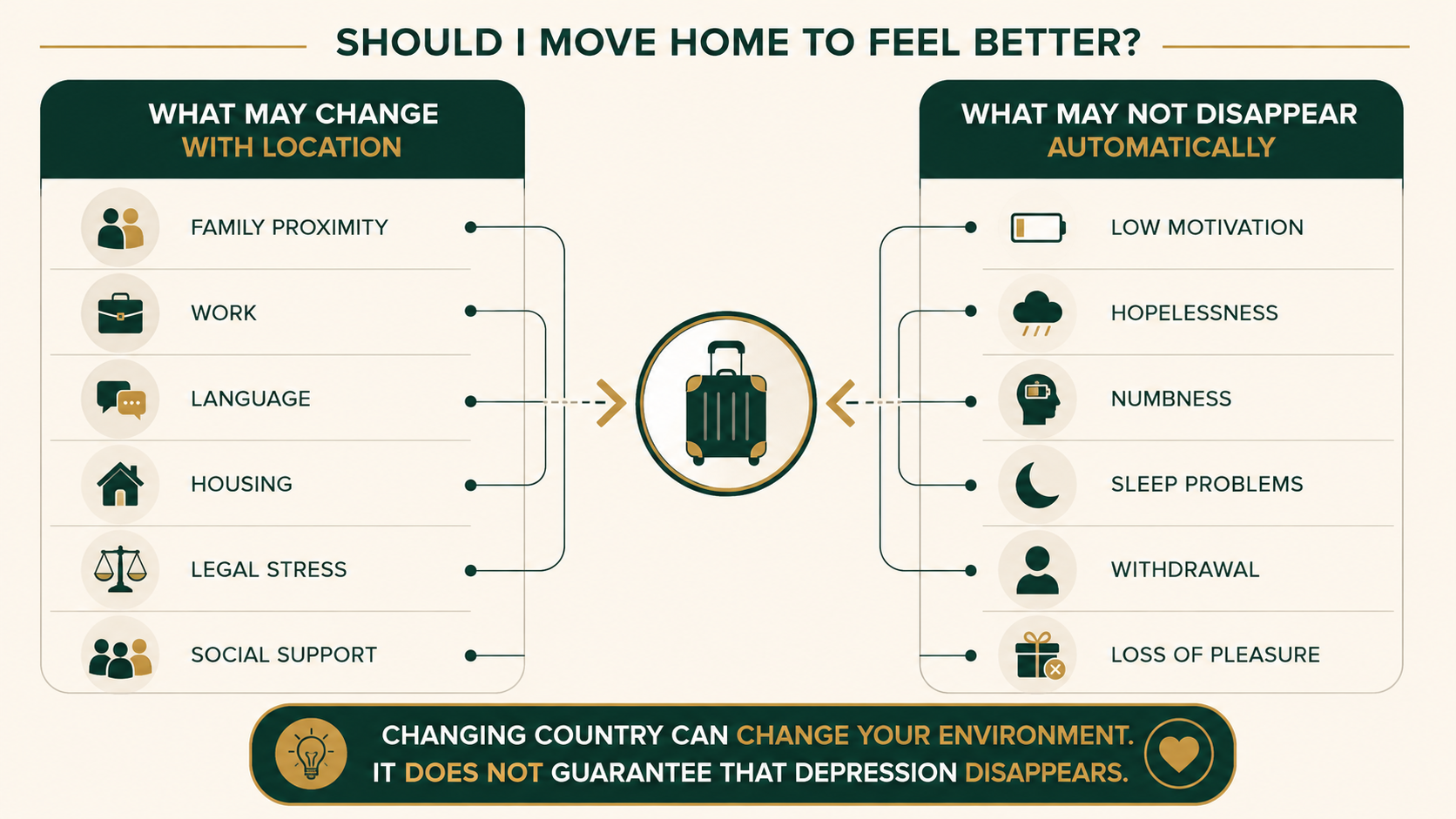
Sometimes it helps, and it is not a treatment. Going home can remove genuine stressors, and if isolation, legal insecurity, an unhealthy job or lack of care are actively maintaining your distress, changing those things matters. But there is no reliable evidence that repatriation itself treats a depressive episode.
That gap in the evidence is worth understanding correctly.
It does not mean going home never helps. It means nobody has demonstrated that crossing a border resolves depression, so you should not plan as though it will.
The distinction that matters for your decision is between the conditions around you and the condition inside you. Relocation acts powerfully on the first. It has no established effect on the second.
A border can change your environment. It cannot guarantee that a depressive episode stays behind.
The broader picture of what depression abroad involves, and what actually treats it, is in our main guide to depression abroad. This article is only about the decision.
Why This Decision Feels Impossible Right Now
Because depression changes how you forecast. Hopelessness makes every option look bad, reduced anticipation makes no future feel appealing, and negative self-evaluation makes staying feel like suffering and leaving feel like failure. You are being asked to compare two futures using the exact faculty the illness affects.
Notice the comparison most people are actually making.
On one side: your real, textured, difficult present, in full detail, including this morning.
On the other: a memory of home, edited, warm, and drawn mostly from visits when you were on holiday and everyone was pleased to see you.
That is not a fair comparison, and it is not your fault that your mind is producing it.
The opposite distortion is just as common. Someone stays not because staying is right but because leaving would mean admitting something. Neither shame nor fantasy should be making this decision on its own.
This does not mean you cannot decide anything while depressed. Plenty of people make sound decisions in difficult states. It means the estimate of how each future will feel is less reliable than usual, and it is worth knowing that before you act on it.
"Do I Hate This Country, or Am I Depressed?"
Very often, both. Real problems exist, and depression can also reduce the reward you get from almost everything at once, which makes the country the obvious suspect because it is the thing all your bad days have in common. Untangling them matters more than picking a side.
Let us be clear that the problems can be real. Housing can genuinely be bad. A job can genuinely be harming you. Discrimination genuinely happens. Loneliness can be severe. A relationship can genuinely have stopped working. Nobody should tell you those are symptoms.
At the same time, depression affects reward processing broadly. A 2024 systematic review of 20 studies by Wong and colleagues found anhedonia in major depressive disorder associated with worse physical, psychological and social functioning and lower quality of life. The mechanics of how that works are covered in our article on anhedonia abroad.
What that means practically: when the flatness is general, everything gets blamed on whatever is most visible. And what is most visible, when you live abroad, is the country.
Two questions that help more than any checklist:
If the single biggest problem here were solved tomorrow, would you expect most of your emotional life to lift? If yes, that points toward environment.
Has almost everything gone flat, including things with nothing to do with this country? Food, music, sex, your closest friendships, a good day at work, plans you used to want. If yes, something broader is happening.
What Would Change, and What Would Travel
This is the most useful frame available for this decision, and it is worth writing out honestly rather than doing in your head. Some things genuinely change the moment you cross the border. Others come with you in the suitcase, unchanged. Most people considering this only ever list one of the two columns.
| Likely to change if you go home | Likely to travel with you |
|---|---|
| Proximity to family and old friends | Loss of pleasure and interest |
| Operating in your native language | Low motivation and fatigue |
| Cultural familiarity and daily friction | Disrupted sleep and appetite |
| Navigating healthcare and bureaucracy | Hopelessness and guilt |
| Immigration and legal uncertainty | Low self-worth |
| Housing, cost of living, climate | Withdrawal from people |
| Access to practical help | Difficulty concentrating |
The left column is real and can matter enormously. If your depression is being fed by isolation, precarity or an inability to get care, changing those conditions is not avoidance. It is treatment-adjacent.
But the right column does not respond to geography. If those symptoms are established, they will be waiting for you in your parents' spare room, and the disappointment of discovering that is its own significant risk.
Also worth listing: what you would lose. The career you built, the relationship or friendships here, the version of your life that took years to construct. A one-sided comparison is how people end up with a second regret rather than none.
Home May Not Be the Home You Remember

Briefly, because it derails plans more often than anything else. You are usually comparing your daily life abroad with your holiday experience of home, and those are different products. Visits are short, social and framed by everyone's pleasure at seeing you.
Living there is not that.
Friends have children now, and a Tuesday evening is not available. Family dynamics are the ones you left. Career options may be narrower than you remember. And you have changed, which is the part almost nobody predicts.
None of this is an argument against going. It is an argument for comparing realistic to realistic, rather than comparing your worst week here to your best weekend there.
Going Home Is Not Failure
Let us dispose of this properly, because it distorts more decisions than any practical factor. Leaving a country that is not working for you is a legitimate choice, not a defeat. The idea that staying proves something is a story, and it is a story that keeps people in situations that are hurting them.
The reason it grips so hard is that the move probably carried a lot of identity. Independence, ambition, adventure, proving something to yourself or to people who doubted it. So I am going home can feel like I could not manage it.
Those are not the same sentence.
Geography is not a moral achievement. Nobody is awarded anything for the number of years survived in a country that stopped fitting. The people whose opinion you are imagining are, in almost every case, thinking about it far less than you are.
Staying Is Not Automatically Strength
The opposite mistake deserves equal weight. Remaining somewhere because you have already invested years, because leaving would look like quitting, or because strong people supposedly do not give up, is not evidence that staying is right. Persistence is only a virtue when it is pointed at something worth persisting with.
Check your actual reasons. If the honest list is mostly I would have to explain it and it would mean the last four years were wasted, that is sunk cost and reputation management rather than a decision.
There is no prize for staying in an environment that is seriously harming you, simply because leaving would feel like losing.
And a related trap: do not wait for time to fix it. Evidence from a meta-analysis of 20 longitudinal studies covering 8,156 refugees and asylum seekers at baseline found that pooled depression prevalence did not simply decline with years since migration. That population is very different from yours and the figures do not transfer, but the narrow point holds: time alone is not a mental health intervention.
When the Environment Deserves Serious Weight
Some circumstances should not be endured while you work on yourself. Therapy exists to help you live your life, not to make you tolerant of conditions that are genuinely harming you. In these situations, changing the environment deserves real weight rather than being treated as escape.
Circumstances in that category include:
- Ongoing discrimination or exclusion
- Any situation where you are not safe
- Severe financial instability
- Being unable to access healthcare you need
- Prolonged, unresolved legal or immigration insecurity
- A relationship that has become harmful
- Work conditions that are seriously damaging your health
- No realistic support here, combined with genuine support elsewhere
Legal insecurity deserves a specific mention because people treat it as paperwork. In a 2024 review of migrants living with prolonged unresolved status, pooled depression prevalence reached 49.5%. That is a very high-risk population and the figure does not describe expats on secure permits. But it demonstrates that living without knowing whether you can stay is a serious psychological condition, not an administrative annoyance.
If your situation is on this list, the question is not whether you are strong enough to cope with it.
How to Get Better Information Before You Decide
Unless something urgent requires immediate change, you can usually improve the quality of this decision before making it. The aim is not to delay you. It is to find out which of the two problems you actually have, and there are a few ways to do that.
Treat the depression as its own problem. Get an assessment. Then watch what happens to the urge to leave as symptoms change. If wanting to go home fades as treatment takes effect, that tells you something important. If it stays exactly as strong, that tells you something too.
Change one major stressor and observe. Take real leave. Fix the housing. Reduce the workload. Increase contact with people who help. Resolve the immigration question if it can be resolved. Not everything is changeable, but if one thing is, it is a genuine experiment.
Social support is worth singling out, because it is often the thing people are really going home for. Research on migrant workers by Kim and colleagues found the link between acculturative stress and depression was stronger where social support was low. Support genuinely buffers. It is also not a substitute for treatment once depression is established, which is why "I will feel better once I am near my family again" is a reasonable hope rather than a plan.
Use a visit for information, carefully. Time at home tells you something, and a holiday at home is not repatriation. Two good weeks with everyone delighted to see you does not predict a Tuesday in February with a job to find.
Write two realistic six-month scenarios. Not "stay and be miserable" versus "go home and be fine." Specifically: housing, work, income, healthcare, relationships, social support, routine, legal status, responsibilities. Both columns filled in honestly. Most people discover their imagined home version has significant blanks in it.
Some of what is driving the pull homeward may also be loneliness rather than the country itself, which is worth knowing because loneliness is addressable without a flight. And if the dominant feeling is missing home specifically, our article on when homesickness becomes depression covers that overlap.
If You Decide to Stay
If you stay, make it an active plan rather than continued endurance. Choosing to stay while changing nothing is not really a decision, it is a postponement, and it tends to produce exactly the same conversation with yourself six months later, with noticeably less energy to act on it.
An active version looks like: getting treatment underway, naming the two or three specific conditions you will change, deliberately building support here rather than hoping it appears, and setting a point at which you will genuinely reassess.
You are also not committing forever. "I will address these specific things and look at this again in a few months" is a complete and legitimate answer. It is usually a better one than a permanent decision made in a bad week.
If You Decide to Go Home
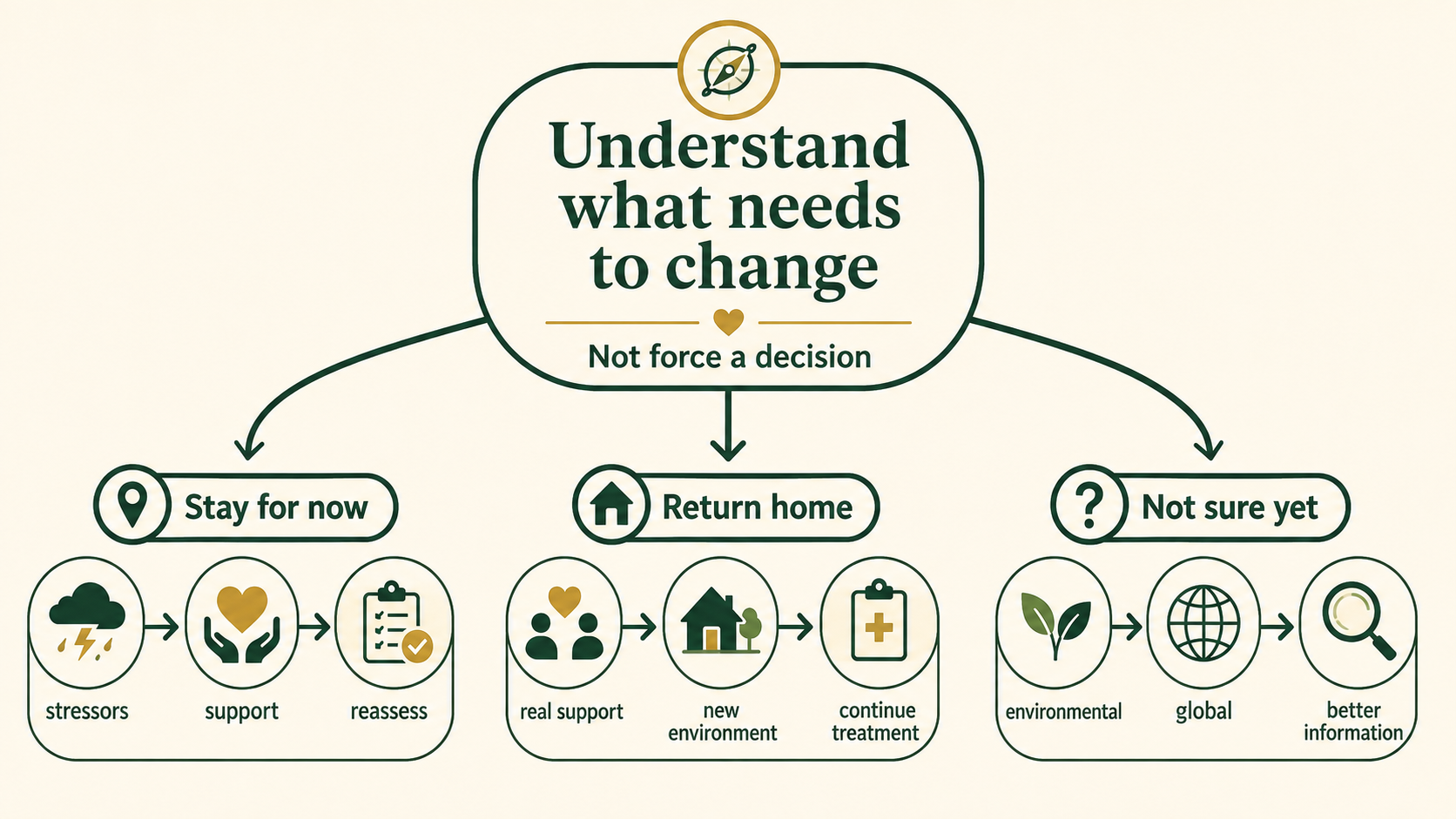
Treat this as a genuine option, because it is one and it is often the right one. The main risk is not that going home is the wrong choice. It is arriving with the assumption that the move itself replaces treatment, and then being blindsided when the symptoms are waiting for you.
If you are already in treatment, plan for continuity: prescriptions, records, insurance, a way to continue with a therapist or transfer to a new one. If you are not in treatment, arriving home is a reasonable moment to start rather than to wait and see.
Expect a period of adjustment on the other side. Coming back is its own transition, and feeling unsettled for a while is not evidence that you made the wrong call.
You can go home and still deserve support for the depression that came with you. Returning is not a treatment plan, and it does not have to be one to be the right choice.
If You Genuinely Cannot Tell
This is the most common position, and it is a reasonable one to be in. Nobody can determine from the inside which portion of this is environment and which is illness, particularly while the illness is affecting the assessment. That is precisely what outside help is for.
A therapist should not tell you which country to live in. What they can help with is separating the threads: what is depressive hopelessness, what is a real and unacceptable circumstance, what is grief for the life you expected, what is fear of how leaving would look, and what actually matters to you underneath all of it.
This decision is unusually tangled because it combines mental health, identity, career, family, belonging and the meaning you attach to home. Much of that sits alongside the wider question of identity and belonging abroad.
Expathy matches expats with psychologists by native language and cultural background, and our psychologists have moved countries themselves. You will not have to explain why "should I move home" is not a travel question.
That matters here more than in most situations, because a therapist who has never left their own country may hear this as a lifestyle preference rather than as the identity-level decision it is. If you want support with it, depression therapy for expats is the direct route, and online therapy for expats covers the wider picture. Working with someone who understands both sides also means the decision stays yours.
If You Are Not Safe Right Now
If you are having thoughts of harming yourself, if life feels not worth living, or if you are frightened you might act on those thoughts, the question of which country to live in can wait. Getting help today cannot.
Contact your local emergency number, your country's crisis line, or go to the nearest emergency department. If you have a doctor or therapist, contact them urgently. Tell someone you trust and ask them to stay with you.
Being far from home makes this harder and not impossible. Emergency services exist everywhere, and you do not need perfect language to ask for urgent help.
Depression is treatable, including when it does not feel that way from inside it.
Final Thought
You may have noticed this article has not told you what to do. That is deliberate, and not evasion.
Anyone confidently telling a stranger whether to leave their country is guessing, and the two easy answers, push through and just come home, are both wrong often enough to be dangerous.
What is defensible is this. Depression is treatable wherever you are. Genuinely harmful circumstances deserve to be changed rather than tolerated. And the two are different problems, even though right now they feel like one.
Work out which one you are actually facing. Then the decision usually gets simpler, whichever way it goes.
You do not have to book anything today.
Sources and Further Reading
- Wong and colleagues (2024), systematic review and meta-analysis of 20 studies on anhedonia and functioning in major depressive disorder: https://doi.org/10.1016/j.jad.2024.04.086
- Handiso and colleagues (2024), meta-analysis of 20 longitudinal studies with 8,156 refugees and asylum seekers at baseline on depression over time after migration: https://doi.org/10.1007/s11469-024-01406-w
- Côté-Olijnyk and colleagues (2024), systematic review and meta-analysis on depression among migrants living with prolonged insecure legal status: https://doi.org/10.1016/j.psychres.2024.115931
- Kim and colleagues (2022), study of migrant workers on acculturative stress, social support and depression: https://doi.org/10.3389/ijph.2022.1604643
Frequently Asked Questions
Should I move home if I am depressed abroad?
There is no universal answer, and anyone giving you one is guessing. Going home can remove genuine stressors such as isolation, legal insecurity or an unhealthy job, and that can matter a great deal. But it is not a treatment for depression, so it works best as a decision made alongside treatment rather than instead of it.
Will my depression disappear if I move back home?
There is no reliable evidence that repatriation resolves a depressive episode. Environmental changes can genuinely help, particularly when specific conditions were maintaining the distress. But core symptoms such as loss of pleasure, low motivation, disrupted sleep and hopelessness tend to travel with you rather than remaining at the border.
How can I tell whether I hate living abroad or I am depressed?
It is frequently both. A useful question is whether solving your single biggest problem here would lift most of your emotional life, or whether almost everything has gone flat, including things unrelated to the country. Broad flatness across unrelated areas points toward depression rather than dissatisfaction with a place.
Should I make a major relocation decision while depressed?
You are not incapable of deciding, but depression makes it harder to estimate how each future will actually feel. Hopelessness makes every option look bad and negative self-evaluation distorts what leaving would mean. Where possible, get support first, then decide with better information rather than during the worst stretch.
What if I only feel better when I visit my home country?
That is genuinely informative and also limited. Visits are short and social, everyone is pleased to see you, and there is no job to find or routine to rebuild. Feeling better on a two-week trip does not reliably predict how living there permanently would feel, so treat it as one data point rather than the answer.
Is going home because of my mental health a failure?
No. Leaving a country that is not working for you is a legitimate decision, and staying somewhere harmful proves nothing. The sense of failure usually comes from the identity attached to the move rather than from the decision itself. Geography is not a moral achievement in either direction.
What if the country really is making my mental health worse?
Then that deserves serious weight. Discrimination, unsafe circumstances, prolonged legal insecurity, inability to access healthcare, harmful work conditions or a harmful relationship are not things anyone should learn to tolerate. Therapy exists to help you live your life, not to make an objectively damaging environment bearable.
Should I wait until my depression improves before deciding?
Not necessarily, and there are situations that require change now. Where nothing urgent is forcing your hand, getting treatment underway first often clarifies things considerably. If the urge to leave fades as symptoms improve, that tells you something. If it stays exactly as strong, that tells you something too.
Can a therapist tell me whether I should move home?
No, and a good one will not try. What therapy can do is separate the threads: depressive hopelessness, genuine environmental problems, grief for the life you expected, fear of how leaving would look, and what actually matters to you. The decision stays yours, but it becomes considerably clearer.
Need support? We're here.
Book a free 15-min consultation with our expat-specialized therapists.