
Key takeaway
You built the life. You know the system, you have friends, you stopped feeling like a visitor years ago. And somewhere along the way a simple question got harder rather than easier: where is home? You visit your home country and find yourself missing your life abroad. You return abroad and miss something you cannot quite name. This article is about why living in another country reshapes your sense of self, your idea of belonging and your relationship with home, and how those changes can fit together.
Two things are true at once here, and most writing on this subject only manages one.
Living abroad can expand your life enormously. More perspective, more capability, more of the world understood from the inside rather than described to you.
It can also make your identity more complicated. Not damaged. Complicated, which is a different thing and a much less alarming one.
You can love living abroad and still find that you no longer know how to answer basic questions about where you are from.
That is not a sign that something has gone wrong. It is what happens when several of the things that quietly held your identity in place move at the same time.
What Identity Actually Means When You Live Abroad
Identity is not just nationality or a passport. It is the accumulated set of things that make you recognisable to yourself: your values, your language, your work, your relationships, your role in a family, your habits, your memories and the future you assumed you were heading toward. Relocation can unsettle several of these simultaneously.
It helps to be precise about what a move actually changes.
Place. Where you physically are. People. Who knows you and reflects you back to yourself. Role. Your profession, status and responsibilities. Language. How easily you express humour, nuance and confidence. Culture. What counts as normal. Routine. The small repeated things that made life feel like yours. Values. Which assumptions still feel like your own. Future. The life you now imagine.
Most life changes move one or two of these. A relocation can move all eight in a single month.
And a useful correction before going further: identity is not a fixed object that moving abroad damages. It is stable enough to give you continuity while still changing through experience. Living abroad simply makes that ordinary change unusually visible.
Why Moving Abroad Affects Your Sense of Self So Much
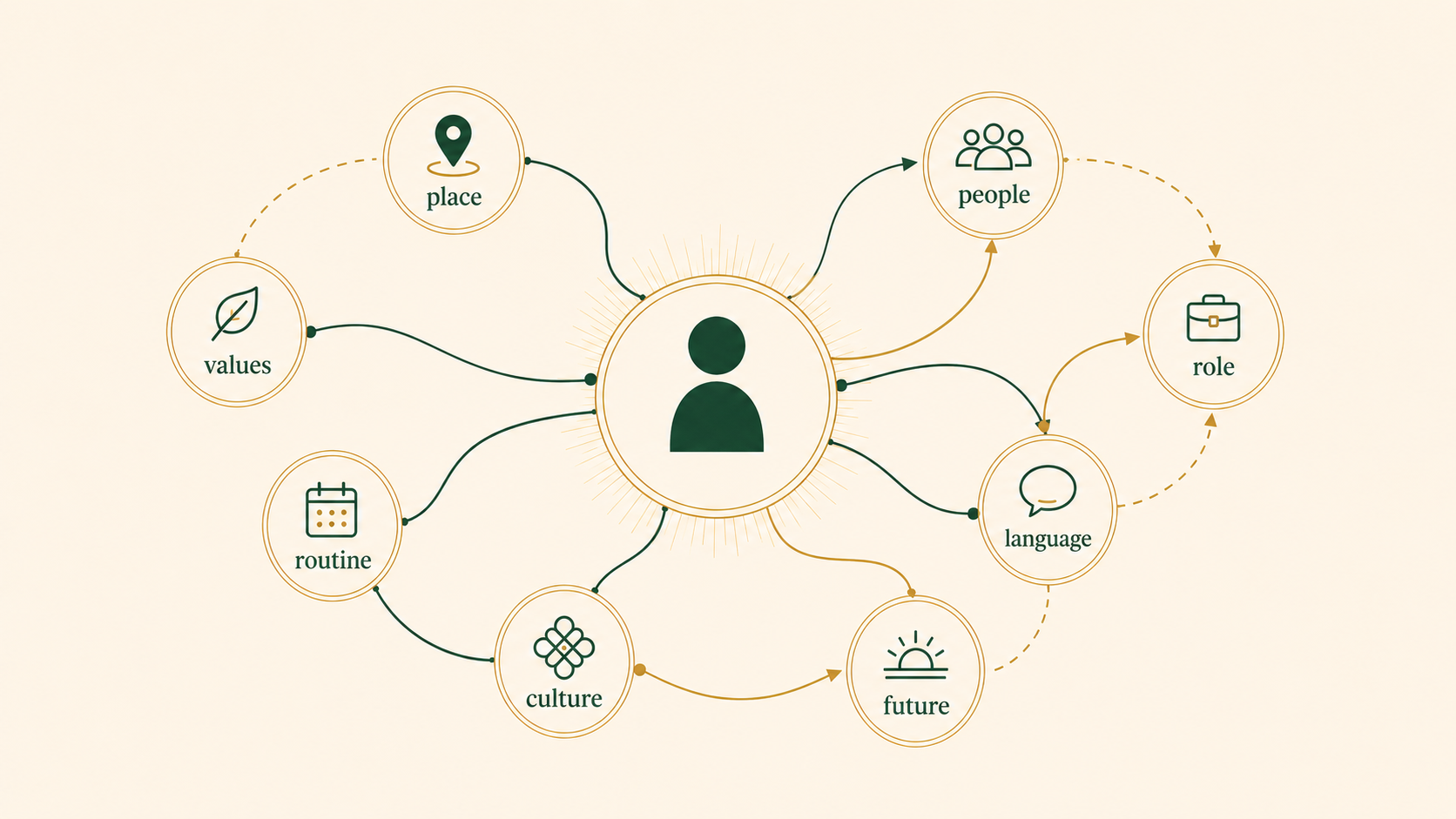
Because at home, most of your identity was confirmed for you without anyone having to try. People understood your references, pronounced your name without effort, knew your history, got your humour, recognised what your qualifications meant and could tell how competent you were. Abroad, much of that confirmation disappears at once.
The result is a specific and disorienting experience.
I know who I am. The environment just does not reflect it back to me the way it used to.
You suddenly have to explain things that previously required no explanation. Where you studied and what that means. Why that joke was funny. What your job title actually involves. Why your family operates the way it does. You are the same person, doing significantly more work to be legible.
Language does a lot of this quietly. Being less witty, slower, more reserved or less precise in a second language is not a personality change, though it can feel like one, an experience we look at in why you feel different speaking another language.
You did not become a smaller person abroad. You moved somewhere that requires more effort to see the whole of you, and where nobody has the context yet.
Identity and Belonging Are Not the Same Question
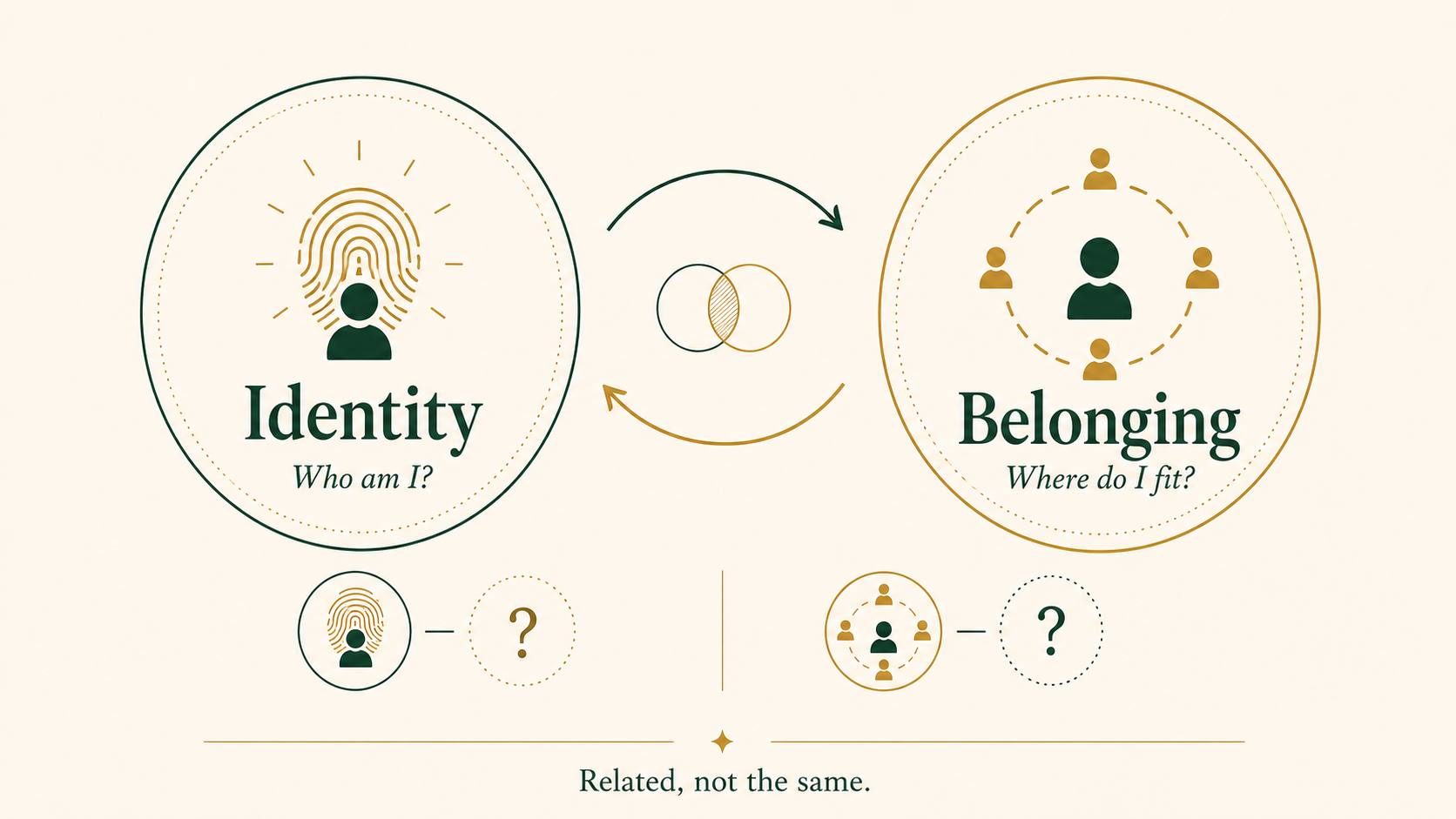
These get merged constantly and they behave differently. Identity asks who am I. Belonging asks where, and with whom, does this version of me feel accepted and understood. You can be entirely clear about the first and unresolved about the second, or the reverse.
That distinction matters practically.
Someone can know exactly who they are and still feel they fit nowhere in particular. Someone else can be socially embedded, invited to everything, and privately unsure who they are turning into.
Belonging is also not the same as loneliness, though they overlap. Loneliness is about missing connection and closeness. Belonging is about fit: whether a place, a group or a culture feels like somewhere you are from rather than somewhere you are in. You can have a full social life and still feel culturally out of place, which is why the loneliness question is treated separately in our guide to loneliness abroad.
The deeper psychology of why belonging matters so much is covered in our article on the search for belonging abroad. This page is about how belonging sits alongside identity and home.
Why Belonging Can Feel Incomplete Even When Life Is Good
This is the version that confuses people most, because on paper nothing is wrong. You have friends, work, a home, maybe a partner, and still there is a gap between belonging here and belonging the way you used to belong. That gap is usually about being understood without translation.
Think about what effortless belonging actually consisted of.
Shared references nobody had to explain. Humour that landed without a beat of delay. Assumptions about family, work and time that everyone in the room shared. Rituals you did not have to ask about. A shorthand built over decades.
Abroad, much of that has to be constructed rather than assumed. It can be constructed, and often is. It just takes years rather than being inherited.
None of this means people from different cultures cannot understand each other deeply. Plenty do. It means the understanding is built rather than given, and the difference between built and given is exactly what people are describing when they say I belong here, but not in the effortless way I belonged before.
The Middle Stage: Less Foreign, Not Quite Local
There is a stage almost nobody warns you about, and it lasts longer than the earlier ones. You stop being a newcomer without becoming local. You know how things work, what the unwritten rules are, what irritates you, what you would genuinely miss. And you remain, in some quiet way, from somewhere else.
This stage gets misread as failure to integrate. It usually is not.
Integration does not require becoming indistinguishable from local people, and treating that as the target sets up a test almost nobody passes. Accent, background, references and history do not dissolve, and there is no reason they should have to.
A more workable aim: a life in which the different parts of you can coexist without one having to be suppressed for the other to function. Local enough to live well. Foreign enough to still be yourself.
Being permanently slightly from somewhere else is not a failed version of belonging. For many people abroad it becomes the actual arrangement, and it works.
Your Home Culture Starts Looking Like a Culture
One of the strangest effects of living abroad is that your own country stops being the default. Things that were simply "how life works" reveal themselves as choices: cultural habits, assumptions, preferences and values that could have been arranged differently. You cannot unsee that.
The consequences run both ways.
Some things you become more attached to. Traditions, ways of eating, forms of directness or warmth you did not know you valued until they were absent.
Others stop fitting. Expectations about family obligation, career, marriage or how you are supposed to spend a Sunday may start to feel like someone else's rules rather than yours.
Both can happen at the same time, which is why people often feel simultaneously more and less connected to where they come from. Where those shifts create real internal tension, that experience has its own name and dynamics, explored in cognitive dissonance in expat life.
None of this is rejecting your home culture. It is having a second reference point, which is what living somewhere else gives you whether you asked for it or not.
What You Gain, Not Only What You Lose

Most writing on expat identity is loss-shaped, and that is an incomplete account. Living across cultures also builds things: independence, flexibility, a wider view of how life can be organised, new competences, relationships that would not otherwise exist, and a much clearer sense of what you actually value.
The research supports taking this seriously rather than treating multicultural identity as a burden.
A meta-analysis by Nguyen and Benet-Martínez covering 83 studies and 23,197 participants found a significant positive association between biculturalism and adjustment, both psychological and sociocultural. The link was stronger than for identifying with only one culture, whether the heritage culture or the new one.
Read carefully, that finding does two things. It undercuts the old idea of bicultural people as caught between worlds. And it suggests the goal is not choosing a side.
The task is usually not becoming the person you were before you moved. It is integrating who you were with who you have become.
Why It Helps When the Two Do Not Feel Opposed
There is a more specific finding worth knowing, because it explains why two people with identical circumstances experience this so differently. Research distinguishes between how blended someone's cultural identities feel and how much those identities feel in conflict, and the difference matters for wellbeing.
Benet-Martínez and Haritatos found these are two separate things, not one. Someone can keep their cultures quite separate, using different parts of themselves in different settings, without experiencing that as a conflict at all. Someone else can feel the two constantly pulling against each other.
The practical implication is useful. The aim is not to blend your cultures into a single seamless identity. Plenty of people successfully operate as somewhat different in each context, and are fine.
What tends to cost more is the sense that the two are at war, that being more of one requires betraying the other. That is the part worth working on, and it is workable.
When Home Itself Becomes Complicated
Many people abroad quietly assume that home will restore certainty. Go back, and you will feel completely like yourself again. Then they visit, and discover that home moved too. Friends have different lives, family dynamics shifted, the country changed, and so did you.
This produces one of the more disorienting realisations available.
I thought going home would make me feel like myself again. Instead I found out that this version of me was partly built somewhere else.
That is not a sign of disloyalty or of having lost something. It is arithmetic. You cannot spend years somewhere and remain unchanged by it, and the version of home you have been carrying is partly a memory of a specific time as much as a place.
For most people this settles into something manageable: home becomes a real place with real people rather than a fixed point of certainty. For some it stays harder, particularly after very long absences or repeated moves.
Home stops being the place where you are automatically understood and becomes a place you have a relationship with. That is a loss, and it is also just what happens.
"Where Are You From?" Gets Harder, Not Easier
For long-term internationals, this small-talk question can require a genuine decision. Birthplace, passport, where you grew up, where you live now, your partner's country, your children's country, the place you lived before this one: several of these can be true, and none of them may be the whole answer.
Most people develop a short version for convenience and a longer version for people who actually want to know.
The useful point is that you do not have to nominate one of these as the authentic one. The pressure to pick usually comes from the question's grammar rather than from anything real about you.
And belonging does not have to be exclusive. You can be genuinely attached to a home country, a host country, a city, an international community, a profession, a language and a place you lived a decade ago. These are not competing claims. Attachment is not a finite resource that gets divided.
That said, it would be dishonest to romanticise it. Multiple belonging can be enriching and inconvenient at the same time. It complicates practical decisions, family expectations and the question of where you eventually want to be.
What If You Feel You Belong Nowhere?
This happens, and it deserves naming rather than reassurance. The old identity no longer fits completely, the new one is not fully established, home has changed and the host country still feels partly foreign. For a while, none of the available options feels entirely like yours.
For many people this is transitional. It shows up strongly in the first years, or after a return visit, or following another move, and then eases as the new life accumulates weight.
For others it persists, and becomes a real and painful part of life abroad rather than a phase.
Two things worth holding onto if you are in it. First, it does not automatically mean anything is wrong with you or your decision. Second, it is not something you have to resolve by picking a country. The resolution, when it comes, is usually about building enough of a life here that this place carries real weight, rather than about choosing correctly between two allegiances.
What Helps Identity Feel More Coherent
There is no procedure for this, and a handful of things do reliably help. The aim is not to preserve exactly who you were, nor to replace that person entirely, but to keep enough continuity that the changes feel like development rather than disappearance. That balance is what most people are actually looking for.
Keep some things that are genuinely yours. Relationships, a language, an interest, a ritual, a tradition you actually care about rather than one you feel obliged to maintain. Continuity is what makes change feel like development rather than loss.
Let new parts develop without auditing them. The wrong question is am I still the same person. The better one is which of these changes actually feel right to me. Some adaptation is not losing yourself. It is learning something you did not previously know.
Pay attention to what you miss and what you do not. Both are information. Missing something tells you it mattered. Realising you have not missed something at all tells you something equally useful about what you were carrying out of habit.
Build belonging on more than nationality. Work, a neighbourhood, an interest, a shared experience, a language community. Belonging attached to only one category is fragile, and belonging attached to nationality alone is particularly hard to satisfy abroad.
Stop demanding a final answer to where home is. Some people eventually choose one place. Some keep several. Some change their answer at different life stages. None of those is the correct one, and the pressure to settle it usually comes from other people's questions rather than from your own life.
When identity changes make previously important goals feel hollow, that is worth attending to in its own right, and our article on purpose and motivation abroad covers that ground.
When These Questions Become More Than Adjustment
Identity questions abroad are normal and mostly not clinical. They become worth professional attention when they stop being reflective and start being disabling: persistent distress, an inability to make decisions that matter, feeling chronically detached from yourself, or a real loss of confidence that does not lift.
Some signals worth taking seriously:
- The questions are consuming energy you need for ordinary life
- You feel disconnected from yourself for long stretches rather than moments
- Important decisions have become impossible rather than difficult
- Relationships are suffering because of unresolved tension about where you belong
- Persistent low mood, loss of pleasure or hopelessness has arrived alongside it
That last one matters, because identity uncertainty and depression are not the same thing and get confused. Not knowing where you belong is not a symptom. If the flatness has spread across your whole life, our guide to depression abroad is the more relevant place to start.
How Therapy Can Help With This
Not by telling you where you belong. Therapy is useful here for sorting through which values still feel like yours, which expectations came from family or culture rather than from you, what you are actually grieving, and which life choices fit the person you have become.
That is genuinely hard to do alone, mostly because the questions do not have clean answers and the mind keeps looping.
What good therapy should not do is decide for you. No therapist should be telling you which culture you belong to, whether to stay abroad, or that you would be happier if you committed to one place. Those are yours.
There is a practical reason many people abroad prefer working with someone who has lived internationally. Explaining the emotional weight of the question where is home, why returning is not simple, what it cost to rebuild a professional identity in a new country, or why family expectations across a border are complicated, uses up a great deal of a session.
Expathy connects expats with psychologists who have lived abroad themselves and can be matched by native language and cultural background. Less of the context needs explaining from zero, so more of the hour goes to you.
We would not claim that matching guarantees a better clinical outcome, because the evidence does not support that. It does reduce the amount of translating you have to do before the actual work starts. If that sounds useful, online therapy for expats is where to begin.
Final Thought
The mistake most people make with this is treating identity abroad as a problem with a solution, where the solution is picking somewhere and committing.
It is more accurate to think of it as an arrangement you build over time. Some continuity with who you were. Some genuine change you have chosen. Several places that hold real weight. And a tolerance for the fact that no single answer to "where are you from" will ever be complete.
You can change without having lost yourself. You can miss home without wanting to move back. You can belong somewhere without feeling completely local.
None of those sentences cancels the others out. Living well abroad, over a long enough time, usually means holding all of them at once.
Sources and Further Reading
- Nguyen and Benet-Martínez (2013), Journal of Cross-Cultural Psychology, meta-analysis of 83 studies and 23,197 participants on biculturalism and psychological and sociocultural adjustment: https://doi.org/10.1177/0022022111435097
- Benet-Martínez and Haritatos (2005), Journal of Personality, on bicultural identity integration and the distinction between cultural blendedness and cultural harmony: https://doi.org/10.1111/j.1467-6494.2005.00337.x
Frequently Asked Questions
Can moving abroad change your identity?
Yes, and that is normal rather than a sign of instability. Relocation can shift several identity anchors at once: place, people, role, language, culture, routine, values and the future you imagined. Identity is stable enough to give you continuity while still changing through experience, and living abroad makes that ordinary change unusually visible.
Why do I feel like a different person after living abroad?
Partly because the environment no longer confirms who you are automatically. At home, people understood your references, history, humour and qualifications without explanation. Abroad, much of that has to be actively communicated, often in a second language. You have not become a different person. You are doing more work to be understood.
Why do I not feel fully at home in either country?
Because you are in a common middle stage: the old identity no longer fits completely, the new one is not fully established, home has changed and the host country still feels partly foreign. For many people this is transitional and eases as life abroad accumulates weight. For some it persists and becomes genuinely painful.
Can you belong to more than one country?
Yes, and attachment is not a finite resource that gets divided. Many people abroad feel genuine belonging to a home country, a host country, a city, a professional community and a language group at once. These do not have to compete, although multiple belonging can be enriching and practically complicated at the same time.
Does adapting to another culture mean losing your identity?
Not necessarily. Research on biculturalism, including a meta-analysis of 83 studies with over 23,000 participants, found engaging with both cultures was more strongly associated with good adjustment than identifying with only one. Some adaptation is learning rather than loss. The useful question is which changes genuinely feel right to you.
Why does visiting home sometimes feel strange after living abroad?
Because home changed while you were away, and so did you. Friends have different lives, family dynamics shifted, and the version of home you have been carrying is partly a memory of a specific period. Discovering that this version of you was partly built somewhere else is disorienting but not a sign of disloyalty.
Is belonging the same as loneliness?
No. Loneliness is about missing connection and closeness. Belonging is about fit, whether a place or group feels like somewhere you are from rather than somewhere you are in. You can have a full social life and still feel culturally out of place, which is why they need different responses.
What helps you feel more grounded when living between cultures?
Keep some things that are genuinely yours, whether relationships, a language, a ritual or an interest. Let new parts of yourself develop without constantly auditing whether you have changed. Build belonging on more than nationality. And stop requiring a final answer to where home is, since many people never settle on one.
When should identity questions be discussed with a therapist?
When they stop being reflective and become disabling: persistent distress, decisions that have become impossible rather than difficult, feeling detached from yourself for long stretches, or relationships suffering from unresolved tension about where you belong. Therapy should help you make sense of the competing parts, not decide where you belong.
Need support? We're here.
Book a free 15-min consultation with our expat-specialized therapists.