
Key takeaway
Becoming a parent abroad can change your identity twice over: you become a parent, and you become someone who has to decide what your culture is actually for. This article explains why parenthood makes your own upbringing visible again, why your native language suddenly carries weight it never carried before, what it feels like to be the foreign parent at the school gate, and what happens when your child treats the host country as home in a way you never quite will. It covers grief for the parenthood you imagined near family, the shift in how you see your own parents, and five moves that help you feel like one person again. Start by separating what you genuinely value from what you feel obliged to reproduce.
Before your child arrived, culture was probably just the water you swam in. Then someone asks which language you will speak at the dinner table. Your mother asks, carefully, whether the baby will know the songs she sang to you. You watch a local parent hand their four-year-old a knife at a birthday party and feel something you cannot name. You think about schools. Names. Which holidays get a tree and which get a phone call.
And underneath all of it, a much larger question is quietly assembling itself.
What parts of who I am do I actually want to carry forward?
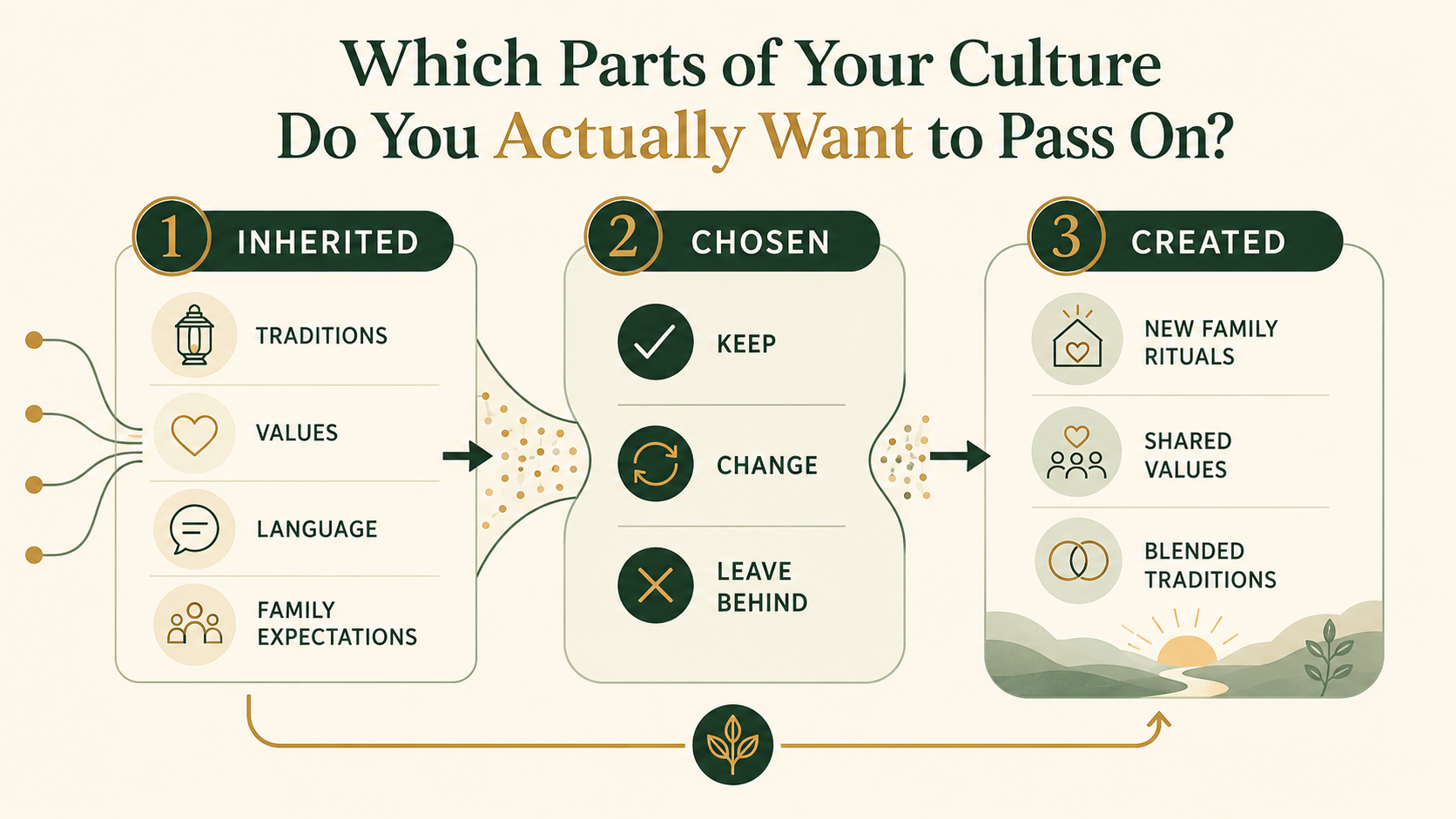
Can becoming a parent abroad change your identity?
Yes, and not because anything has gone wrong. Becoming a parent already reshapes roles, priorities, work, sleep and your sense of the future. Living abroad adds culture, language, distance and unfamiliar parenting norms. When both happen together, parts of your identity that used to run automatically suddenly require conscious decisions.
That is the core of expat parent identity: two transitions overlapping. This is different from the broader question of how living abroad changes you over time, which is covered in Expathy's work on expat identity crisis and belonging abroad. Parenthood abroad narrows the question from "who am I becoming here" to "what am I handing on."
The research on parent identity is reassuring about what a settled version looks like. Work reported in a 2023 Frontiers in Psychology paper describes a study of parents aged 18 to 83 in which those with a clearer, more committed sense of themselves as parents reported higher life satisfaction and fewer depressive and anxiety symptoms. The same literature separates that from ruminative exploration, the loop of worrying about what you should be doing.
The distinction matters enormously here. Deciding which traditions to keep is exploration. Lying awake convinced you are failing your grandmother is rumination. They feel similar at 3am. They are not the same thing.
Why parenthood makes your own upbringing visible again
Because you are no longer only the product of a childhood. You are now producing one. Before children, your upbringing is largely history. Once you are responsible for someone else's, it becomes a live reference document, and every page invites a verdict: keep this, change this, quietly drop this.
Questions arrive unbidden. Was I raised in a way I want to repeat? What did my parents get right that I never thanked them for? Which rules did I assume were universal until I moved and discovered they were regional?
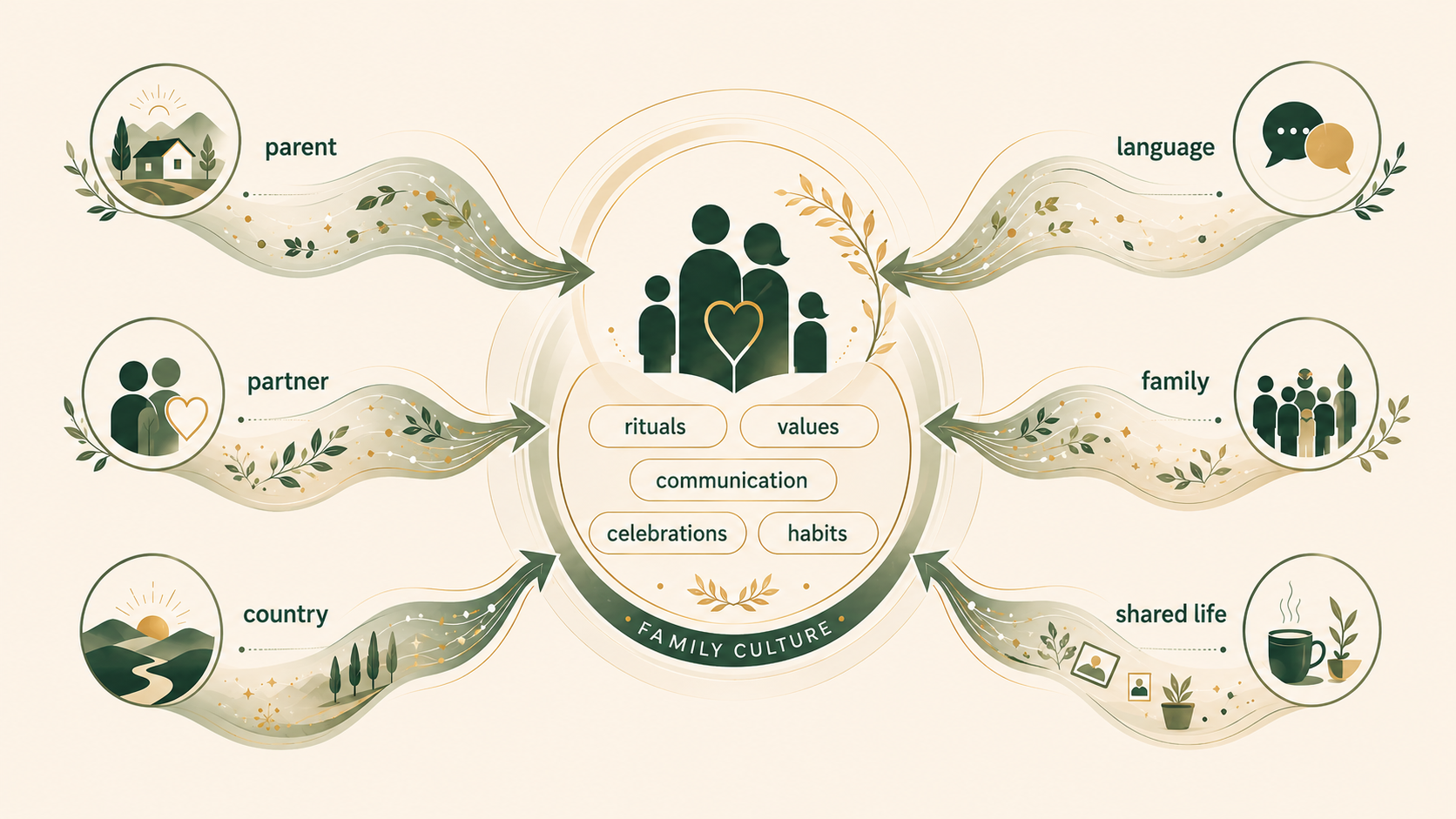
Living abroad hands you a second comparison point, then a third and a fourth. You are now weighing the culture that raised you, the host culture around your child, your partner's upbringing, and the family culture you are actually building. This is what "parenting between cultures" really means: not choosing a side, but running four scripts at once and deciding which lines you keep.
Parenthood can turn cultural inheritance into conscious evaluation. You stop simply living inside a culture and start editing it.
Why your culture may suddenly matter more after having children
Because culture changes category. Before parenthood, culture is something you experience. After parenthood, it becomes something you either transmit or do not. That shift alters its emotional weight almost overnight, which is why people who never considered themselves traditional find themselves fiercely protective of a soup recipe.
You may suddenly care about your native language, saints' days, a particular lullaby, the way your family says goodbye on the phone, the cartoon you watched at seven. None of this made your list of core values last year.
The honest explanation is not sentimentality. It is that transmission has a deadline and experience does not.
You may not realise which parts of your culture feel deeply yours until you have to decide whether your child will inherit them.
You may also decide not to pass parts of it on
Cultural continuity does not require cultural reproduction. Parenthood abroad often surfaces the opposite instinct too: a clear sense of what you will not be repeating. Rigid gender expectations, obedience as a virtue, achievement pressure, emotional silence, discipline you flinch to remember. Naming those is not betrayal.
Many people arrive at parenting differently from how I was raised with real guilt attached. It helps to separate the culture from the specific household. You can love a country, a language and a cuisine while declining one particular family's approach to shame.
You can stay connected to where you come from without reproducing every part of your childhood. That sentence does more work for identity integration than almost anything else in this article.
Why your native language suddenly feels emotional
Because language is not only communication, it is access. Access to your parents, your humour, your childhood, the version of you that exists in your first language. The practical question is which language is easiest. The identity question is what it would mean if your child could never quite reach that part of your world.
Research involving 776 multilingual families in the Flemish region of Belgium, published in the International Journal of Bilingualism, found that parents' efforts to maintain a heritage language were shaped not only by their own beliefs but by advice from early childhood professionals and other outside sources. In other words, the decision is rarely made in private. It is made under pressure from people who sound authoritative.
And the drift is real. A follow-up study of 488 multilingual families in Belgium, surveyed twice 18 months apart and published in Language Policy, found family practices shifting measurably toward Dutch, the institutional language, including in how parents spoke with each other and with their child.
Nobody decides that. It simply happens, one tired evening at a time.
The question may not be "which language is easiest." It may be "what would it mean to me if my child could not share this part of my world?"
That is the parent's question. The practical mechanics of managing several languages at home belong elsewhere, and Expathy's guide to language barriers for expats covers the adult side of that experience.
What it means to become "the foreign parent"
It is a competence problem, not a paperwork problem. You may run a department at work and still stand at the daycare door unsure whether you are supposed to bring a cake, whether the teacher expects an email or a conversation, whether the other parents thought you were rude. Feeling like a foreign parent is the experience of being an expert everywhere except the room your child lives in.
A systematic review of parenting self-efficacy in immigrant families, published in Frontiers in Psychology, examined 11 studies and found that the relationship between a parent's cultural orientation and their confidence in the parenting role was inconsistent across the research. Confidence does not simply track how "integrated" you are. It is shaped by context, support and stress.
Which is the useful news. Your uncertainty at the school gate is a situation, not a verdict on you. New parents everywhere feel incompetent for a while, and culture shock produces its own version of the same feeling. When both land at once, it can be intense without meaning anything is wrong with you.
What if your child feels more local than you do?
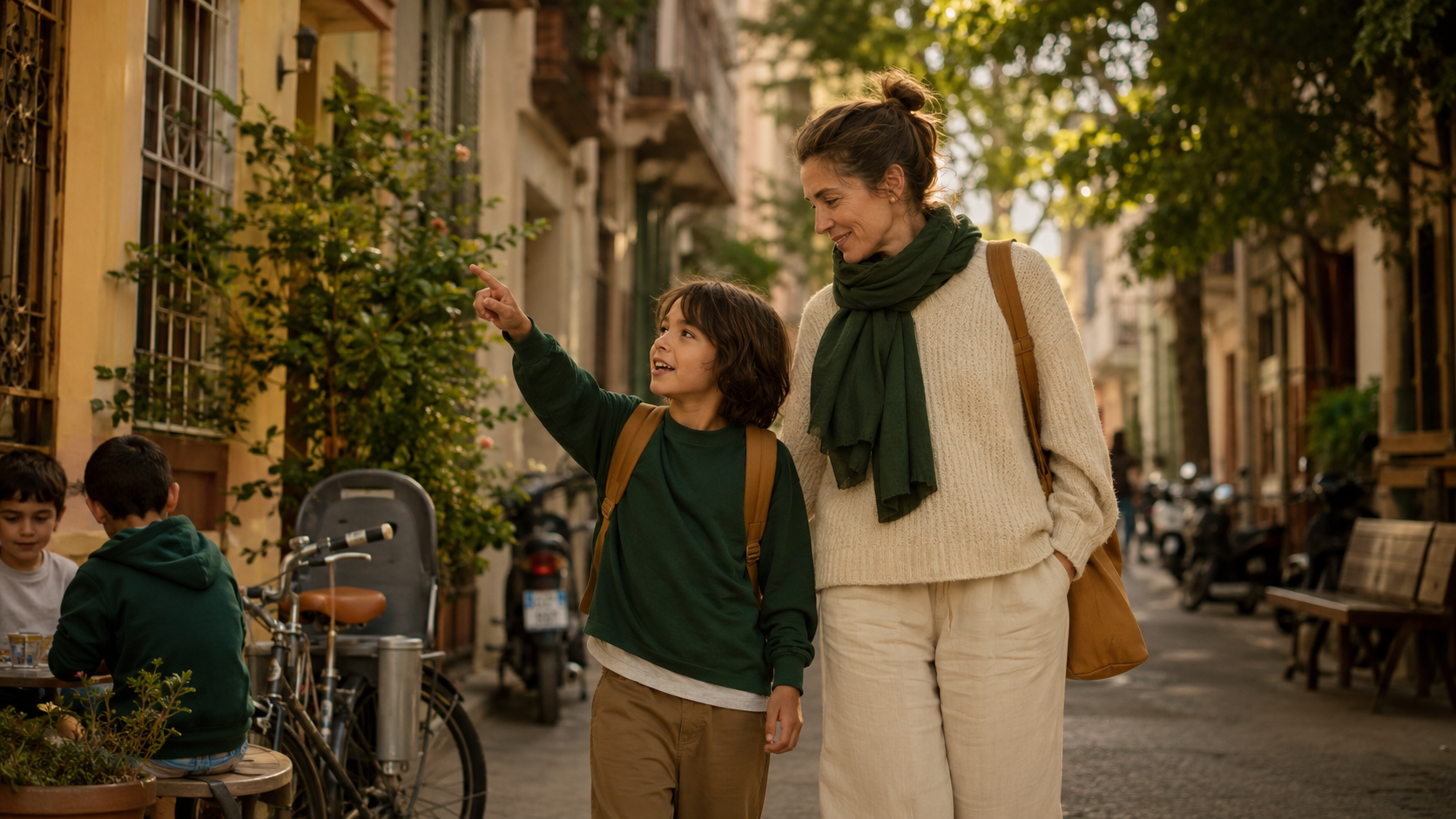
Then you are watching something work. Your child may speak the local language more naturally than you, catch jokes you miss, correct your pronunciation with a five-year-old's total confidence, and describe this country as home without a flicker of hesitation. You may feel proud, relieved, amused and quietly left behind, all inside the same afternoon.
That mixture is not disloyalty. It is accuracy.
The research here is more nuanced than most parenting content admits. A 2025 systematic review in Clinical Psychology Review examined parent-child acculturation gaps and found that they are inconsistently linked to child and family outcomes. Whether the gap runs toward the heritage culture or the host culture appears to matter less for family life than how the family is functioning overall.
Your child can feel completely at home in a country where part of you still feels foreign. That is a difference in relationship to a place, not a distance between you.
Two people in the same family can develop genuinely different cultural relationships with the same street. How your child settles into that place is its own subject, and Expathy covers it in child adaptation after moving abroad.
How parenthood changes the meaning of home
Home stops being a lifestyle question and becomes an intergenerational one. Before children, "where do we want to live" was about work, weather, friends and the cost of a flat. After children it quietly becomes "where will their childhood happen," which is a much heavier sentence.
Suddenly home includes: which grandparents are reachable on a Tuesday, which school system shapes their teenage years, which language their earliest memories are stored in, whose funeral they will fly to.
Living abroad with children changes what you are optimising for. You are no longer only choosing a place to be. You are choosing the setting for someone else's origin story.
Grieving the parenthood you imagined near family
You can love this life and still grieve the one you pictured. Most people quietly assumed a version of parenthood with grandparents dropping in, a sister who becomes a real aunt, childhood friends whose kids know yours, celebrations that simply happen without anyone booking flights. Raising children away from extended family means that imagined version does not arrive.
This is grief for a future, not for a place, which is why it is so easy to dismiss and so persistent.
There is a specific loss inside it that research makes visible. A systematic scoping review of 65 studies on transnational grandparents, published in Ageing & Society, identified grandparents across the literature as kin-keepers and as home educators of language, food, family tradition and homeland culture. When the grandparents are 2,000 kilometres away, that transmission role does not disappear. It lands on you.
You are doing a job that in most families is shared across three generations. Feeling stretched by it is not weakness. It is arithmetic. Expathy's pillar on homesickness abroad sits alongside this, though the ache here has a different shape: you are not missing a place you left, you are missing a version of family life that never got to exist.
Sometimes you are not only missing your family. You are grieving the version of parenthood you assumed you would have.
Why your relationship with your own parents changes
Because you can finally see their work from the inside. Having a child abroad tends to produce two reactions at once: sudden appreciation for sacrifices you never registered, and sharper criticism of choices you had accepted without question. Both are signs of the same thing, which is that you are no longer only their child.
Distance sharpens all of it. Advice arrives concentrated over video calls. Visits carry the weight of months. You may find yourself renegotiating adult boundaries with people you love, in a second language of your own family's making.
This is identity work across three generations, not a family argument. Understanding it that way tends to lower the temperature. Staying connected across that distance is its own skill, and Expathy covers it in staying connected to home while living abroad.
"I miss who I was before becoming a parent abroad"
Yes, this is normal, and it is not a warning sign. You may miss spontaneity, professional identity, travel, adult friendships, cultural ease, being known as yourself rather than as someone's parent. Abroad it stings extra, because the self you miss was often more competent in her first language and her first country.
The unhelpful conclusion is that you need your old self back.
Identity integration is not identity restoration. The person who existed before does not need to be recovered or erased. She needs to be brought forward and given room inside the person you are now. If your professional identity took the harder hit, Expathy's page on the trailing spouse and expat partner experience covers that specific loss in more depth.
You are not trying to get back to who you were. You are trying to build someone who contains her.
You do not have to pick one culture's parenting model
And your family can build its own. An international parent is handed several competing scripts: how you were raised, how your partner was raised, host-country norms, school expectations, advice from grandparents, and whatever parenting philosophy is currently loud online. Trying to rank these by correctness is a trap.
The better question is not which culture parents properly. It is: which values do we actually want our family life to reflect?
Families combine deliberately. Language on some days, food on others, one set of holidays kept fully and another kept in miniature, communication styles borrowed from whichever side does it better. It is not effortless and it produces real disagreements, usually in December. But it is authorship.
Parenthood abroad can move culture from inheritance toward authorship. You are not only living inside traditions. You are deciding what the next version of your family is.
Your child does not have to reproduce your identity
Successful cultural transmission is not producing a copy of yourself. Parents worry quietly: will they feel connected to my country, will they speak my language well enough to argue in it, will my traditions mean anything to them, will they feel like me?
Treat that worry gently, then hold it to a fair standard. Your child will build an identity from your culture, the host culture, their friendships and their own temperament, and the result will not match yours. That is not failure. It is what happens to everyone's children, including in families who never moved.
You can give your child access to your culture without requiring them to experience it the way you do.
What helps your identity feel coherent again
Coherence comes from clarity about your values, not from resolving your cultural category. Five things do most of the work.
Separate inheritance from choice. Ask what you are preserving because you value it and what you are reproducing because you would feel guilty otherwise. Write two short lists. Most people are surprised by how short the first one is, and how much lighter that feels.
Keep the parts of yourself that are not parenting. Your work, your friendships, the thing you are good at that has nothing to do with your child. Not for balance. For identity continuity.
Build family rituals on purpose. A Sunday call in your language, one dish that is non-negotiable, a birthday tradition from each side. Rituals are how abstract values become things a child actually remembers.
Let your cultural identity change. Some traditions will grow in importance, others will fade, new ones will appear from a country you did not grow up in. That is not inconsistency. That is a living culture.
Stop demanding one clean label. Your family may not fit any national category. What matters is whether your values and relationships feel coherent to the people inside them.
When these questions become something more difficult
Identity change is normal. Persistent distress is a signal. Most of what this article describes is ordinary and resolves as you settle into the role. It is worth taking more seriously when the questions come with lasting low mood, severe guilt, ongoing conflict with your partner about culture or country, an inability to make family decisions, anxiety that will not settle, or a chronic sense of losing yourself.
Feeling culturally complicated is not a diagnosis. Being unable to function is a reason to get support.
How therapy can help
Not by telling you which culture to choose. A good therapist will not decide your family's language, your country, or which traditions are correct. What therapy can do is help you separate your actual values from inherited obligation, work through grief about the parenthood you imagined, address cultural guilt and family expectations, and integrate the person you were with the parent you are becoming.
For expat parenting questions specifically, working with someone in your own language and cultural context matters, because half of what you are describing does not translate cleanly. Expathy's overview of what mental health therapy involves is a reasonable starting point, and a free introductory session is available if you want to talk it through first.
You may not need someone to teach you how to parent. You may need somewhere to work out who you are becoming as a parent across cultures.
Frequently asked questions
Can becoming a parent change your identity?
Yes. Parenthood reliably changes roles, priorities, relationships, professional identity and your sense of the future. Research on parental identity treats this as a developmental process rather than a disruption, and finds that parents with a clearer, more committed sense of themselves in the role tend to report better wellbeing.
Why do I feel different after becoming a parent abroad?
Because two identity transitions are happening at once. You are adjusting to parenthood while also renegotiating your relationship with culture, language, home and belonging. Things that ran on autopilot, like which language you speak or which holidays matter, now require decisions.
What is an expat parent identity crisis?
It is an informal phrase, not a clinical diagnosis. People use it to describe a period of intense questioning about culture, upbringing, language and belonging after becoming a parent abroad. It usually reflects active reappraisal rather than illness, though persistent distress alongside it is worth discussing with a professional.
Why does my culture feel more important after having a child?
Because culture shifts from something you live to something you either pass on or do not. Transmission has a deadline; experience does not. That is why people who never described themselves as traditional suddenly care intensely about a language, a recipe or a holiday.
Why do I suddenly care more about my native language?
Because your native language carries relationships, humour, affection and childhood memory, not just vocabulary. Native language identity after becoming a parent is usually about access: to your parents, to your own history, and to the version of you that exists most fully in that language.
Is it normal to parent differently from how I was raised?
Very. Reconsidering discipline, gender expectations, achievement pressure or emotional expression is a common part of becoming a parent, and living abroad accelerates it by giving you more models to compare. Cultural continuity does not require reproducing your specific childhood.
What if my child feels more local than I do?
It is common and usually a sign that they are settling well. Research on parent-child acculturation gaps has found them inconsistently linked to family outcomes, with overall family functioning mattering more than the size of the gap. Different cultural relationships to the same place do not weaken the bond between you.
How do you raise a child between two cultures?
By building a family culture rather than picking a winner. Decide which values you want your family life to reflect, then choose language, food, celebrations, communication style and extended-family relationships to match. Raising a child between two cultures works best as deliberate authorship, not as a compromise between two national defaults.
Is it normal to miss who I was before becoming a parent?
Yes, and abroad it is often sharper, because the self you miss was frequently more fluent, more socially at ease and more professionally established. The goal is integration rather than restoration: carrying that person forward into who you are now instead of trying to reverse the transition.
Can therapy help with identity changes after becoming a parent abroad?
Yes, particularly when the questions have become persistent or are creating conflict at home. Therapy can help you distinguish your genuine values from inherited obligation, process grief about the parenthood you imagined near family, and integrate parent, professional, partner and cultural identities into something that feels like one person.
Need support? We're here.
Book a free 15-min consultation with our expat-specialized therapists.