
Key takeaway
The boxes are gone. The first week at work is done. You cook something simple, sit down with it, and realise nobody is going to ask how any of it went. Your phone is full of people who love you and none of them are in this country. This article is about what happens when you move abroad alone: why the loneliness usually arrives later than you expect, why wanting the move does not protect you from it, and how to build a life here without reading a hard beginning as proof you got it wrong.
Somewhere in the first month, a sentence changes.
"I moved abroad" is a headline. It carries excitement, a little pride, the sense of a decision executed.
"I live here now" is something else entirely. It is quieter and it usually arrives on an ordinary evening, without warning, while you are doing something completely mundane.
That is the moment this article is about.
Why Moving Abroad Alone Is Different From Moving Abroad
Relocating alone means you lose your support network and your everyday companionship at the same time. You are building an entire life while carrying every part of it without a witness. People who move with a partner or family still lose their old network, but they keep someone beside them who knows what today was like without being told.
That is the real distinction, and it has nothing to do with being single.
You can move abroad alone while having a devoted partner in another country, close siblings, and friendships of fifteen years. The defining feature is not your relationship status. It is that nobody who already knows you is physically embedded in your new daily life.
The general experience of feeling alone in another country, whatever your situation, is covered in our main guide to loneliness abroad. This article is about the specific version that comes from arriving with nobody.
So there is no one to turn to after the confusing appointment and say what on earth was that. No one who also finds the supermarket strange. No one who was there for the bad first day, or the small victory of finally understanding the bus system.
Everything gets reported afterwards, to people who were not there, usually in a summary that leaves out how it actually felt.
Why the Loneliness Arrives After the Chaos Settles
Most people expect the first days to be hardest. They are usually the busiest instead. Registration, furniture, paperwork, onboarding, learning the routes: the practical work of relocation is absorbing enough to postpone the emotional part. The loneliness tends to show up once the admin runs out and the routine begins.
This catches people off guard, and it makes them think something has gone wrong.
Nothing has gone wrong. The distraction simply ended.
Loneliness often does not arrive at the airport. It arrives about six weeks later, when the move stops keeping you busy.
There is a specific version of this that almost everyone experiences. The first weekend with nothing that must be done. No box to unpack, no form to submit, no shop to find. Just an open Saturday, and the sudden awareness that the structure was doing a lot of emotional work you had not noticed.
The Guilt of Feeling Lonely About Something You Chose
This is the part people rarely say out loud. You wanted this. You may have worked for years to get here, turned down other options, made a case for it to everyone who doubted it. Feeling lonely then arrives with a second layer on top: the sense that you have no right to feel it.
The thoughts are recognisable.
This was my dream. I should be enjoying it. People at home think my life is incredible. How can I complain about something I chose?
So you post the good photos, tell your parents it is going well, and say nothing to anyone about the Sunday evenings.
Here is the thing worth holding onto. A decision can be completely right for you and still cost you something. Wanting the move and finding parts of it painful are not contradictory, and the pain is not evidence that you chose wrong. It is evidence that you left a life behind, which is exactly what you did.
Nobody grieves the thing they wanted. Which is why so many people abroad grieve it privately and call it something else.
What You Lose When Nobody Here Knows Your History
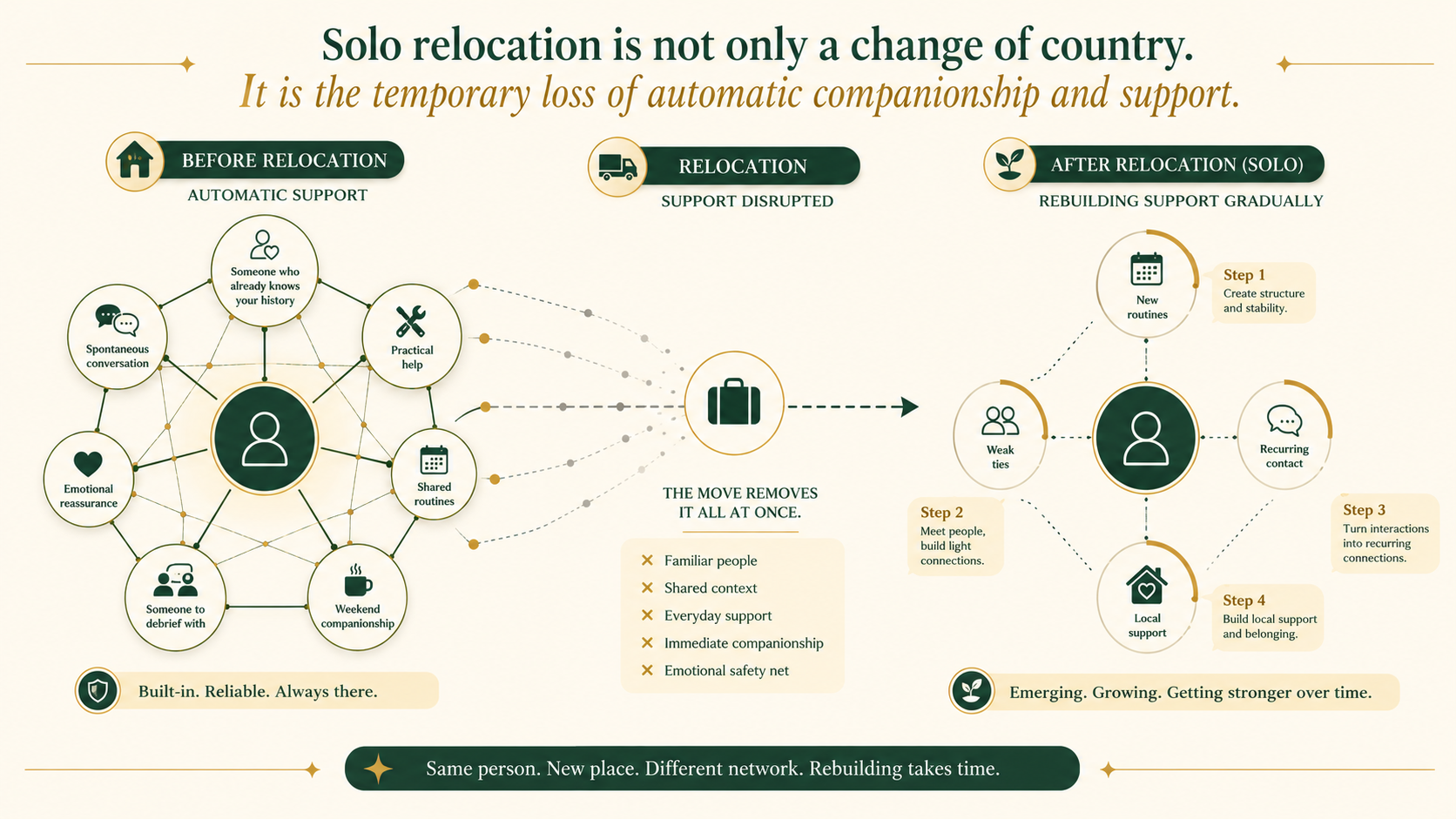
At home, relationships came pre-loaded with context. People knew what made you laugh, could read your mood without an interview, knew your family and your old stories and who you were before all of this. In a new country every relationship starts at page one, and even a socially successful newcomer can feel oddly unseen.
Think about how much work that context used to do.
A friend at home asks how you are, and they already know what "fine" means from you. A new colleague asks the same question and gets an accurate but weightless answer, because supplying the background would take twenty minutes neither of you has.
This is why you can have a genuinely pleasant week full of conversations and still feel like nobody has actually met you. They are meeting the version of you that exists in this country, which is currently about four months old.
It is also why a call home can feel like stepping back into your own body. Not because those people are better, but because with them you skip the setup and go straight to the point.
Why Weekends Expose It
Weekdays have scaffolding. Work or study creates structure, contact and a reason to be somewhere, so the absence is manageable. Then Friday evening arrives and none of that applies. Nobody is automatically part of your weekend, and every hour of it has to be actively built by you.
The details are painfully specific.
Waking on Saturday with no plan and no one expecting you anywhere. Eating alone near a table of eight people who clearly have years of history. Wanting company but not wanting to attend another event full of strangers where you introduce yourself four times. Drafting a message to a new acquaintance, then deleting it because twice in one week might seem eager.
The weekend is not a separate problem. It is where the arithmetic of moving alone becomes visible, because nothing external is filling the space.
Worth knowing: almost everyone who moves alone has this exact experience and almost nobody mentions it. Whole cities full of newcomers having quiet Saturdays, each assuming they are the only one.
When Independence Starts Working Against You
People who move abroad alone become extremely capable, fast. You learn to solve everything yourself because for a while there is genuinely nobody else, and that competence is real and worth being proud of. The complication is when self sufficiency stops being a skill and becomes the only acceptable way to function.
It shows up in small refusals.
Not mentioning you are ill. Not asking a colleague for help with something you could work out alone in three hours. Not telling anyone you have nothing on this weekend. Not saying I would like some company because it feels like an admission.
The independence that got you through the move can quietly make connection harder, because relationships need someone to be needed occasionally. A person who never requires anything is difficult to get close to, however much people like them.
This is not an argument against being capable. It is an argument for letting a few people see the parts that are not.
Why Your New Contacts Do Not Feel Like a Support Network Yet
Because friendship runs on accumulated hours, and you have not had time to accumulate them. Research tracking people who had recently relocated found it takes roughly 40 to 60 hours together to move from acquaintance to casual friend, 80 to 100 to become a friend, and over 200 hours to become genuinely close. You are not behind. You are early.
That evidence comes from Jeffrey Hall's study of 355 recent movers and 112 students in a new city, and it contains a detail that explains a lot about expat life.
Hours spent together at work counted for noticeably less than hours spent in chosen leisure time. Which is why you can share an office with someone for six months and still not feel you know them, while three long dinners with a person you met at a class feels like something real.
Do the arithmetic on your own week. A colleague you lunch with twice weekly accumulates about two hours, and those are the discounted kind. At that rate closeness is a matter of years, not months, which reflects on nobody.
That is not cause for despair. It is a reason to stop treating month four as a verdict, and to spend limited social energy where hours actually accumulate: the same people, repeatedly, outside the place you met them. The mechanics of finding those people are in our guide to making friends abroad.
Why Belonging Lags Behind Competence
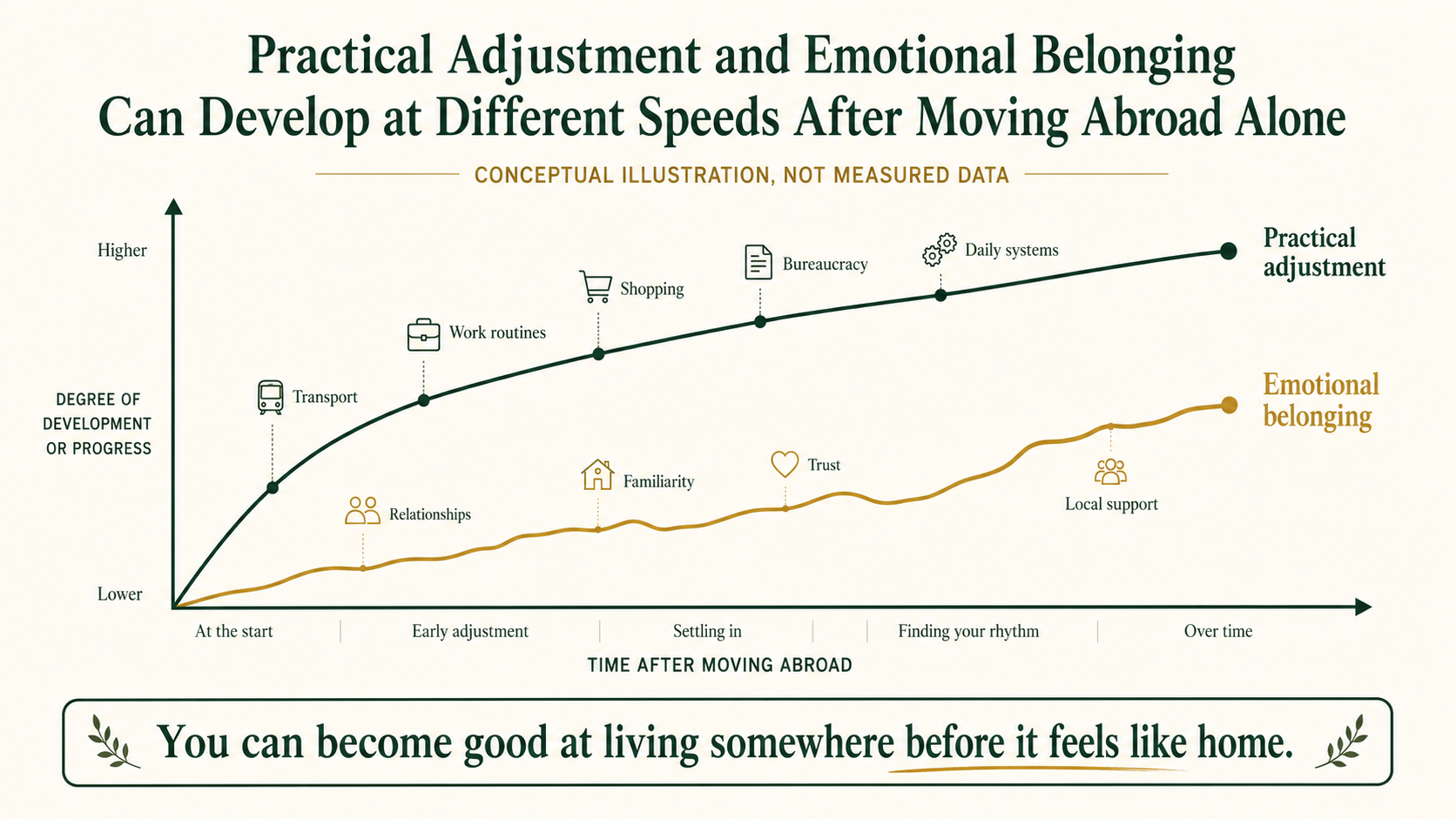
You will master the city long before you feel at home in it. Practical adjustment and emotional belonging run on separate clocks, and the gap between them is where most solo movers lose confidence, because the visible progress suggests they should be feeling better than they do.
Research on migrant adaptation treats these as two distinct dimensions: how well someone functions day to day, and how they are doing psychologically. The two do not have to move together, and often do not.
You understand the transport system, handle the bureaucracy, perform well at work and cook dinner in a kitchen that finally feels like yours. And you still feel like a visitor. Both readings are accurate, of different things.
Knowing how a country works and feeling that you belong in it are separate achievements. The first takes months. The second takes considerably longer, and it is not a measure of how well you are doing.
What Actually Helps in the First Stage
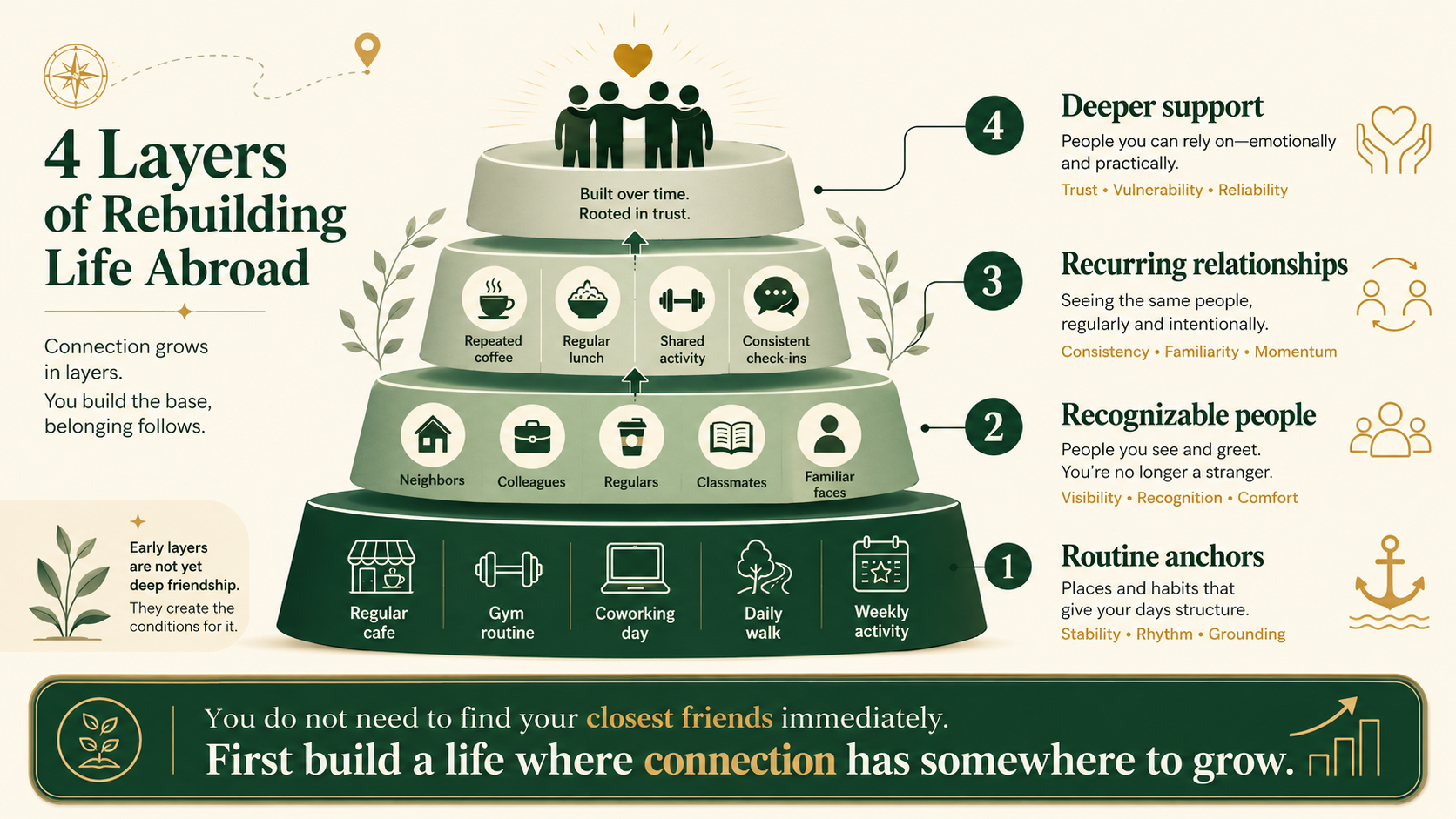
The goal at this stage is not to find your people. It is to reduce the emotional load of doing everything alone while relationships are still slowly forming. That means building predictability into the week before expecting intimacy from it, which is a much smaller and more achievable task.
Build anchors before you build friendships. An anchor is anything that reliably repeats: the same gym class on Tuesdays, the same coffee place on Saturday mornings, a coworking day, a weekly call home, one recurring lunch with a colleague. The aim is that parts of your week have a shape and a probable cast, so not every day starts from nothing.
Let weak connections count. The neighbour who nods, the barista who knows your order, the person at the gym who recognises you. These are not friendships and should not be mistaken for them. But they change a city from anonymous to one where your presence is registered, and that matters more than it sounds at month two.
Convert group contact into one to one contact. Instead of attending endless larger events, notice the two or three people you already find easy, and see them individually. Hours only accumulate with the same person.
Keep home relationships alive without living inside them. Calls home are genuinely protective and nobody should be told to cut back arbitrarily. But if every free evening is spent digitally in your old country, there is less room for the new one to develop. The balance is the point, not the sacrifice.
Ask for small practical help earlier than feels comfortable. How does this work here, do you know a good dentist, could you help me with this for five minutes. Small requests create reciprocity, and reciprocity is what turns a pleasant acquaintance into something with substance. Total self sufficiency reads as politeness and functions as distance.
Expect the timeline to be longer than anyone told you. Not because you are doing it badly. Because 200 hours is 200 hours.
When Time Is Working, and When It Is Not
"Give it time" is genuinely good advice at this stage, and it stops being enough at a certain point. The difference is not how lonely you feel. It is whether anything is still moving. Early loneliness that comes with gradual progress is normal. Loneliness that has become static and hopeless is a different situation.
Signs it is still working: routines are forming, you are meeting people even if none are close yet, you are still trying things, some weeks are better than others, and you generally believe this will improve.
Signs it is getting stuck: you have stopped initiating, you decline invitations you actually wanted, you spend nearly all free time alone without choosing to, your mood or motivation has dropped noticeably, or you have started to conclude that people here simply will not be interested.
That second pattern behaves differently and needs a different response, which we cover in chronic loneliness abroad.
The stay or leave question usually arrives around here too, and it deserves better than a bad Sunday. Try separating it into parts. Do I dislike this country, or my current social life in it? Is there still something here I want to build? If I had two real friendships here, would this feel different?
If the honest answer to the last one is yes, the problem is probably not the country. Some people do go home and it is a good decision, not a defeat. But one hard stage is not a verdict on the whole move, and it is worth not confusing the two while you are still inside it.
Some of what you are feeling may also be ordinary adjustment rather than loneliness at all, which is worth reading about in our guide to culture shock.
When Professional Support Helps
Therapy cannot build you a social circle, and anyone who implies otherwise is selling something. It becomes relevant when the problem stops being logistical and becomes something you now believe about yourself. That shift is the signal worth watching for.
The distinction is fairly clean:
The practical problem is "I do not know enough people here yet." The psychological problem is "I am starting to think people here will not want to know me." Therapy is for the second one.
It also helps when the loneliness has begun interacting with something heavier: persistent low mood, anxiety that was not there before, a sense that your worth dropped when your social status did, or an independence so total that accepting support has become genuinely difficult.
There is a practical reason to do this with someone who has lived abroad. Explaining why a voluntary move can still hurt, why going home is not the obvious answer, or why an exciting international life feels completely different on a quiet Sunday, takes up a lot of a session with someone who has not experienced it.
Expathy matches expats with psychologists by native language and cultural background, and our psychologists have moved countries themselves. The premise does not need defending, so the hour goes to you.
If that is the support you want, loneliness therapy for expats is built for exactly this, and online therapy for expats covers the broader picture if more than one thing is going on.
Final Thought
The hardest part of moving abroad alone is not the practical work. It is the stretch in the middle, after the excitement fades and before the belonging arrives, when there is no external evidence that anything is working.
That stretch is not a warning. It is what building a life from nothing actually looks like from the inside, and almost nobody photographs it.
You are doing something in eighteen months that most people around you were given twenty years to build. The friendships they have were assembled slowly, through school and university and old jobs, without anyone having to be brave about it.
You are not failing at this. You are early in it, which looks identical from where you are standing and is completely different.
Put one repeating thing in your week. Then let the hours do what hours do.
Sources and Further Reading
- Hall (2019), Journal of Social and Personal Relationships, studies of 355 recent movers and 112 students on the hours required to form friendships: https://doi.org/10.1177/0265407518761225
- Bierwiaczonek and colleagues (2025), meta-analysis of 1,114 studies and 571,260 migrants, students, expatriates and refugees on psychological and sociocultural adaptation, Nature Communications: https://doi.org/10.1038/s41467-025-67468-z
- Bayraktar and colleagues (2026), study of 281 expatriates on local social networks, host country support and adjustment: https://doi.org/10.1007/s11575-025-00605-4
Frequently Asked Questions
Is it normal to feel lonely after moving abroad alone?
Yes, and it is close to universal. Moving alone removes your support network and your everyday companionship simultaneously, so you are building a whole life while processing it without anyone beside you who already knows you. Feeling lonely in that situation is a reasonable response, not a sign the move was a mistake.
When does the excitement of moving abroad usually wear off?
There is no fixed timeline, but the pattern is consistent: the excitement lasts while the practical work does. Registration, furnishing, onboarding and learning the city are absorbing. When the admin finishes and routine begins, often around the second month, the emotional side becomes noticeable because nothing is distracting from it any more.
Why do I feel lonely even though I chose to move?
Because choosing something does not cancel what it cost. You left an established network, and that loss is real regardless of how much you wanted the new life. Many people abroad add guilt on top of the loneliness, which makes it harder to talk about and therefore harder to resolve.
Why are weekends so hard after moving abroad alone?
Weekdays provide structure through work, commuting and errands, which masks the gap. Weekends remove all of it, so every hour has to be actively created by you and nobody is automatically part of them. This is why many solo movers cope well from Monday to Friday and struggle from Friday evening.
How long does it take to make real friends after moving abroad?
Longer than most people expect. Research following recent movers found roughly 40 to 60 hours together to become casual friends, 80 to 100 to become friends, and over 200 hours for genuine closeness. Time at work counted for less than chosen leisure time, which is why colleagues often stay colleagues.
How do I build a support system after moving to a new country alone?
Start with anchors rather than friendships: things that reliably repeat each week with roughly the same people. Then move a few of those contacts from group settings into one to one time, since hours only accumulate with individuals. Ask for small practical favours early, because reciprocity is what gives a new relationship substance.
Does moving abroad alone get easier?
For most people it does, but the improvement is uneven and slower than expected. Practical competence arrives within months. Emotional belonging usually takes considerably longer, and the gap between the two is what makes people conclude they are failing when they are simply at a normal point in a long process.
How do I know whether to stay or move home?
Separate the questions before deciding. Do you dislike the country, or your current social life in it? Is there still something here you want to build? If you had two genuine friendships here, would it feel different? If the answer to the last one is yes, the problem is more likely the stage than the place.
When should I get therapy for loneliness after moving abroad?
When the problem shifts from circumstance to self belief. If you have stopped initiating, if you expect people not to be interested, if your mood, sleep or confidence has dropped, or if independence has made asking for support feel impossible, professional support is appropriate and usually faster than waiting for it to pass.
Need support? We're here.
Book a free 15-min consultation with our expat-specialized therapists.