
Key takeaway
Everyone is fed, dressed and out of the door. The school bag was found. The message from the teacher was answered. Then the flat goes quiet, and instead of relief you sit down and discover there is nothing left in you at all. Somewhere in that silence the thought arrives: my children deserve a happier parent than this. This article is about raising children abroad while depressed, and why that thought is a symptom rather than a fact.
Let us deal with the guilt first, because it will get in the way of everything else.
Depression is not a failure of love, and struggling with it does not make you a bad parent. You are still getting them to school. You are still remembering the dentist. You are doing a demanding job with a fraction of the internal resources you had a year ago, and nobody is giving you credit for it, least of all you.
What is actually happening is a mismatch. Parenting demands a steady supply of attention, patience and energy. Depression reduces exactly those three things. The demands do not pause while your capacity changes.
What Parenting Abroad With Depression Actually Feels Like
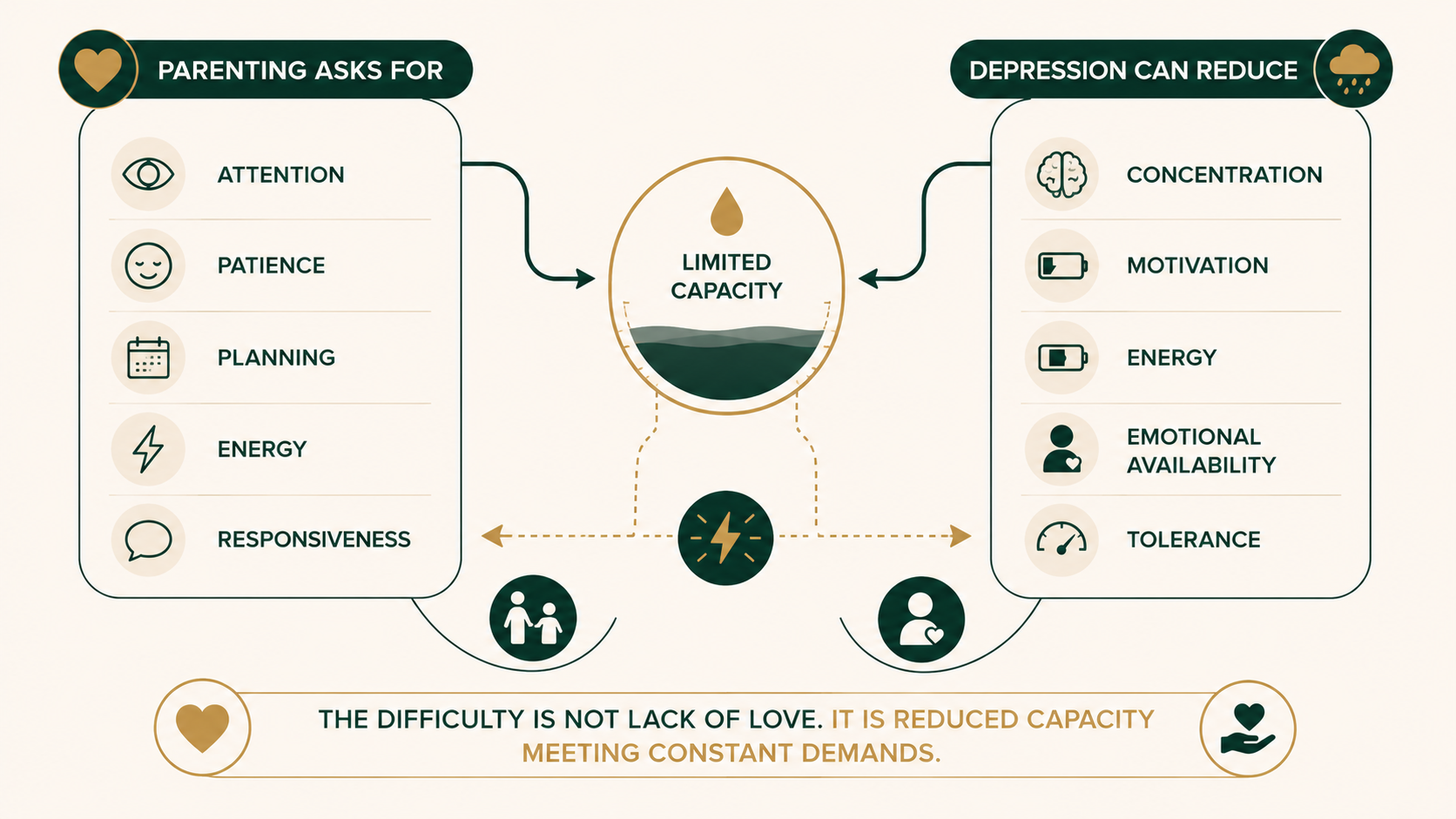
It usually looks like functioning and feels like nothing. The lunches get made, the appointments get kept, the homework gets supervised, and underneath that the parent is exhausted, numb, irritable, guilty and disconnected from moments they know they should be enjoying. Very little of it is visible from outside.
The specifics tend to be recognisable.
Getting through bedtime by counting down the minutes. Sitting on the floor while they play and feeling like you are watching from behind glass. Snapping at a spilled drink and hating yourself for an hour afterwards. Being asked to do one more small thing and feeling something close to panic.
And the school gate, where everyone appears to be managing this easily.
Depression makes ordinary parenting tasks feel disproportionately heavy. Living abroad removes many of the people who would normally help you carry them.
The general picture of what depression abroad involves is covered in our main guide to depression abroad. This article is about doing it while raising children.
Why Parenting Makes Depression Harder to Notice
Because children generate structure whether you have any internal motivation or not. School runs, meals and bedtimes create a scaffold that keeps you moving, so the usual signal that something is wrong, stopping, never arrives. You keep going, so you conclude you must be fine, just tired.
That is why so many parents abroad reach a year or more before they name it.
There is also a specific version of the trap. Being needed constantly means never having enough quiet to notice how you feel. The absence of a crisis is not evidence of health. It may only be evidence that nothing in your life allows for one.
And normal parental exhaustion genuinely exists. Small children are tiring, and being tired is not depression. What distinguishes it is whether rest restores you, whether pleasure has gone missing across the board, and whether the flatness follows you into things that have nothing to do with the children.
Why Moving Abroad Removed the Backup System
Because most family support was never formal. Grandparents, siblings, cousins, old friends, a neighbour who could collect a child, a babysitter you trusted, people who noticed when you were not yourself. None of that came with you, and rebuilding it takes years rather than months.
The practical effect is that there is no slack.
At home, "can you take them for two hours" was a phone call. Here it is a logistical problem, often a financial one, and sometimes it is simply not available. When you have less capacity than usual, there is nowhere for the overflow to go.
There is a second loss that matters more than people expect: the people who would have spotted it. Your mother would have known within one visit that something was wrong. Here, the parents at school met you already tired, and think this is who you are.
It is worth being honest about the evidence here. There is no reliable figure showing how much losing extended-family support raises depression risk for parents abroad, and anyone quoting one is inventing it. What the research does establish is that relocation is a family-system event rather than an employee one, with childcare, schooling, careers, friendships, healthcare and practical support all being rebuilt at once, usually by whoever has the least protected time.
"I Love Them, So Why Do I Feel Nothing?"
This is the question that frightens parents most, and it has a clear answer. Depression reduces your capacity to feel pleasure, including pleasure in your children. It does not reduce your love for them. Those are different systems, and only one of them is affected.
You can know with total certainty that you would step in front of a car for this child, and still feel flat at their school play.
A 2024 review combining 20 studies found that loss of pleasure in depression is linked not only to mood but to wider difficulties in social and everyday functioning. In family life that shows up as reduced warmth in moments you would normally enjoy, less spontaneous play, and a kind of emotional muffling around people you love most.
Feeling less joy is not the same as loving less. How that loss of pleasure works, and why it can be so disorienting, is covered in our article on anhedonia abroad.
Two practical things follow. Your children experience your consistency, not your internal weather, so continuing to show up matters even when it feels hollow. And the flatness is a symptom, which means it is treatable, which means it is not the permanent condition of your relationship with them.
Guilt, and How It Differs From Responsibility
Guilt is doing a lot of work here and almost none of it is useful. Responsibility sounds like "my depression is affecting family life, so I need support." Depressive guilt sounds like "I am ruining my children's childhood." The first leads somewhere. The second just costs you energy you cannot spare.
The thoughts are familiar. They deserve better. Other parents manage. We moved here for a better life and I am wasting it. If I admit this, people will think I cannot cope.
Notice what those have in common: none of them produce an action. They are self-attack presented as accountability.
The useful question is not "am I failing?" It is "what does my family need around us while my capacity is lower?"
That reframe changes the answer from a verdict into a logistics problem, and logistics problems can be solved.
When It Comes Out as Irritability
Depression in parents often looks less like sadness and more like a very short fuse. Noise becomes intolerable, routines become infuriating, small requests feel enormous, and the guilt arrives immediately afterwards. This is common and it is not evidence that you are a bad-tempered person.
Two things matter more than eliminating it.
Repair. Children cope well with a parent who gets it wrong and comes back. I got cross earlier and that was not about you. I have been feeling tired and unwell. I am sorry. That sequence teaches something valuable, and it protects the relationship far more than never snapping would.
Reducing the pressure points. Most irritability clusters around specific moments: mornings, transitions, the hour before dinner. Simplifying those, even crudely, removes more friction than trying harder does.
One line that needs stating plainly: depression explains irritability, but it does not excuse behaviour that frightens a child. If you are worried about how anger is showing up, that is a reason to get support quickly rather than a reason for more shame.
What Should Your Children Know?
Something honest, simple and matched to their age. Children usually notice far more than parents assume, and when nobody explains it they tend to conclude it is their fault. A short, calm explanation protects them better than a convincing performance.
For most ages, this covers it:
I have not been feeling well lately, and it makes me very tired and sometimes grumpy. It is not because of you, and it is not your job to fix it. I am getting help, and I am still your parent.
Three things need to land in whatever words you choose: they did not cause it, they are not responsible for fixing it, and adults are handling it.
What they do not need is adult detail. Not your symptoms, not your fears about the future, not the specifics of your treatment. Your child should not become the person you confide in. That is a role for another adult.
Keeping Your Child Out of the Caregiver Role
This risk is higher abroad, precisely because there are fewer adults around. Children can help with age-appropriate tasks. What they should not carry is responsibility for your wellbeing. The line is between participating in family life and managing a parent.
Reasonable: tidying up, helping with a younger sibling briefly, making their own breakfast at an age where that fits.
Not reasonable, however capable they seem: monitoring your mood, comforting you about your depression, keeping it secret from other adults, interpreting in medical appointments about your health, or taking on the running of the household.
Watch for the child who becomes unusually well behaved and watchful. That is often not resilience. It is a child managing the situation, and they need to be told explicitly that this is not their job.
A child can help with the dishes. A child should not be helping with your depression.
If relocation has also been hard on them in ways you have not had capacity to address, our article on helping children adapt after moving abroad covers that separately.
What to Simplify When Capacity Is Low
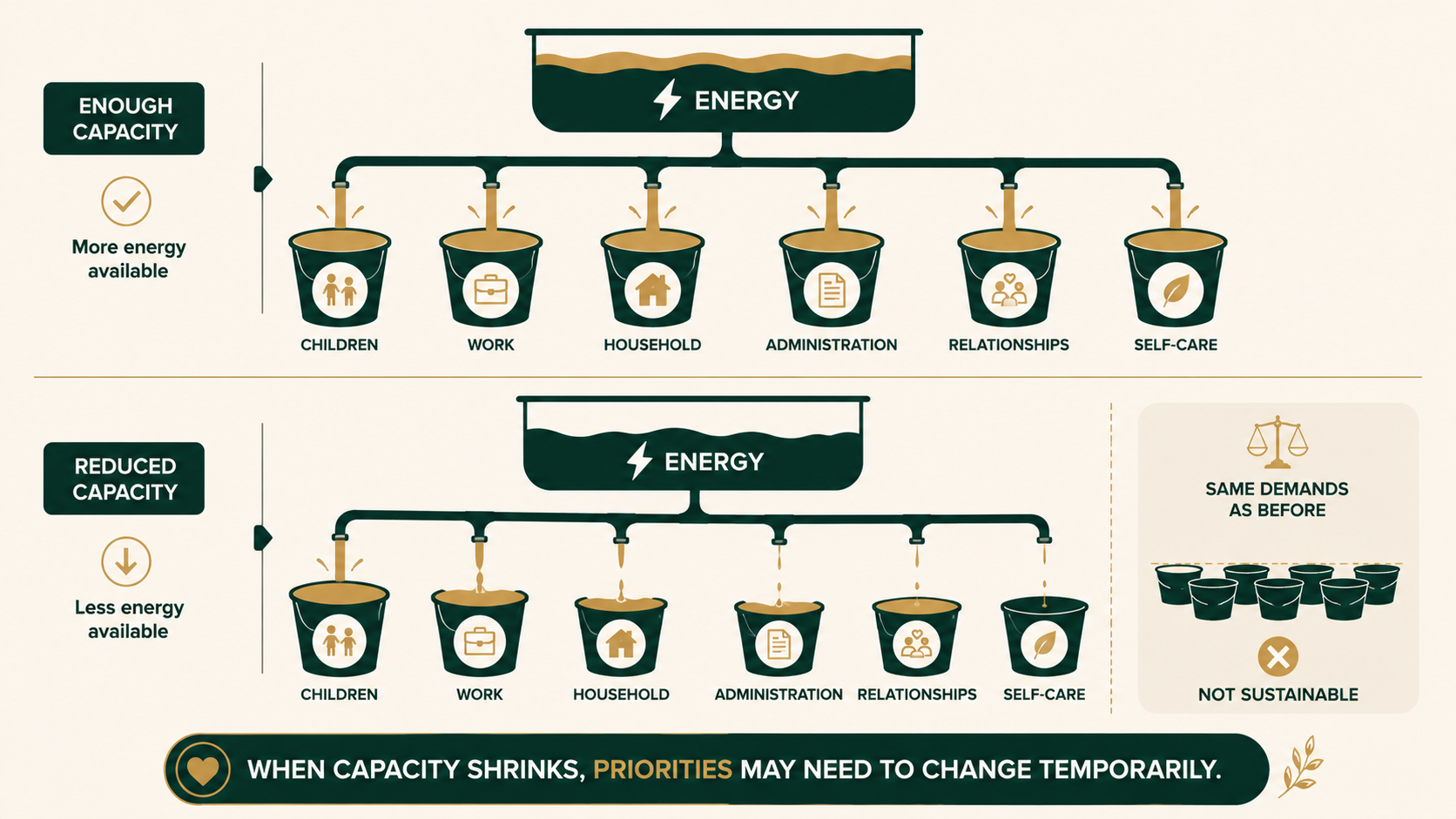
Almost everything, temporarily, and with less guilt than feels natural. The goal during a depressive episode is to protect what genuinely matters rather than maintain an ideal version of family life that was designed for a version of you with far more resources. Your old standards can come back later, when you have the capacity for them again.
On difficult days, aim for four things and let the rest go:
- Safety. Everyone is safe. Nothing else on this list is more important.
- Basic care. Fed, clothed, delivered where they need to be. It does not have to be impressive.
- Connection. One genuine moment. Ten minutes on the floor, a story, a proper hug at bedtime.
- One step for you. Book the appointment, send the message, take the medication, go outside for fifteen minutes.
That is a complete day. Not a good day by your old standards, but a complete one.
Everything else is negotiable for a while: simpler meals, grocery delivery, fewer activities, declining optional events, lower expectations on tidiness, more screen time than you would ideally like. None of these will damage your children. Running yourself into the ground will affect them more.
How to Ask for Help That People Can Actually Give
"Let me know if you need anything" is generous and almost useless. Vague offers require the exhausted person to do the work of identifying, specifying and requesting, which is precisely what depression makes hard. Specific asks get said yes to far more often.
Practise the specific version:
Could you collect Sofia on Thursday? Could the kids come to yours for two hours on Saturday? Could you bring dinner one evening this week? Would you come with me to this appointment? Could you call me tonight?
Spread these across more than one person if you can. If your partner is the only adult carrying this with you, both of you will be depleted, and neither of you will have anywhere to put it.
Asking is not an admission that you cannot cope. It is the thing that makes coping possible, and most people are relieved to be given something concrete to do.
If You Have Almost No Support Here
Then be realistic rather than aspirational. Nobody rebuilds a village in a month, and advice to "find your community" is not useful when you have no energy to socialise. The aim is narrower: reduce the number of things one depleted parent is carrying alone.
Places support can realistically come from: one other parent at school who is also new, a paid babysitter even occasionally, an after-school club that buys you two hours, the school itself if they know what is going on, a family member at home who can coordinate practical things remotely, or your partner if the load has never been explicitly divided.
Research on internationally mobile partners is instructive here. A 2025 study of 207 internationally mobile partners by Aegerter and colleagues found stress and isolation stood out as major factors in wellbeing. The person raising children abroad is frequently rebuilding their own life at the same time as trying to create stability for everyone else, and that combination is genuinely hard, not a personal shortcoming.
If isolation is a large part of the picture, our guide to loneliness abroad covers rebuilding connection more fully.
What Actually Helps You
Treatment, and it is worth stating plainly that treatment is available and effective. Depression responds to structured psychotherapy, to medication in appropriate cases, and often to both, with sleep, activity and connection as genuine supports rather than substitutes. NICE guidance sets out the established options.
One thing specifically relevant here. The stress of adapting to a new country is not a background detail. A 2024 review of 26 studies covering more than 7,000 international students found a meaningful link between the strain of adapting abroad and depressive symptoms. That population is students rather than parents, and the mechanism is recognisable: functioning in another language, learning a new school and health system, rebuilding friendships, and doing daily life without the people who used to help.
You have been doing all of that while raising children.
And this matters: getting treatment is not something you do for your children. You deserve care because you are a person, not because your recovery would improve your family's outcomes. The framing matters, because "I should get better for them" turns your health into another parenting obligation, and there are already enough of those.
When to Get Professional Support
You do not have to reach the point of being unable to parent. The threshold is that low mood, numbness or exhaustion have persisted for weeks and are affecting how you function, feel or relate to your family. That is sufficient reason on its own.
Worth speaking to someone if several of these hold:
- Numbness or low mood has lasted more than a couple of weeks
- Ordinary parenting tasks feel disproportionately difficult
- Irritability is affecting your relationship with your children
- You are withdrawing from your partner, friends or the children themselves
- Pleasure has gone, including in things you used to enjoy with them
- Guilt or hopelessness has become constant
- Your own sleep, eating or self-care has slipped noticeably
- Nothing has improved despite genuine attempts to manage it
Expathy matches expats with psychologists by native language and cultural background, and our psychologists have lived abroad themselves. You will not have to explain why raising children far from your own family changes everything about this.
That saves real time when you have very little. Parenting abroad therapy is built for exactly this situation, and depression therapy for expats is the direct route if depression is the main thing you want to work on.
If You Cannot Keep Yourself or Your Children Safe
If you are having thoughts of harming yourself, if you feel you might act on them, or if you do not feel able to safely care for your children right now, get help today.
Contact your local emergency number, your country's crisis line, or go to the nearest emergency department. Contact your doctor urgently if you have one. At the same time, bring in another safe adult to be with your children, whether that is your partner, a friend, a neighbour or someone from the school.
Asking for someone to take the children for a few hours in a crisis is responsible parenting, not evidence against you. Being far from home makes this harder and not impossible.
Depression is treatable, including when it feels least true.
Final Thought
The version of yourself you are comparing against, the parent who had energy for the park and patience at bedtime, is not gone. They are currently unwell.
That distinction matters, because one of those is a character judgment and the other is a treatable condition with a good recovery rate.
Your children do not need a happier parent. They need this one, present in whatever form is available today, and getting the help that makes more of you available tomorrow.
If you take one thing from this: pick the smallest possible next step. Book the appointment, or ask one person for one specific thing this week. That is enough.
Sources and Further Reading
- Wong and colleagues (2024), review combining 20 studies on loss of pleasure in depression and its links with social and everyday functioning: https://doi.org/10.1016/j.jad.2024.04.086
- Soufi Amlashi and colleagues (2024), review of 26 studies covering more than 7,000 international students on the stress of adapting abroad and depressive symptoms: https://doi.org/10.3389/fpsyg.2024.1403807
- Aegerter and colleagues (2025), study of 207 internationally mobile partners on stress, isolation and wellbeing: https://doi.org/10.3389/fpsyg.2025.1607178
- NICE guideline NG222, Depression in adults: treatment and management: https://www.nice.org.uk/guidance/ng222
Frequently Asked Questions
Can you still be a good parent with depression?
Yes. Depression affects your energy, patience and capacity for pleasure. It does not affect your love for your children or your commitment to them. Plenty of people parent well through depressive episodes, particularly with treatment and practical support, and the guilt that says otherwise is usually a symptom rather than an accurate assessment.
Why do I feel emotionally distant from my children?
Because depression reduces the capacity to feel pleasure, including in relationships you value most. A 2024 review of 20 studies found loss of pleasure in depression is linked to wider difficulties in social and everyday functioning. Feeling less joy is not the same as loving less, and it is a symptom that responds to treatment.
Does depression make parents more irritable?
Often, yes. Irritability is a common presentation of depression, particularly in parents managing constant demands, noise and transitions. It is not specific enough to diagnose depression on its own. What helps most is repairing afterwards and reducing pressure at the predictable flashpoints rather than trying to suppress it through willpower.
Should I tell my child that I am depressed?
Something honest, simple and age-appropriate usually helps. Children notice more than parents assume and often conclude it is their fault when nothing is explained. Cover three points: they did not cause it, it is not their job to fix it, and adults are dealing with it. Leave out adult detail.
How much should children know?
Enough to understand why you seem tired or short-tempered, and not enough to make them your confidant. Symptoms, fears about the future and treatment specifics are for other adults. The aim is to remove their confusion and self-blame without transferring any of the weight onto them.
What if I have no grandparents or family nearby?
That is a genuine structural problem rather than a personal failing, and rebuilding support takes time. Aim to reduce what one person is carrying rather than to recreate your old network. One other parent, occasional paid childcare, an after-school club, the school itself or remote coordination from family at home all help.
How can I parent when I have very little energy?
Protect four things on hard days: safety, basic care, one moment of genuine connection, and one small step toward your own recovery. Everything else is temporarily negotiable, including meals, tidiness, activities and screen time. That is a complete day during a depressive episode, even if it does not meet your usual standards.
Can my depression affect my children?
It can affect family life, which is a reason to get support rather than a reason for guilt. It does not mean your children will develop mental health problems. What protects them most is consistent care, honest age-appropriate explanation, not being placed in a caregiving role, and you receiving treatment.
When should I seek professional help?
When low mood, numbness or exhaustion have lasted weeks and are affecting how you function or relate to your family. You do not need to become unable to parent first. Persistent irritability, withdrawal, loss of pleasure and constant guilt are all sufficient reasons on their own.
What if I do not feel able to keep myself or my children safe?
Treat it as urgent. Contact emergency services, a crisis line or the nearest emergency department, and contact your doctor. At the same time, arrange for another safe adult to be with your children. Asking someone to take them for a few hours in a crisis is responsible, not a mark against you.
Need support? We're here.
Book a free 15-min consultation with our expat-specialized therapists.