
Key takeaway
You land in your home country and for a few hours everything works. The supermarket, the language, the streets, your mother's kitchen. Then someone mentions a shop that closed, a person you have never heard of, a change to the road you grew up on, and you feel yourself become a visitor. Two weeks later you fly back, and somewhere between the airport and your apartment you miss home again. This article is about that specific contradiction, and why it does not mean you have chosen the wrong country.
There is a sentence people abroad say quietly, usually after several drinks and usually to another expat.
"I do not really feel at home anywhere anymore."
It is rarely said with self-pity. More often it comes out as a piece of information the person has been carrying around and has not found the right place to put.
You can love the country you live in, love the country you came from, and still feel that neither one entirely contains your life.
The broad picture of how living abroad reshapes identity is covered in our guide to expat identity and belonging. This article stays on one narrower question: what happens when no single place feels completely like home.
Why Neither Country Feels Completely Like Home
Because two things have been changing at once, and you were only tracking one of them. You changed abroad, in habits, expectations, independence and what you consider normal. Home also changed, in people, friendships, prices, politics and daily life. Neither side stood still, but only one of those changes was visible to you.
This produces a specific mismatch.
You have been comparing your actual current life abroad against a version of home that is partly a memory. Not a false memory. A real one, of a specific period, involving people at a particular stage of their lives, including a version of you that no longer exists.
Meanwhile, the country you live in has your apartment, your work, your routines and your daily reality, and still asks you to explain yourself occasionally.
Neither comparison is unfair. Both are incomplete.
Familiarity Is Not the Same as Belonging
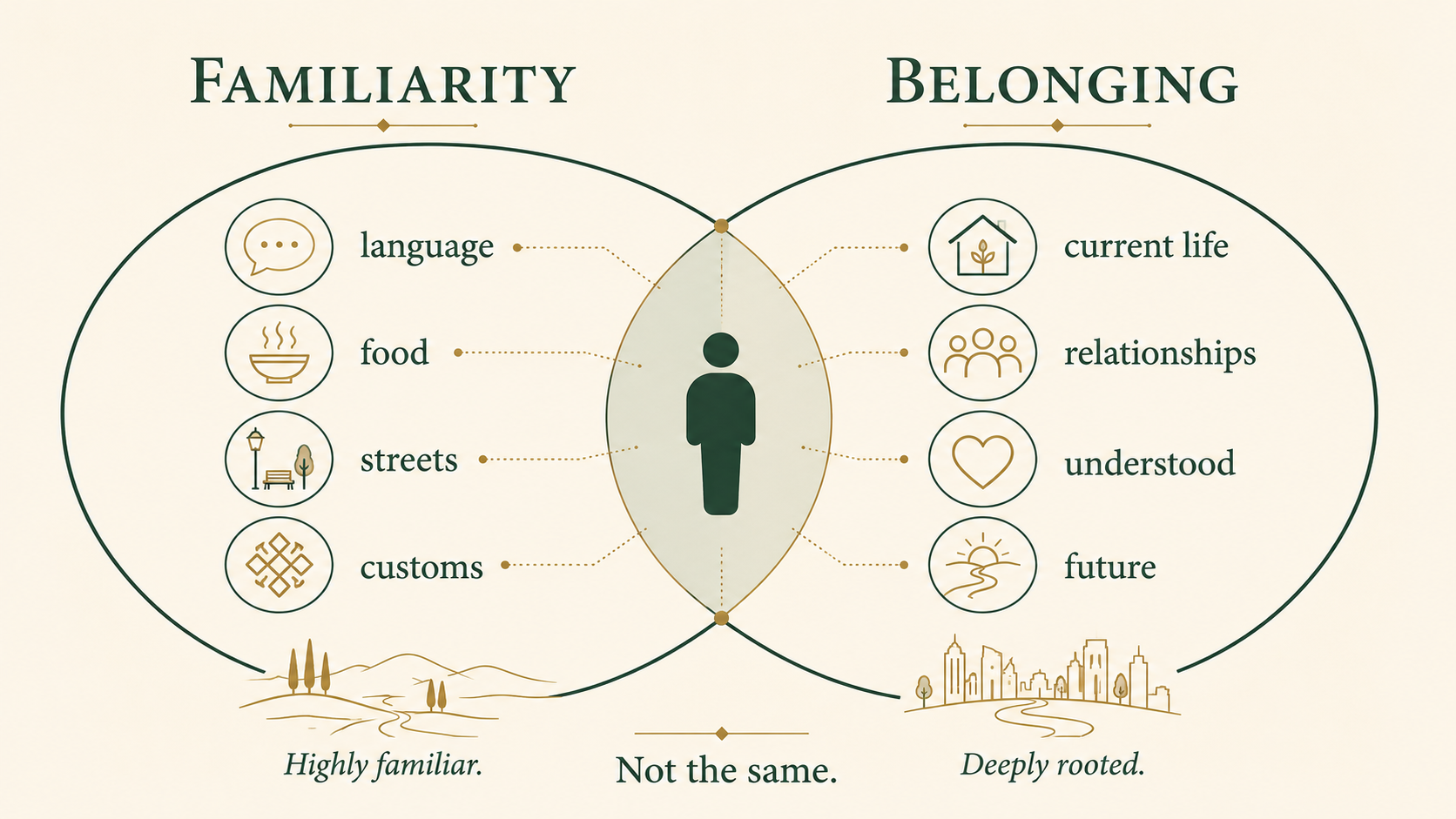
This distinction resolves a lot of confusion. Your home country can remain completely familiar, linguistically effortless, and emotionally important without being where your current life belongs. The country you live in can hold your entire actual life while still occasionally making you feel foreign. Familiarity and belonging come apart.
That is why the question which place feels more familiar does not answer the question where is home.
You can navigate your home city without thinking, understand every joke, know exactly how things work, and still feel that your life is somewhere else. Familiarity is about ease. Belonging is about fit, and the two used to arrive together because most people never separated them.
Living abroad separates them, permanently for some people, and that separation is the actual source of the feeling rather than any failure to integrate.
Home used to be the one place that was both familiar and yours. Once those two things live in different countries, no single answer to "where is home" will feel complete.
Home Stops Being a Place and Becomes a Collection
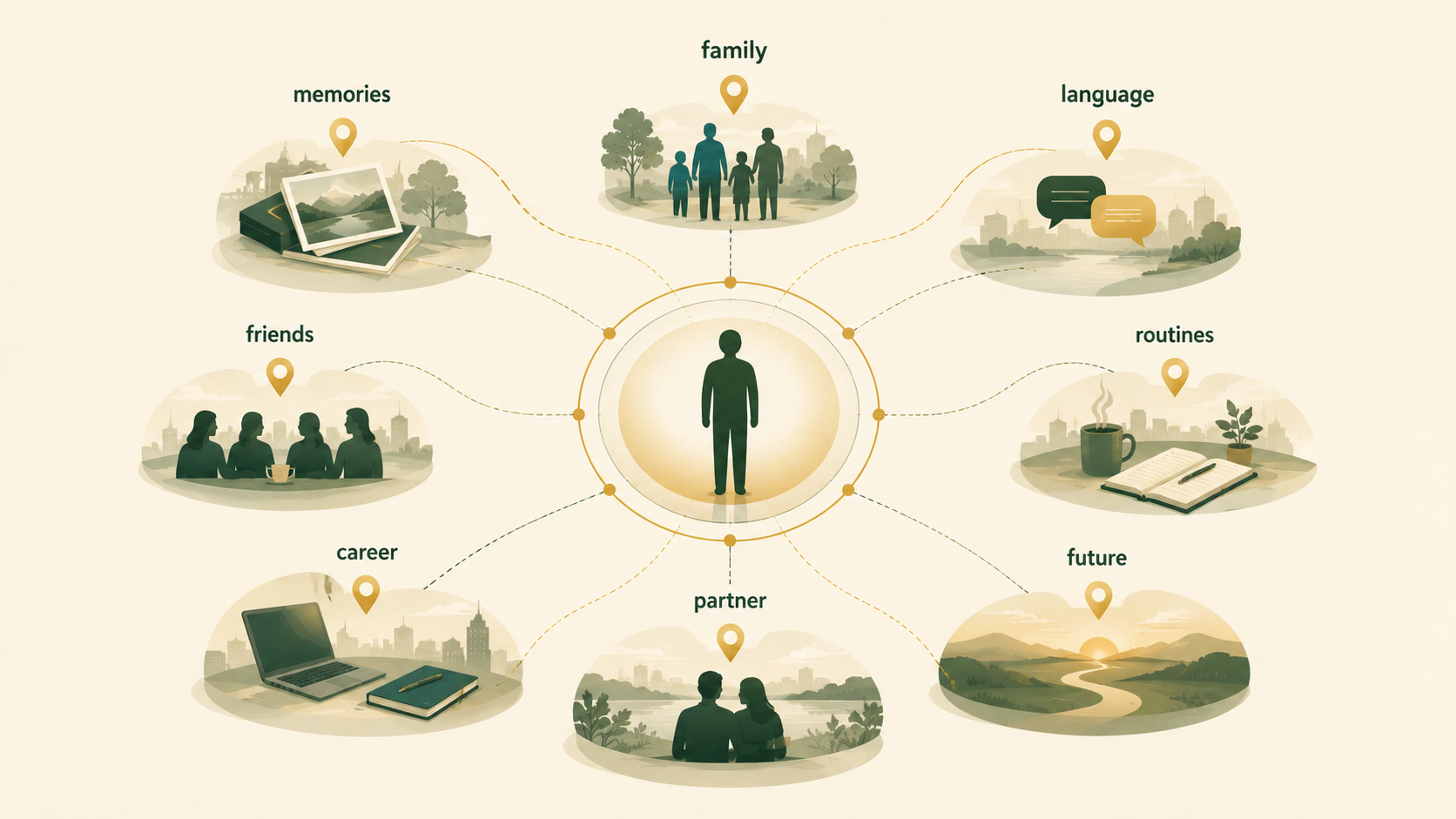
This is the most useful reframe available, and it explains why the feeling is so hard to articulate. Every place now contains part of your life, and nowhere contains all of it. That is not a failure of belonging. It is an accurate description of how your life is actually distributed.
Consider where the components of your life currently sit.
Your family may be in one country. Your partner may be from another. Your closest friends may now be spread across four. Your career exists where you live. Your daily routines, your gym, your walk, your Sunday, belong to your current city. Your childhood memories belong somewhere else entirely. And your future may not clearly belong to any of them.
Ask someone in that situation to name their home and they will hesitate, not because they lack attachment but because they have too many attachments to fit into one word.
Research on place attachment supports this more than the traditional model does. Scannell and Gifford's review describes attachment as involving the person, the psychological process and the place itself, and notes that despite mobility and globalisation, places continue to attract strong attachments. Later work has moved further, finding that attachment is not confined to one location and can be sustained across several places at once.
The old model, one birthplace producing one home, was never a law. It was just what happened when most people stayed put.
The Uncomfortable Middle
There is a stage where you are no longer the person who left and not yet somebody local, and it lasts longer than people expect. Going home does not restore your old identity. Staying abroad does not resolve the foreignness. Both options are partly right and neither is complete.
This gets misread as being stuck. It is closer to being between descriptions.
The categories available to you, local and foreigner, native and expat, here and home, no longer map cleanly onto your actual life. That is uncomfortable, and it is a problem with the categories rather than with you.
Nobody needs a clinical label for this and it is not a syndrome. It is what a life looks like when it has been genuinely lived in more than one place, and for many people it eventually stops being distressing without ever fully resolving.
Why It Gets Stronger After Several Years, Not Weaker
This surprises people, and it is one of the more counterintuitive parts. In the early years, the question is how do I function here. Later it becomes what does living here mean for who I am. The practical difficulties shrink while the identity question becomes more visible.
The sequence usually looks like this.
You arrive and everything is logistics. Bank account, apartment, language, transport, work. There is no spare capacity for existential questions and the difficulty has an obvious cause.
Then, somewhere around year four or year seven, you succeed. You speak the language. You know the city. You have friends and a life that works.
And precisely then, with the practical noise gone, a quieter question becomes audible: so is this where I am from now?
Competence does not answer the belonging question. It just clears the room enough for you to hear it.
Nobody warns you that the hardest version of this arrives after you have succeeded, not while you are struggling.
What You Are Actually Missing May Not Be a Country
This is the insight most people miss about their own feeling. When you are at home missing your life abroad, and abroad missing home, you may not be missing places at all. You may be missing different versions of yourself.
Look at what is on each side.
At home you may miss the person who never had to explain a reference, who was funny without a delay, who had a role in a family and a set of friendships that required no maintenance. The ease of being known.
Abroad you may value the person you became after leaving. More independent. More capable. Less defined by other people's expectations. Someone who built a life from nothing.
The question that feels like "which country do I prefer?" is often really "which parts of myself am I afraid of losing?"
Once you see it that way, the problem changes shape entirely. Neither version has to be given up, and no plane ticket resolves the tension, because the tension is not geographic.
"Maybe I Should Just Move Somewhere Else"
This thought arrives regularly and deserves a straight answer. A different country will genuinely change your environment. It will not automatically resolve grief for a version of home that no longer exists, multiple attachments, or uncertainty about who you are becoming. Those travel.
Moving is sometimes exactly right. Plenty of people move again and are much happier.
The useful step before deciding is simply to name what you are asking the new place to provide. If the answer is "somewhere I finally feel completely at home," that is a lot to ask of a country, and it is worth knowing that you are asking it.
This article is not going to help you choose between countries, and that is deliberate. A belonging problem does not always have a geographic solution, and treating it as one is how people end up in their fourth country with the same feeling.
Can More Than One Place Genuinely Be Home?
Yes, and in practice it works considerably better than the single-home model suggests it should. Multiple belonging does not require feeling equally attached to several countries at once. It usually means different places carry different functions in your life, which is coherent rather than confused or indecisive.
In practice, it often looks like this.
One place is your family home, where your history and your parents are. Another is your adult home, where your actual daily life happens. Another might be your professional home, where your work makes sense. Another might hold a particular relationship or a period you loved.
These are not competing claims on your loyalty, and none of them is disqualified by the others. They also change over time, which is normal rather than evidence of rootlessness.
What makes this genuinely uncomfortable is not the arrangement itself. It is other people's questions, and the small administrative moments when you are asked to name one place and none of the options is accurate.
What Actually Helps
Not "make your home within yourself," which sounds good and helps nobody. What helps is separating what home means into its parts, then building each part deliberately rather than waiting for a country to supply all of them at once.
Break the word down. When you say home, which of these do you actually mean: people, familiarity, safety, language, routine, being understood, memories, physical place, or the feeling of being from somewhere? Most people discover they mean three or four of these, and that no country currently provides the whole set. That is worth knowing, because some of those components are buildable where you are.
Stop requiring one country to supply everything. Family connection from one place, career meaning from another, close friendship distributed across several, cultural familiarity from more than one community. Less tidy than the traditional arrangement, and entirely workable.
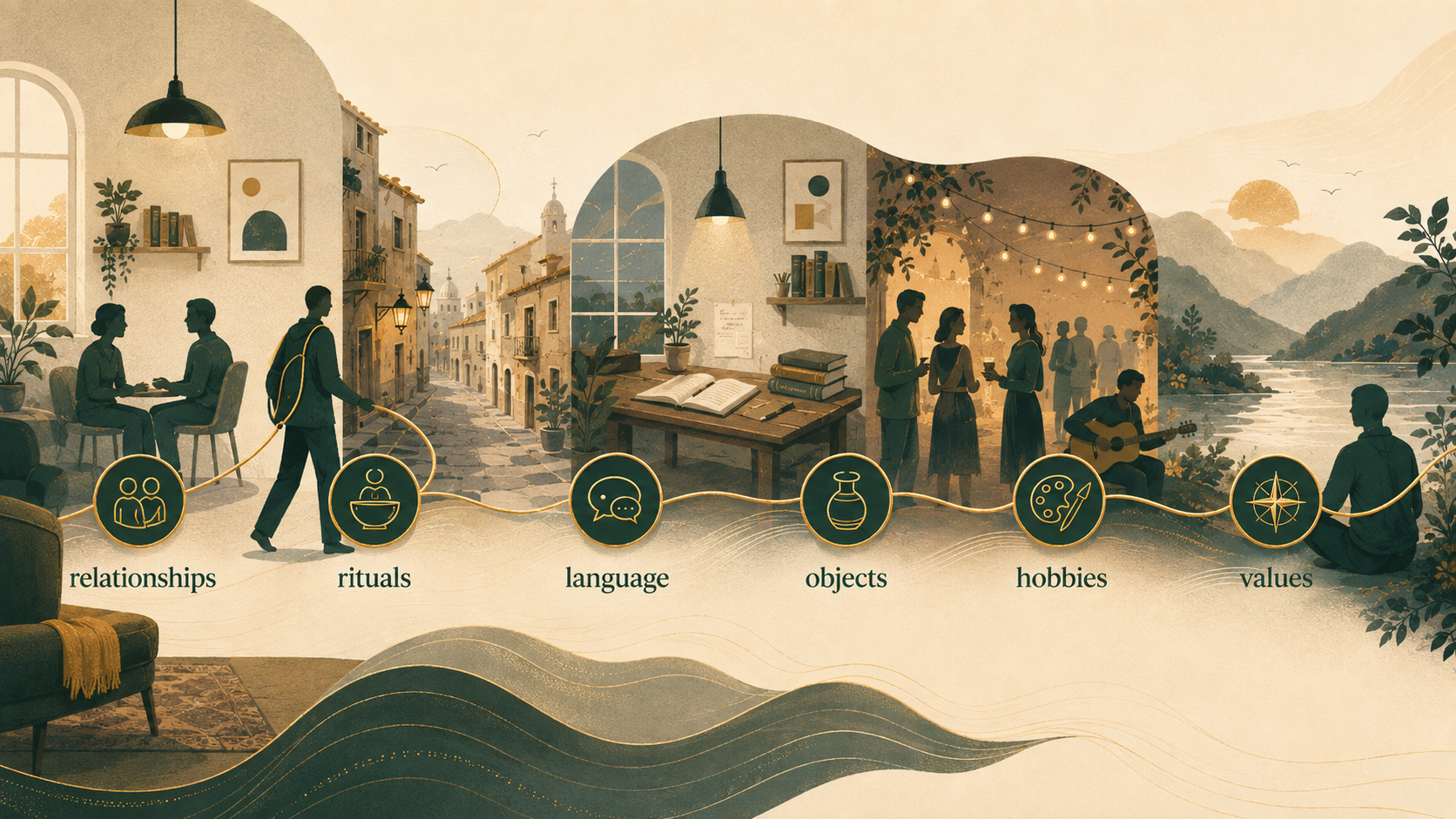
Build continuity that travels. Rituals you keep regardless of country. A language you maintain. Objects that mean something. Food you cook. Relationships you protect across time zones. The aim is not to recreate your old country inside the new one. It is continuity of self across places, which is what makes change feel like development rather than erasure.
Attach to the life you actually live. Belonging to a place tends to grow through repetition rather than through a dramatic moment when a country suddenly feels like home. The same café, the same route, the same market, the same seat. This is quieter than it sounds and it works. Note this is about attachment to place and routine, not about your social life, which is a related but separate question covered in loneliness abroad.
Let the answer be provisional. A place can be genuinely home for this stage of your life without being your permanent answer. Very few people are required to settle this question at forty, and the pressure to do so usually comes from other people's small talk.
The Grief Underneath the Question
Some of what you are feeling is not a search. It is a loss, and naming it correctly makes it easier to carry. You may be grieving the home you remember, the friendships that changed shape, the family life that no longer exists in that form, and the assumption that you could always go back and everything would still fit.
That assumption is usually the real casualty.
Most people leave with an unspoken belief that home will be held in reserve, unchanged, available. Discovering that it moved on is a genuine loss even when nothing bad happened to anyone.
Sometimes what you miss is not a place. It is a version of your life that cannot be returned to, and no amount of travel will get you back to it.
Grief is not the same as depression, and this experience is not a mental health condition. If it has arrived alongside persistent low mood, loss of pleasure or real difficulty functioning, that is a different situation and our guide to depression abroad is the more useful place to go.
When This Becomes Worth Getting Help With
Feeling between places is extremely common among long-term expats and mostly does not require therapy at all. It becomes worth professional attention when the question stops being reflective and starts actively running your decisions, or when it arrives alongside distress that does not lift on its own.
Signals worth taking seriously:
- You cannot make significant life decisions because the belonging question is unresolved
- You keep wanting to relocate without being able to say what you expect to change
- It is causing recurring conflict in your relationship
- You feel detached from your own life for long stretches rather than moments
- You cannot enjoy a life you objectively built well
- Persistent low mood or hopelessness has arrived with it
Therapy here is not about being told where you belong. No therapist should be telling you that your real home is one country or the other, and one who does is overstepping.
What it can do is unpick what home actually represents for you emotionally, what you are grieving, which parts of your identity changed and which you want to protect, and whether you are looking for belonging, familiarity, safety or connection, which are four different needs that people routinely confuse.
The goal is not to work out which country is correct. It is to understand what you need in order to feel grounded wherever you end up living.
There is a practical reason to do that work with someone who has lived internationally. Explaining why home feels foreign, why going back is not simple, and why you can be settled and unsettled simultaneously takes a long time with someone who has never experienced it. Expathy connects expats with psychologists who have lived abroad themselves and can be matched by native language and cultural background. That does not guarantee a better outcome, and it does mean less of the hour goes to background. If it would help to talk this through, online therapy for expats is where to start.
Final Thought
The question that started this is usually the wrong one. Where do I belong? implies there is a single correct answer waiting to be identified, and that you have somehow failed to find it.
A better question: what would I need in order to feel grounded in the life I am actually living?
That one has answers. Continuity, relationships that hold across distance, routines that are genuinely yours, a place you have repeated enough times to be attached to it, and permission to stop auditing whether you have chosen correctly.
You can be attached to several places and fully contained by none of them. That is not a broken version of belonging. For a lot of people who have lived internationally, it is simply what belonging looks like now.
Sources and Further Reading
- Scannell and Gifford (2010), Journal of Environmental Psychology, tripartite framework defining place attachment across person, process and place: https://doi.org/10.1016/j.jenvp.2009.09.006
- Lewicka (2011), Journal of Environmental Psychology, review of several hundred studies finding that place continues to attract strong attachments despite mobility and globalisation: https://doi.org/10.1016/j.jenvp.2010.10.001
Frequently Asked Questions
Why do I not feel at home anywhere after living abroad?
Usually because two things changed at once. You changed abroad, in habits, expectations and what you consider normal, while your home country also changed in ways you did not witness. You end up comparing your real current life against a version of home that is partly a memory of a specific period.
Is it normal to feel caught between two countries?
It is very common among people who have lived abroad for several years, and it is not a disorder or a syndrome. The categories available, local and foreigner, here and home, stop describing a life that has genuinely been lived in more than one place. The discomfort is with the categories rather than with you.
Why does my home country feel strange when I visit?
Because home moved while you were away. Friends have different lives, family dynamics shifted, and daily life continued without you. The version of home you have been carrying is partly a memory of a particular time. Feeling like a visitor somewhere you are from is disorienting but not a sign of disloyalty.
Can you belong to two countries at the same time?
Yes, and it does not require feeling equally attached to both. Research on place attachment indicates that attachment is not confined to a single location and can be sustained across several places. In practice, different places often serve different functions: a family home, an adult home, a professional home.
Why do I miss home but not want to move back?
Because what you miss may not be the country. It is often a version of yourself that existed there, one who never had to explain a reference and was known without effort. Missing that person is not the same as wanting to give up the independence and life you built after leaving.
Does not feeling at home abroad mean I should leave?
Not necessarily. Moving changes your environment but does not automatically resolve grief for a home that no longer exists, multiple attachments, or uncertainty about identity, all of which travel with you. Before treating geography as the answer, it helps to name exactly what you are asking a new country to provide.
Is feeling like you belong nowhere the same as being lonely?
No. Loneliness is about missing connection and closeness. This is about fit, whether a place feels like somewhere you are from rather than somewhere you are in. Someone can have close friends, a partner and an active social life and still feel that no country entirely contains their life.
Can living abroad permanently change your sense of home?
For many people, yes, and not necessarily for the worse. Home often stops being a single location and becomes a set of attachments distributed across places. Some people eventually root firmly in one country again. Others keep several, and both outcomes can work.
Can therapy help if I do not know where I belong?
It can, provided the aim is understanding rather than a verdict. No therapist should tell you which country is your real home. What therapy can do is clarify what home represents for you emotionally, what you are grieving, and whether you are actually seeking belonging, familiarity, safety or connection.
Need support? We're here.
Book a free 15-min consultation with our expat-specialized therapists.