
Key takeaway
You realise it on a Sunday evening, doing the mental arithmetic backwards. Thursday was a video call. Friday was the supermarket. Saturday was errands. You have not had a real face to face conversation with anyone since Wednesday, and nothing went wrong to cause it. This article is about the structural side of disconnection abroad: how relocation quietly removes the systems that used to create contact for you, how to audit what your social life actually contains, and how to rebuild regular human contact without endlessly meeting strangers.
Nobody would look at this life and call it isolated.
You work. You exercise. You answer messages. You have plans occasionally. You are, by every visible measure, a functioning adult with a normal life abroad.
But if you disappeared for four days, it is not obvious who nearby would notice.
That is the thing this article is about. Not sadness. Not rejection. Just a life that has gradually become smaller than you meant it to be, one removed routine at a time.
What Social Isolation Abroad Actually Means
Social isolation is structural. It describes the objective contents of your social life: how much regular contact you actually have, how much practical support is within reach, and whether you belong to any recurring environment. It is about what exists, not about how you feel about it. That distinction is the whole point.
In practical terms, isolation abroad usually looks like some combination of these:
- Days pass without in person conversation that is not transactional
- No recurring weekly commitment where the same people show up
- Nobody nearby you could call at short notice for practical help
- Most meaningful relationships are in another country
- Work happens remotely, so colleagues exist but are not physically present
- No connection to the neighbourhood, a sport, a community or any local group
Notice that none of those are feelings. They are facts about a calendar and a contact list. You can measure them. That is what makes isolation a different problem from loneliness, and usually a more solvable one.
Social Isolation Is Not the Same as Loneliness
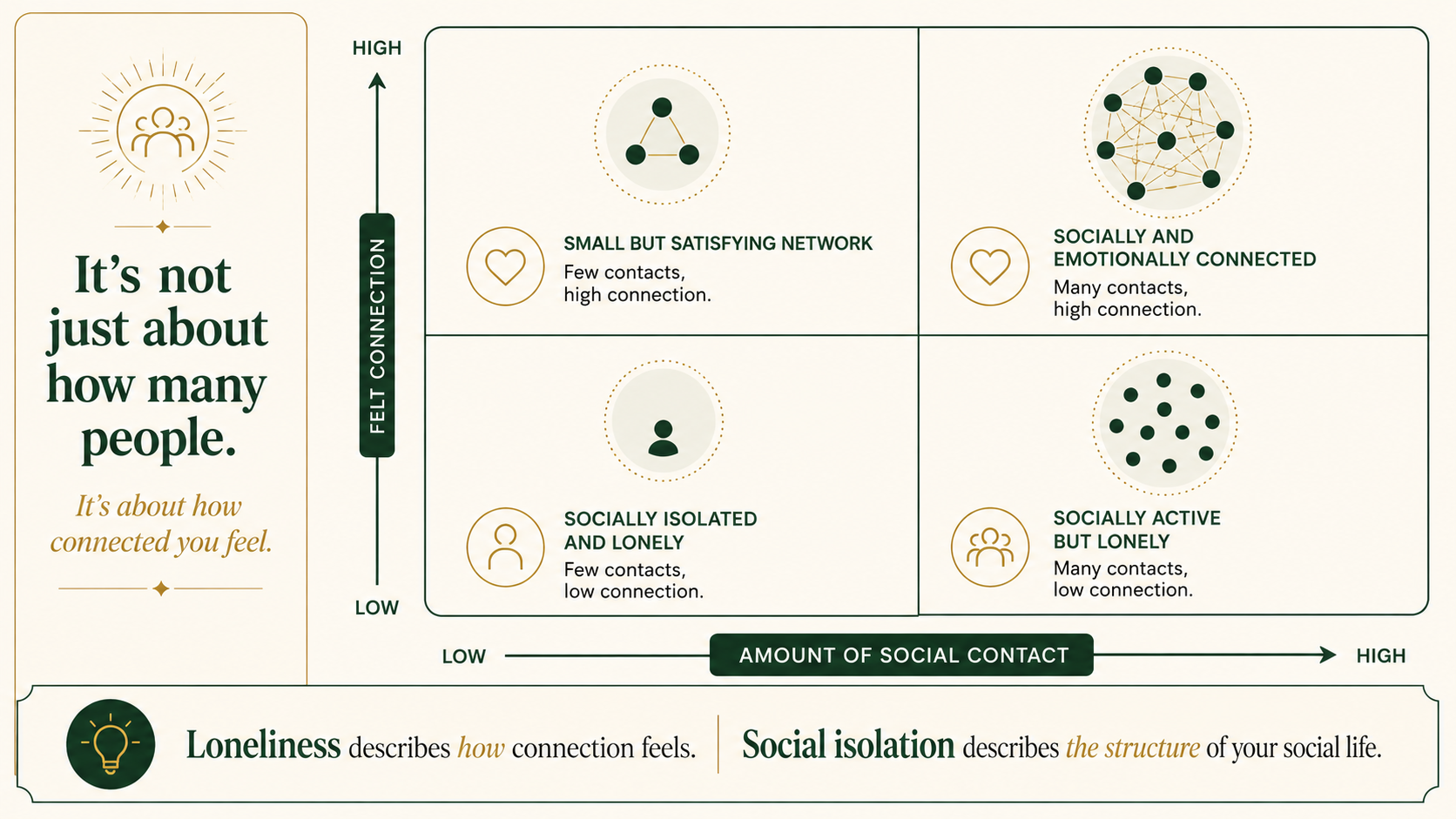
This distinction changes what you should actually do. The World Health Organization defines loneliness as the painful feeling of a gap between wanted and actual connection, and social isolation as the objective lack of it. The WHO Commission on Social Connection notes the two are only weakly related.
Which means all four of these combinations exist in real life:
| Your situation | Actual contact | How it feels |
|---|---|---|
| Full calendar, no close relationships | High | Lonely |
| Small quiet network, two real friendships | Low | Connected |
| Few interactions, disconnection you did not choose | Low | Lonely |
| Regular contact and satisfying relationships | High | Connected |
You cannot measure loneliness by counting contacts, and you cannot measure isolation by asking someone whether they feel lonely.
The OECD makes the same point from the data side. Its 2025 report on social connections and loneliness found that frequent in person interaction does not necessarily translate into high quality or supportive relationships, and that different indicators genuinely tell you different things.
So this article stays on the structural side. If what you recognise is the feeling rather than the structure, the emotional side is covered in our main guide to loneliness abroad.
Why Relocation Removes Contact You Never Had to Arrange
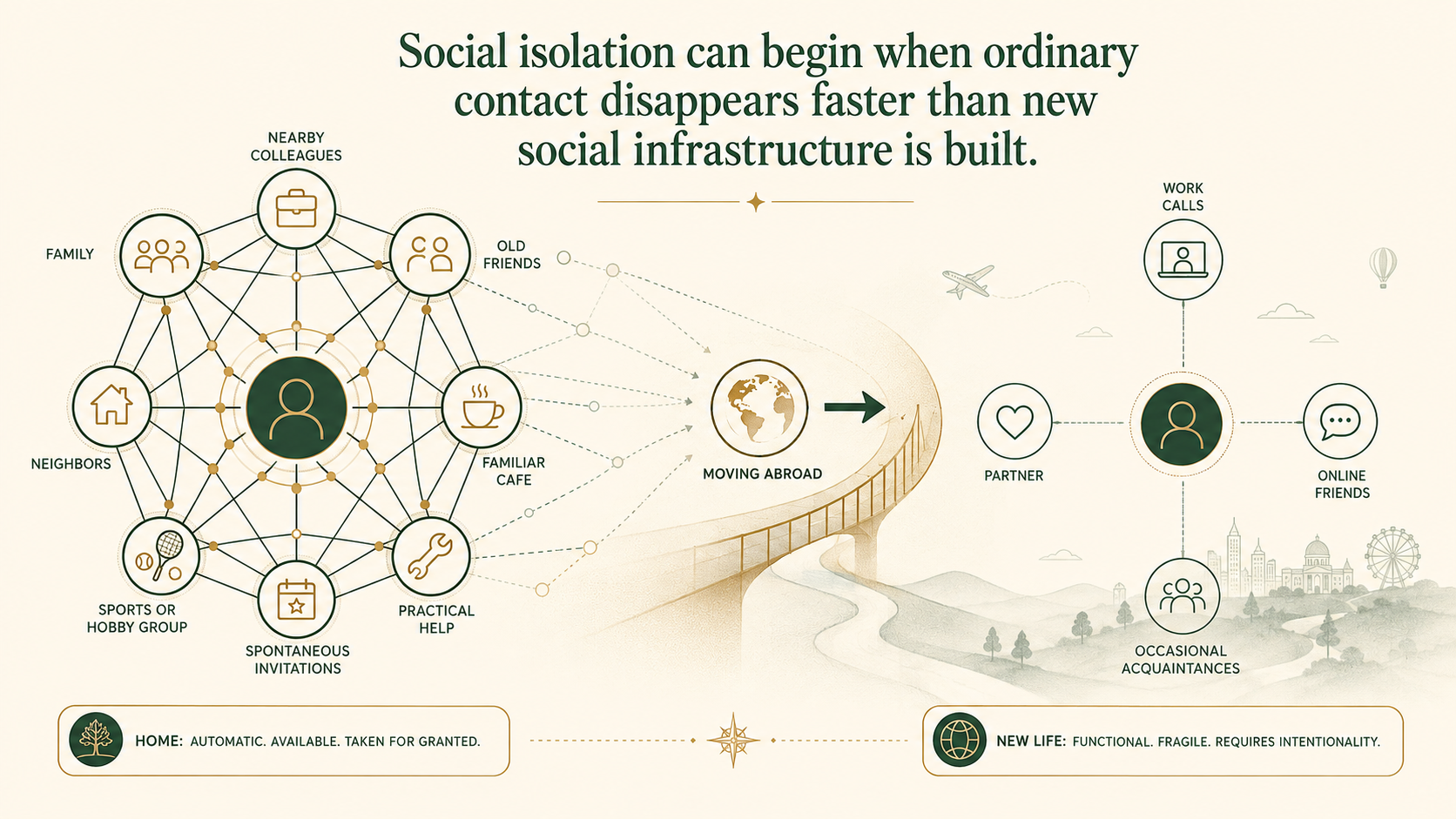
Most people badly underestimate how much of their old social life was automatic. Before moving, contact happened without being planned: colleagues in the same building, a sibling twenty minutes away, neighbours you recognised, the same faces in the same places. Relocation removes almost all of that infrastructure at once, and it goes largely unnoticed because nothing dramatic happens.
Think about what actually used to generate your social contact.
Not friendships. Systems. The commute, the office kitchen, the gym where you knew the regulars, the corner shop, the parents at the school gate, the friend who called on a Thursday for no reason, the neighbourhood where walking to buy bread meant two short conversations.
None of that required intention. It was produced by the environment.
Now compare that to your first year abroad. Every single interaction has to be deliberately created: identified, initiated, scheduled, followed up. You went from a life where contact was automatic to one where it is a project, at exactly the moment when you also had the least energy for projects.
That is why capable, sociable people become isolated abroad. Not a personality change. An infrastructure collapse.
At home, your social life ran on systems you never had to think about. Abroad, every single interaction became something you have to arrange.
The Structural Pathways Into Isolation
Isolation abroad rarely has one cause. It usually comes from two or three structural factors overlapping, each of which independently removes a source of recurring contact. Recognising which ones apply to you matters more than any general advice, because each one has a different fix.
Remote and hybrid work. This is the big one now. Remote work does not cause isolation by itself, but it removes an enormous amount of incidental contact: the commute, lunch, the corridor conversation, the after work drink, and crucially, exposure to other people's networks. You can speak to fourteen people before noon and still have had no physical contact with anyone. Communication volume is not the same as local social embeddedness.
Moving for a partner. One person arrives with an employer, colleagues, a schedule and a ready made social entry point. The other arrives with none of it. That asymmetry is structural rather than personal, and it often ends with the accompanying partner's entire social world running through one person, which is a lot of weight for any relationship to carry. We look at this in more depth in our guide for the trailing spouse and accompanying partner.
Geography. Car dependent suburbs, dispersed expat contacts, expensive or limited transport, an hour between you and anyone you know. Distance quietly converts every social plan into a logistics decision, and some of them stop being worth it.
Language. You can function perfectly well and still avoid the environments where fast local language conversation dominates, which tend to be exactly the informal ones where contact accumulates. That avoidance is understandable and often invisible, and it is explored in our article on language anxiety abroad.
Turnover. International communities are fluid. People arrive and leave on contract cycles, and a network can lose three of its five anchors in one year through no fault of anyone in it.
Life stage. New parents lose evenings and caregivers lose flexibility, and the network that fitted an old schedule rarely fits the new one.
Isolation Is Not the Same as Liking Your Own Company
This needs saying clearly. Solitude that you choose and enjoy is not a problem, and a small social circle is not a deficiency. Plenty of people are content with two close relationships and quiet weeks, and they are not isolated in any meaningful sense. Nothing here suggests everyone needs a large network.
The question is not how big your social life is. It is whether it is smaller than you actually want or need.
A more useful test than counting friends: is there regular contact you can rely on, someone who could help if something went wrong, at least one environment where your absence would be noticed, and relationships that go in both directions?
If yes, and your calendar is quiet, that is solitude and it is fine.
If several of those are missing and you did not choose that, the structure has become thin. That is worth addressing on practical grounds, before it becomes an emotional one.
The Support Network Problem
There is a moment that exposes isolation faster than any amount of reflection. You get genuinely ill, need a lift to a medical appointment, lose your keys or receive bad news, and you discover that the people you trust most are in another time zone. That is practical isolation, and it is separate from whether you feel lonely.
Most people abroad have never audited this until they need it.
The OECD reports that across member countries around 90% of people say they have someone to rely on in times of need. It is worth checking whether you are still in that 90% since you moved, or whether your answer now depends on a video call and a five hour flight.
This matters beyond emergencies. Knowing help exists nearby changes how risky ordinary life feels. Without it, small problems stay larger than they should, and a layer of low grade vigilance sits under everything.
There is also good evidence that local networks do real work. A study of 281 expatriates by Bayraktar and colleagues found that support from local colleagues and contacts was central to how well people adjusted, and that strong local networks partly compensated for weaker local language ability. The network is not a nice extra. It is load bearing.
Audit Your Social Infrastructure
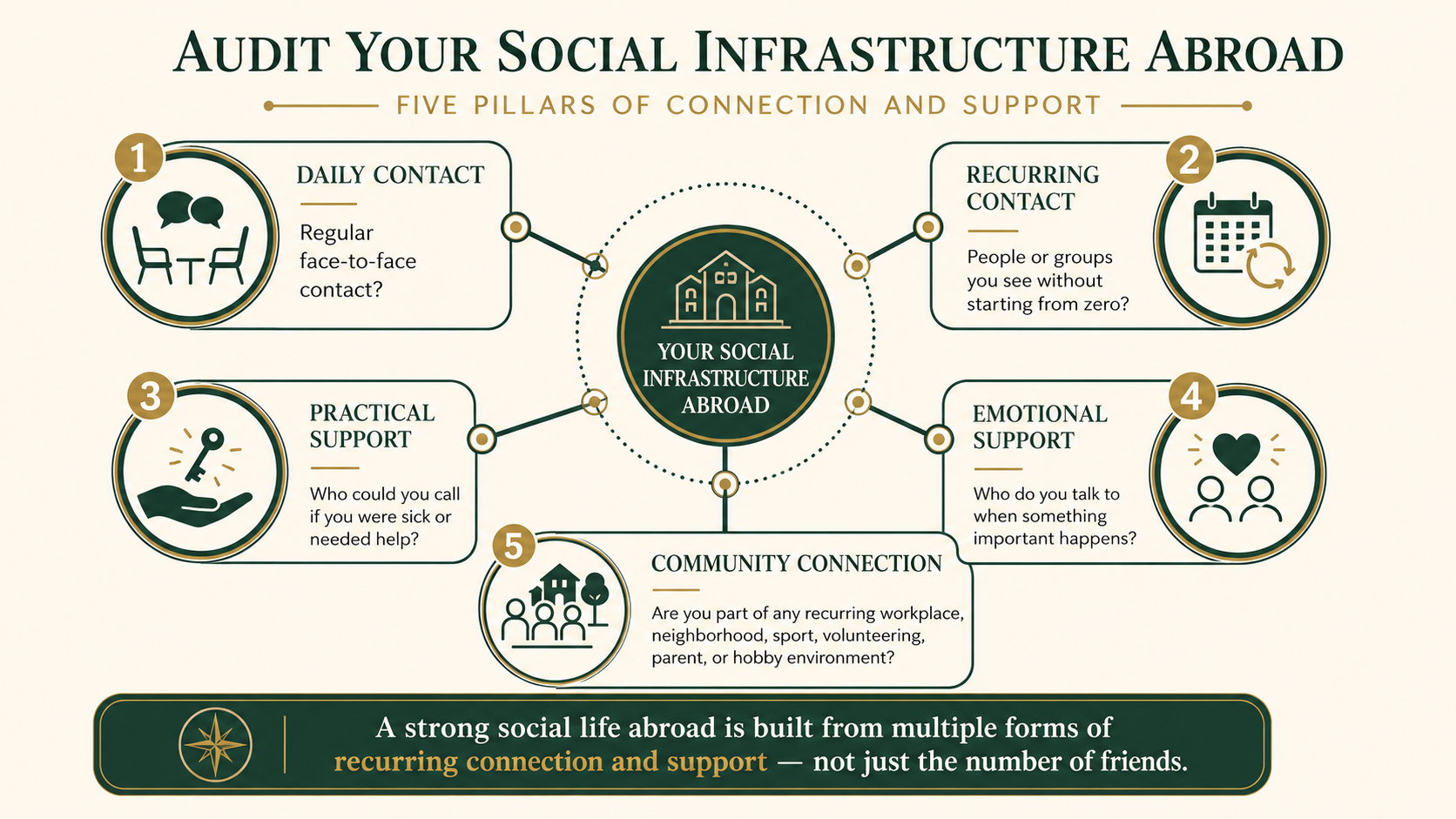
Instead of asking whether you are lonely, audit what your social life structurally contains. The goal is not a high score. It is to find the specific layer that is missing, because the fix for thin daily contact is completely different from the fix for absent practical support.
Go through these five honestly, thinking about the last month.
1. Daily contact. How many days passed with no in person conversation beyond a transaction? Does your work provide any real human contact, or only screens?
2. Recurring contact. Who do you see weekly, fortnightly or monthly without having to organise it from scratch each time? Recurrence is the layer most expats are missing entirely.
3. Practical support. Who could you call locally if you were ill, stranded or needed help within the hour? Write actual names. If you cannot name two, that is the gap.
4. Emotional support. Who do you tell when something significant happens? It is fine if some of these people are abroad, but notice if all of them are.
5. Community participation. Are you part of any recurring environment at all: workplace, neighbourhood, sport, volunteering, faith or cultural community, parent group, hobby, professional association?
Most people discover the thin layer is either recurrence or practical support. Both are fixable, and neither requires becoming a more social person.
How to Rebuild Regular Contact
Rebuilding is about installing structure, not about meeting more people. The aim is to create situations where contact happens repeatedly without you having to generate it each time, because that is what your old life had and this one does not. Volume of introductions is not the mechanism. Recurrence is.
Choose repetition over events. A one off meetup produces encounters. A weekly class, a regular five a side game, a fixed volunteering shift or the same coworking desk produces familiarity. The same faces, at the same time, without negotiation. This single shift does more than any other item on this list, and it is why our broader guidance on making friends abroad starts from environments rather than from people.
Rebuild weak ties deliberately. Not every relationship needs to become a friendship. The barista who knows your order, the neighbour you greet, the gym regular, the person at the desk next to yours. Weak ties will not solve emotional loneliness, but they change a city from anonymous to inhabited, and they are much cheaper to build than friendships.
Set a minimum social rhythm. Think regularity, not popularity. Something like: one recurring contact midweek, one activity at the weekend, one local person you check in with, one place where you are expected to come back. Adjust it to your life. The number matters far less than the fact that it repeats.
Fix the practical layer on purpose. Identify two or three nearby people or systems you could actually call. A neighbour, a colleague who lives close, a local friend. Ask a small favour once so that asking is no longer a first time.
Treat digital connection as a bridge, not the structure. Calls home are genuinely protective and worth protecting. But if every meaningful relationship is remote, nobody can bring you soup or meet you at a hospital, and your local life stays structurally empty regardless of how connected you feel.
Change the environment if it offers nothing. Sometimes the honest answer is that your current setup produces almost no opportunity for repeated contact. Coworking two days a week instead of the kitchen table, a different route, a neighbourhood cafe you use consistently. This is not motivational advice. It is redesign.
When Isolation Starts Turning Into Loneliness
The two often arrive in sequence. Someone can be structurally isolated for months and feel basically fine, then find that the absence of shared experience, spontaneous contact and practical support begins to hurt. That is the point where a structural problem acquires an emotional one, and where a purely practical fix stops being enough.
This progression is common and worth catching early.
If the feeling has arrived but is still tied to circumstances, the broader picture is in loneliness abroad. If it has been going on long enough that you have stopped expecting connection to work, that pattern behaves differently and is covered in chronic loneliness abroad.
The practical implication is simple: fixing the structure is easier before the expectations change. Rebuilding contact is far more straightforward for someone who still believes it will work than for someone who has concluded it will not.
When Psychological Support Also Helps
Be clear about what therapy can and cannot do here. A therapist cannot build you a local network, and if the honest problem is that your life contains no opportunities for contact, the answer is structural. Therapy becomes relevant when something is preventing you from using the opportunities that do exist.
The distinction is worth stating plainly:
If your life contains too few chances for contact, you need to change the structure. If fear, avoidance or hopelessness is stopping you from using the chances you already have, psychological support is likely to help too.
That second situation is common and rarely named. Social anxiety in another culture. Withdrawal after a difficult first year. Grief for the network you left, which does not feel like grief because nobody died. Losing confidence in a version of yourself that used to find this easy.
There is a practical reason to do that work with someone who already understands the context. Explaining why rebuilding a life from zero is exhausting, or why your entire social world runs through your partner, or why going home is not the obvious solution, uses up a lot of a session.
Expathy matches expats with psychologists by native language and cultural background, and our psychologists have lived abroad themselves. You start from the problem rather than from the explanation.
Therapy does not replace community, and we would not suggest otherwise. But it can remove what is standing between you and building one. If that is where you are, online therapy for expats is built for exactly this situation.
Final Thought
The thing worth taking from all of this is that social isolation abroad is usually not a verdict on your personality. It is what happens when someone removes every automatic contact system from a life and expects the person to notice in time.
You did not become worse at people. You lost the infrastructure that used to make being good at people effortless.
Which is oddly good news, because infrastructure can be rebuilt deliberately, and it does not require becoming a different person. It requires one recurring commitment, two nearby names you could call, and a few places that expect you to come back.
Start with the calendar, not with your feelings. Put one repeating thing in it this week.
Sources and Further Reading
- World Health Organization, Commission on Social Connection (2025), on the definitions of loneliness and social isolation and their weak correlation: https://who.int/news/item/30-06-2025-social-connection-linked-to-improved-heath-and-reduced-risk-of-early-death
- OECD (2025), Social Connections and Loneliness in OECD Countries, on social support availability and why different indicators capture different things: https://www.oecd.org/en/publications/social-connections-and-loneliness-in-oecd-countries_6df2d6a0-en/full-report/social-connections-across-oecd-countries_4e46a241.html
- Bayraktar and colleagues (2026), study of 281 expatriates on local social networks, host country support and adjustment: https://doi.org/10.1007/s11575-025-00605-4
Frequently Asked Questions
How do I know if I am socially isolated abroad?
Look at structure rather than feelings. Count the days in a normal week with no in person conversation beyond transactions, check whether you have any recurring commitment where the same people appear, and see whether you can name two nearby people you could call for help within the hour. Those three answers tell you more than any mood check.
Is living alone abroad the same as social isolation?
No. Living alone is a housing arrangement, and many people who live alone have rich social lives and strong local support. Isolation is about the total amount of regular contact and practical support available to you. Living alone becomes a factor only when it combines with remote work, few local ties and no recurring routines.
Can I be socially isolated even if I speak to people at work all day?
Yes, and this is extremely common with remote work. Video calls and messaging produce a high volume of communication that ends entirely when the laptop closes. Communication volume is not the same as local social embeddedness. The test is whether any of those interactions extend into physical presence, spontaneous contact or practical support.
What is the difference between social isolation and loneliness?
The World Health Organization defines social isolation as an objective lack of sufficient social connection and loneliness as the painful feeling of a gap between desired and actual connection, and notes the two are only weakly correlated. Isolation is a fact about your circumstances. Loneliness is an experience. Either can exist without the other.
Why does remote work make isolation abroad worse?
Because it removes several sources of contact at once: the commute, lunch conversations, corridor encounters, after work plans, and exposure to colleagues' wider networks. For someone in their own country these losses are partly cushioned by existing friends and family nearby. Abroad, that cushion often does not exist yet.
How can I build a local support network after moving abroad?
Prioritise recurring environments over one off events, because repetition creates familiarity with far less effort. Then work on the practical layer deliberately: identify two or three nearby people you could call, and ask a small favour once so that asking becomes normal. Recurrence and practical support are the two layers most expats are missing.
Are online friendships and calls home enough?
They are genuinely valuable and worth protecting, but they cannot cover everything. Remote relationships cannot help when you are ill, provide spontaneous contact or make a city feel inhabited. Treat digital connection as a bridge that keeps important relationships alive while you build local structure, rather than as a replacement for it.
What if my partner is my only social connection abroad?
This is very common for accompanying partners and it is structural rather than a personal failing, since one person arrived with an employer and a built in network and the other did not. It puts significant weight on the relationship. The practical priority is one independent recurring commitment that is yours alone.
When should I seek professional support for social isolation?
When something is preventing you from using the opportunities that exist. If you have chances for contact but avoid them, if the thought of starting again feels hopeless, or if your mood, confidence or motivation has dropped alongside the isolation, professional support is appropriate. If the honest problem is that no opportunities exist, start with structure instead.
Need support? We're here.
Book a free 15-min consultation with our expat-specialized therapists.