
Key takeaway
You asked what they wanted to do this weekend and they said nothing, so you made the plan. Then you cooked. Then you cancelled the dinner with friends because they could not face it, answered the messages from their family, and sorted the thing with the landlord. It felt like helping. Somewhere around month five you realised you are holding both of you up, and you have nowhere to put that down. This article is about how to support someone through depression abroad without disappearing into it.
Two things are true at the same time here, and most articles only manage one of them.
Your partner is genuinely struggling. What looks like withdrawal, laziness or indifference is usually a symptom, and they are not choosing it.
You are also being affected. The exhaustion, the resentment you feel guilty about, the slow disappearance of your own life. That is real too, and it is not selfish to say so.
Nobody here is the villain. The situation is just considerably bigger than one relationship was built to carry.
What Depression Actually Does to a Relationship
Depression is not an individual event inside a couple. It changes communication, affection, sex, social life, household contribution, parenting and how decisions get made, and the strain that creates can in turn make the depression harder. Research on couples consistently finds one partner's mental health is linked to the other's wellbeing.
The technical way to describe that is spillover or partner crossover. Depression is not contagious, and nobody catches it from a spouse. What happens is that living closely alongside someone who is unwell changes your daily life, and that has consequences.
It also runs both directions. Relationship strain can feed depression, and depression can feed relationship strain, which is why it becomes so hard to identify what started it.
One reframe that helps early: most of what you are experiencing as rejection is symptom. Loss of interest and pleasure is a core feature of depression, not a comment on you. A 2024 systematic review of 20 studies by Wong and colleagues found anhedonia in major depressive disorder associated with worse social and psychological functioning and lower quality of life, which is covered further in our article on anhedonia abroad.
If you want the broader picture of what your partner is experiencing, our main guide to depression abroad covers symptoms, causes and treatment.
Why Living Abroad Puts All of It on You
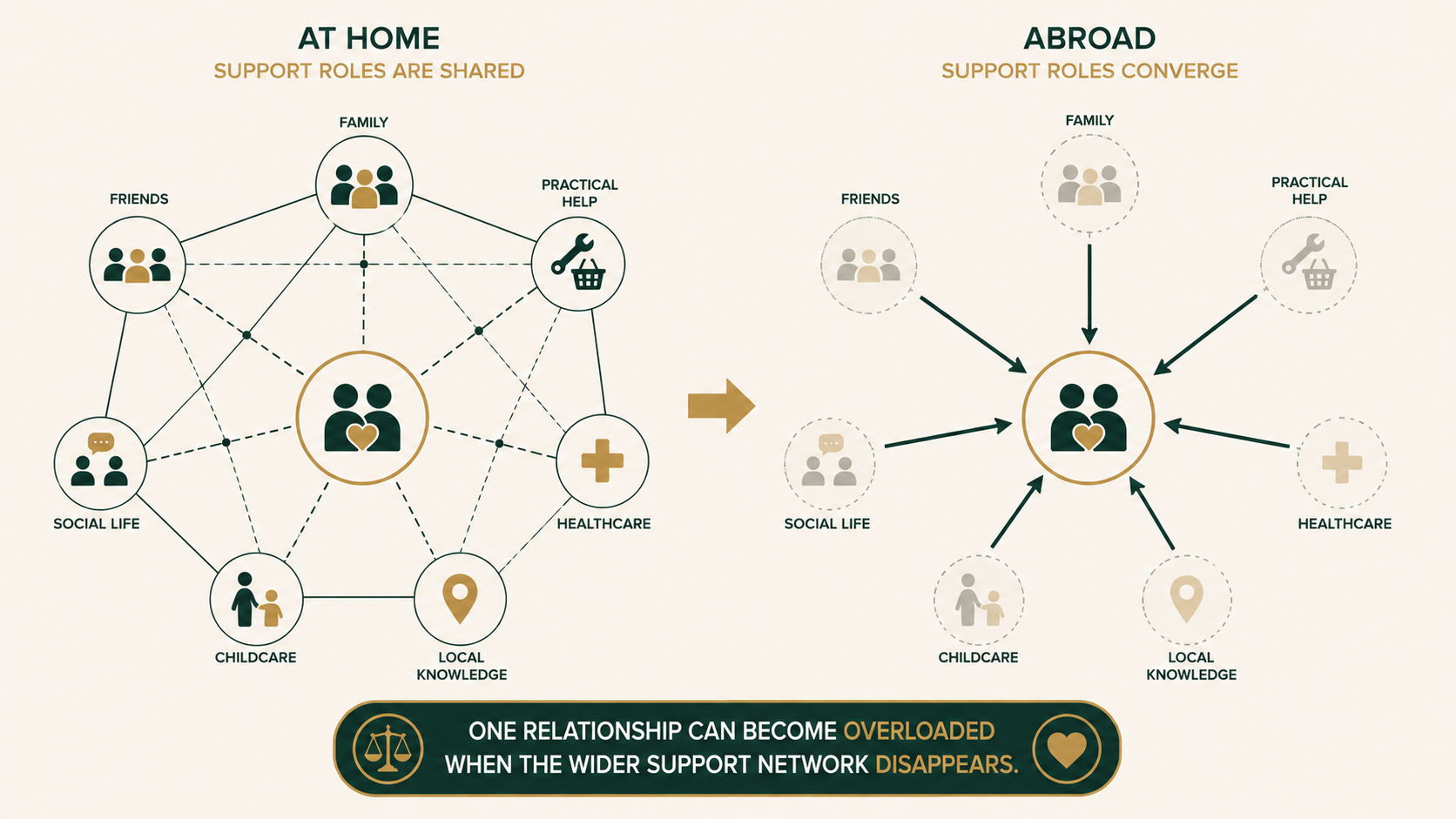
Because the support system that would normally absorb some of this is in another country. At home there were parents, siblings, old friends, neighbours, a familiar doctor, maybe childcare. Abroad, one person often becomes all of it, and when that person's partner becomes depressed, the entire structure rests on whoever is still standing.
Look at what you have probably absorbed without noticing.
Closest friend. Emotional support. Practical support. Interpreter. Administrator. Social organiser. Emergency contact. Substitute for their entire family.
The problem is usually not that your relationship is weak. It is that your relationship is being asked to do the work of an entire missing support network, and now it is doing that work with one person functioning.
It is worth knowing that international mobility already strains partners before any of this begins. A 2025 study of 207 internationally mobile partners by Aegerter and colleagues found perceived stress was the strongest single predictor of their wellbeing, with isolation second. You may have arrived at this situation with your own reserves already low, and that is worth naming rather than treating as weakness.
How to Support Without Becoming the Therapist
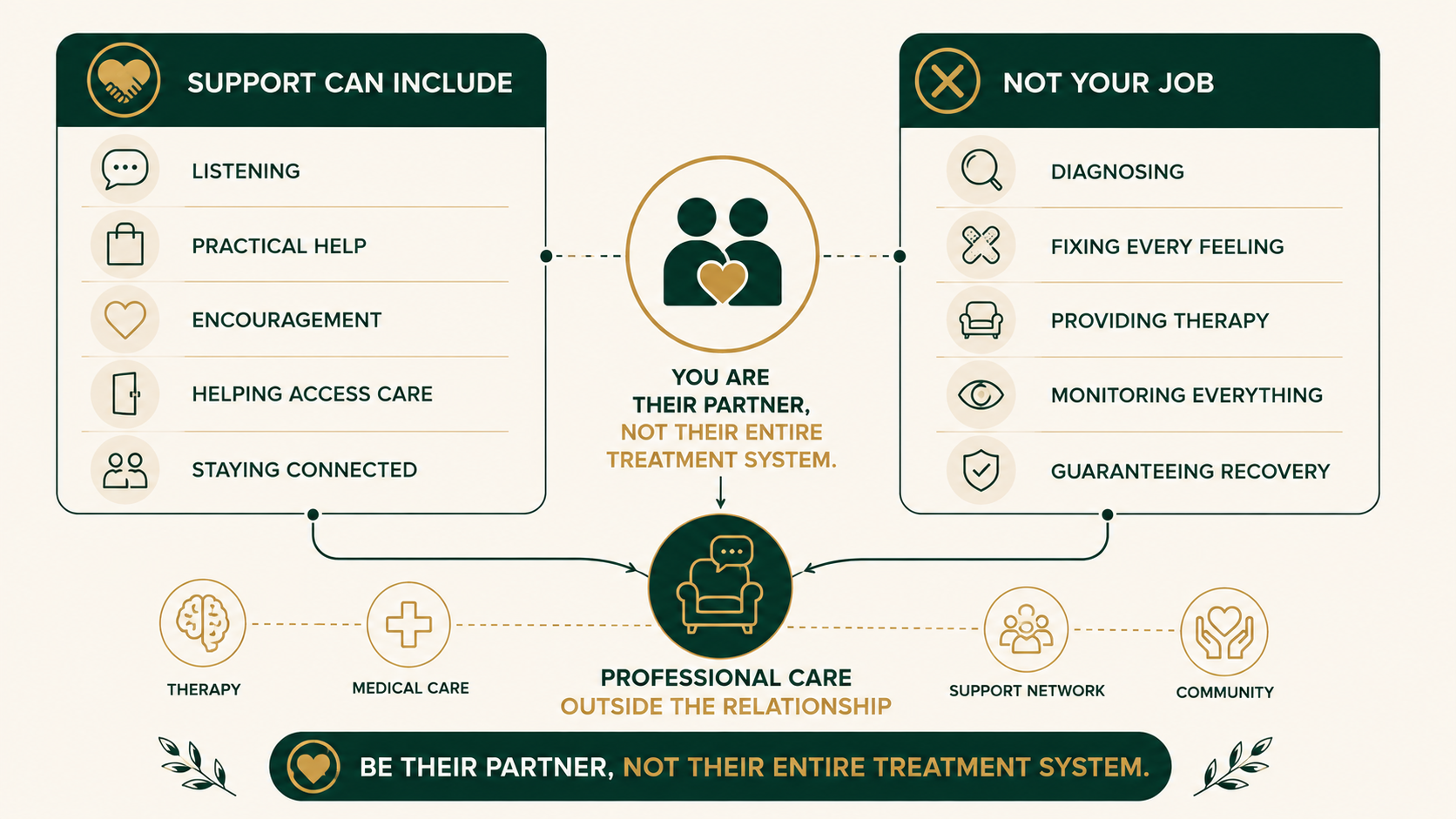
The most useful thing you can do is be steady, be present, and help with the next practical step. What you cannot do is diagnose, treat, monitor every mood or take responsibility for whether they recover. Those are not your jobs, and attempting them tends to exhaust you without helping them.
Things that genuinely help sound quite ordinary:
I can see how hard this has become. You do not have to convince me. What would actually help today?
Things that do not help, even when kindly meant: you have so much to be grateful for, maybe you just need to get outside, try to think positively, we moved here for a reason. None of these are wrong exactly. They just ask a depressed person to argue for their own experience, which costs energy they do not have.
Help with the next step, not the whole recovery. That might mean finding two therapist options rather than fifteen, sitting with them while they send the email, explaining how the health system works here, or coming to an appointment if they want you there.
It does not mean researching endlessly on their behalf, deciding their treatment, tracking their symptoms or feeling responsible when a session goes badly.
Support can make the next step easier. It should not require you to become the treatment.
Support Versus Accommodation
This distinction matters and it is easy to get wrong in both directions. Temporarily taking something over is support. Permanently reorganising your whole life around avoidance can quietly make their world smaller. The difference is usually whether it is a bridge or a new permanent arrangement.
| Reasonable support | Worth watching if it becomes permanent |
|---|---|
| Cooking on a bad day | Every meal, indefinitely |
| Helping arrange one appointment | Managing all their healthcare |
| Cancelling one social thing | Cancelling everything, every time |
| Speaking for them at a difficult appointment | Speaking for them in all situations |
| Giving space when they need it | Becoming their only human contact |
| Not broadcasting their situation | Hiding the severity from everyone, including their family |
This is not about blame. Every item in the right column starts as an item in the left column, done with love, one reasonable decision at a time.
The useful question is not "am I doing too much" but "is this temporary, and is there a route back?" Where your partner can still reasonably own something, letting them keep it protects their sense of agency, and agency is one of the things depression erodes fastest.
When the Housework Quietly Became Yours
Depression genuinely reduces capacity for cooking, cleaning, admin, childcare and errands, so the load shifts. The problem is that it usually shifts silently, and the person carrying it decides they are not allowed to be frustrated because their partner is ill. Both things can be true.
Say this plainly to yourself, because nobody else will: your partner may genuinely have less capacity, and you may genuinely be exhausted by carrying more. The second does not cancel the first.
What helps is making it visible rather than letting it accumulate into resentment. Four questions worth doing together, out loud:
What actually has to happen this week, and what can slide? What can be simplified or paid for temporarily? What can someone else take, if anyone is available? And which things can you still reasonably own, even in a reduced form?
That last question matters more than it looks. Keeping one or two responsibilities is often better for a depressed person than having everything removed, provided the bar is set realistically.
Do not aim for an equal split during an illness. Aim for something sustainable for both of you, and revisit it, because sustainability for six weeks is different from sustainability for two years.
Affection, Intimacy, and Not Taking It Personally
Depression commonly reduces sexual desire, physical affection and emotional responsiveness. That is a symptom of the illness, not a verdict on the relationship or on you, even though it is almost impossible for it not to feel personal when you are living inside it.
Both facts deserve room here.
Your partner may have very little to give right now, and pressure will not produce more of it.
And you are allowed to miss them. Being told to indefinitely suspend your own need for closeness is not reasonable advice, and quietly doing it usually produces resentment rather than patience.
A conversation that tends to go better than the alternatives: I know you are struggling, and I am not asking you for more than you have. I do miss feeling close to you. Can we work out what closeness is possible at the moment? That leaves room for affection that is not sex, and for honesty rather than performance.
If this has been going on long enough that the relationship itself feels lonely, that is its own recognisable experience, covered in loneliness in expat relationships.
When They Withdraw From Everyone Except You
Withdrawal is part of depression, so the shrinking social world is expected. The risk abroad is that you become the last remaining connection, which is the most fragile possible arrangement for both of you. One person cannot be an entire support network, and being that person is not sustainable.
Where you can, gently keep other doors open. Their family. One or two friends who know. A doctor. Anyone who can carry even a small piece.
There is evidence that support genuinely matters here. Research by Kim and colleagues on migrant workers found the link between acculturative stress and depression was stronger when social support was low. Support buffers. It is also not a treatment, which is exactly why the goal is support around the relationship rather than concentrated inside it.
This is also where telling one or two trusted people, with your partner's knowledge where possible, stops being a betrayal and starts being necessary. Complete secrecy protects nobody and isolates you both.
When They Say They Want to Go Home
You will probably hear this, and it lands badly whichever way you take it. Treat it as neither irrational nor final. Depression can make everything about the current environment feel like the cause, and there may also be genuine problems here worth taking seriously.
Try not to argue with it. Arguing turns it into a position they have to defend.
What tends to work better is curiosity: what specifically do they think would be different, and what do they imagine would follow them. That is the actual question, and we work through it properly in our article on whether to move home when you are depressed abroad.
One thing worth holding onto: a decision this large, made during the worst stretch, is usually worth postponing rather than refusing. Not forever. Just until there is more information.
"They Refuse to Get Help"
You cannot make a competent adult get treatment, and pretending otherwise will exhaust you. What you can do is be clear about what you are seeing, make the practical route easier, and be honest about what this is costing the relationship. That is genuinely a lot, and it is where your influence ends.
Describe specifics rather than labels. Not I think you are depressed, which invites debate, but you have not left the flat in three weeks and you have stopped calling your brother. Observations are harder to argue with than diagnoses.
Then be straightforward about your own position, without turning it into a threat:
I love you and I want to help. This has been getting worse for months, and I cannot be the only thing holding it up. I would really like us to bring someone in.
Reduce the friction where you can. Two options rather than a list. Their language if that matters. An appointment time that does not require them to organise anything. Sometimes the barrier is not unwillingness. It is that every step feels impossibly heavy, which is itself a symptom.
Boundaries Are Not Abandonment
You are allowed to have limits, and having them is part of doing this well. A boundary is not "I have stopped caring." It is "I cannot support you sustainably if I disappear entirely in the process." Partners who set none tend to burn out eventually, and a burnt-out supporter is no use to anyone.
Reasonable boundaries might cover your sleep, your work, your own social contact, time that is not spent in the caregiver role, how household basics are handled, or how much of the family communication you take on.
And a harder line that needs stating clearly: depression explains a great deal, and it does not excuse abuse. Intimidation, controlling behaviour, repeated cruelty or anything that makes you unsafe is not a symptom you are obliged to absorb. If that is happening, you need support for yourself, and possibly advice about your own safety, regardless of your partner's diagnosis.
You Need Support Too
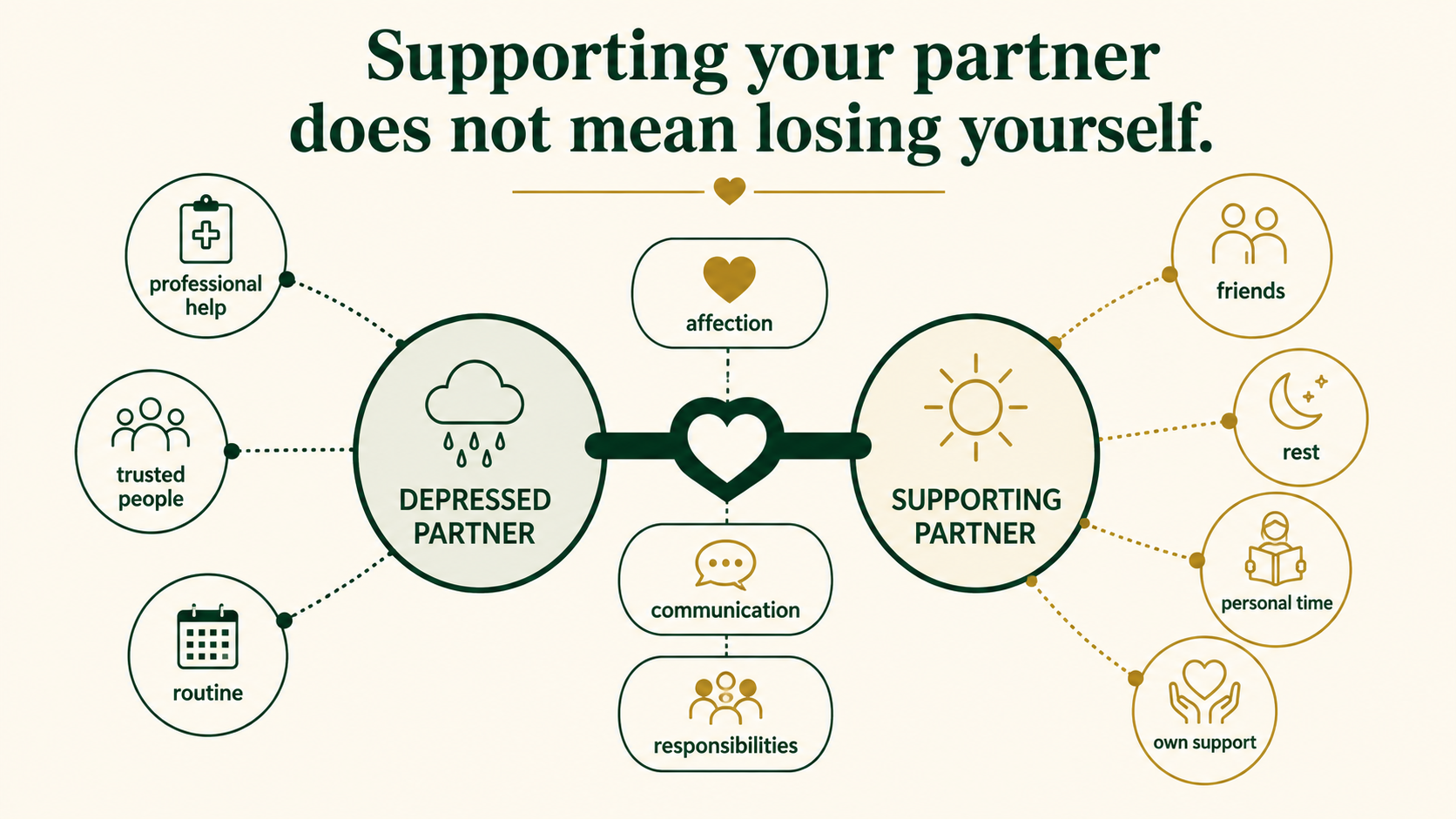
This is the part almost every supporting partner skips. You need somewhere to say "I am angry, exhausted and frightened" that is not your depressed partner, because asking them to comfort you about their depression puts weight on the person least able to carry it.
Concretely, that means keeping some things that are yours: a friend who knows the real situation, your own routines, sleep, movement, contact with family, some hours where nobody needs anything from you.
Abroad this is harder, because your own network may be thin. The instinct is to postpone your own support until your partner is better. That can be a very long wait, and you will be a worse support in the meantime.
You are not a spare part in your partner's illness. Two people live in this house, and both of them need something.
Your own therapy is a legitimate option here, not an overreaction. Online therapy for expats exists for exactly this kind of situation, where someone is managing an enormous amount without much around them.
Individual Therapy, Couples Therapy, or Both
They do different jobs. Individual treatment addresses the depression itself. Couples therapy addresses what depression has done to the relationship. For a significant depressive episode, couples work is not a substitute for individual treatment, and quite often both are appropriate.
Couples therapy tends to help when the issues are resentment, communication, intimacy, an unsustainable caregiving imbalance, escalating conflict, or a stay-versus-leave decision neither of you can discuss calmly.
The reassuring part is that depression is treatable. NICE guidance sets out established options including cognitive behavioural therapy, behavioural activation and medication depending on severity and preference. Your job is not to deliver any of that. It is to help the door open.
There is a reason international couples often prefer a therapist who has lived abroad. You would otherwise spend the first sessions explaining why there is no family nearby, why one of you gave up a career, why "just go home" is not simple, and why the two of you are each other's everything here.
Expathy matches expats with psychologists by native language and cultural background, and our psychologists have lived abroad themselves. Less of the hour goes to context, and more of it goes to what depression is doing to your partner and to the two of you.
If your partner is ready for support, depression therapy for expats is the direct route. If the relationship itself needs attention, couples therapy is where that work happens.
If Your Partner Is Not Safe
If your partner talks about suicide, says they might harm themselves, or seems unable to keep themselves safe, take it seriously and act today. Do not wait to see whether it passes, and do not try to manage it alone.
Contact your local emergency number, your country's crisis line, or take them to the nearest emergency department. Contact their doctor or therapist urgently if they have one. Stay with them if it is safe to do so, and bring in another trusted person where you can.
A mental health crisis needs a wider safety system than one exhausted partner. Involving professionals is not a failure of your support. It is the correct response, and being far from home does not change that. Emergency services exist everywhere.
Depression is treatable, including at its most severe, and including when neither of you can see how right now.
Final Thought
There is no version of this where you fix it. That is worth accepting early, because a lot of supporting partners exhaust themselves trying to be the intervention.
What you can be is the person who stays steady, keeps some of the ordinary life going, makes the next step slightly easier, and refuses to let the whole thing rest on one relationship in a country where you have no backup.
Loving someone through depression is not the same as treating them. The first is yours to give. The second belongs to someone qualified, and asking for them is part of the love, not a failure of it.
If you have read this far and recognised most of it, the useful thing to do this week is not another conversation with your partner. It is one honest conversation with someone about you.
Sources and Further Reading
- Wong and colleagues (2024), systematic review and meta-analysis of 20 studies on anhedonia and functioning in major depressive disorder: https://doi.org/10.1016/j.jad.2024.04.086
- Aegerter and colleagues (2025), cross-sectional study of 207 internationally mobile accompanying partners on stress, isolation and wellbeing: https://doi.org/10.3389/fpsyg.2025.1607178
- Kim and colleagues (2022), study of migrant workers on acculturative stress, social support and depression: https://doi.org/10.3389/ijph.2022.1604643
- NICE guideline NG222, Depression in adults: treatment and management: https://www.nice.org.uk/guidance/ng222
Frequently Asked Questions
How can I support my depressed partner abroad?
Be present, help with practical things temporarily, and make the next step toward professional support easier rather than taking responsibility for their recovery. Abroad, the most important addition is making sure support exists around the relationship rather than entirely inside it, since one person cannot replace a whole support network.
What should I say, and what should I avoid?
Helpful responses acknowledge rather than argue: I can see how hard this is, what would actually help today. Avoid gratitude reminders, positivity advice or suggestions to get outside more. They are well meant, but they ask a depressed person to defend their own experience, which uses energy they do not have.
Why is my partner withdrawing from me?
Withdrawal and loss of interest are core features of depression rather than statements about the relationship. Research links anhedonia in depression with worse social functioning generally. It genuinely is not personal, though it is almost impossible for it not to feel personal when you are the one being withdrawn from.
Can depression reduce affection and sexual desire?
Yes, commonly. Reduced desire, less physical affection and lower emotional responsiveness are recognised features of depression, not evidence that attraction has gone or the relationship is failing. You are still allowed to miss closeness and to say so, ideally as an honest conversation rather than as pressure.
How much should I take over for my partner?
Enough to get through, not so much that everything is permanently removed. Taking something over temporarily is support. Making it permanent can shrink your partner's world and your own capacity. Where they can still reasonably own something, even in reduced form, keeping it usually protects their sense of agency.
Is it selfish to set boundaries with a depressed partner?
No. A boundary protects your ability to keep supporting them, which is the opposite of abandonment. Sleep, work, your own friendships and some time outside the caregiver role are not luxuries. Separately, depression never excuses abuse, intimidation or behaviour that makes you unsafe.
What if my partner refuses professional help?
You cannot make an adult get treatment. You can describe specific changes you have noticed rather than offering a diagnosis, remove practical friction by narrowing options and handling logistics, and be honest about what the situation is costing the relationship. Sometimes the barrier is not refusal but that every step feels impossibly heavy.
Can couples therapy help when one partner is depressed?
It can, particularly for resentment, communication, intimacy, caregiving imbalance or a stay-versus-leave decision. It is not a replacement for individual treatment of a significant depressive episode, and quite often both are appropriate at once, working on different parts of the same situation.
How do I know when it has become too much for me?
When your own sleep, work, health or relationships are deteriorating, when resentment is constant, when you have no one to talk to honestly, or when you cannot remember the last time anything was about you. Those are signs you need your own support, not signs that you are failing at supporting them.
What should I do if my partner talks about harming themselves?
Take it seriously and act the same day. Contact emergency services, a crisis line, or go to the nearest emergency department, and contact their doctor or therapist urgently. Stay with them if it is safe and involve another trusted person. Crisis situations need a wider safety system than one partner can provide alone.
Need support? We're here.
Book a free 15-min consultation with our expat-specialized therapists.