
Key takeaway
You moved here together, which was supposed to be the safe version. Two years in, one of you comes home energised from drinks with colleagues and the other has been waiting since four o'clock to talk to the only person in this country who knows them. Neither of you is doing anything wrong. This article is about why loneliness inside an expat relationship is so common, why having a partner does not touch the kind of loneliness relocation actually creates, and what helps when one relationship is quietly carrying an entire social world.
There is a sentence that gets said early in most international relocations, usually at the airport or on the first strange evening in an empty apartment.
"At least we have each other."
It is true, and it is meant kindly, and for the first few months it works.
Then somewhere around month eight, one of you says something like I feel so alone here and the other one hears you are not enough, and the evening goes badly for reasons neither of you can quite explain afterwards.
That misunderstanding is the subject of this article, and there is a good reason it happens.
Can You Be Lonely When You Have a Partner?
Yes, and psychology has a specific explanation for it. Loneliness comes in two distinct forms: emotional loneliness, the absence of a close intimate attachment, and social loneliness, the absence of a wider network of friends, colleagues and neighbours. A partner addresses the first. They cannot address the second, because they are not a community.
This distinction comes from Robert Weiss and underpins most modern loneliness measurement. In research by De Jong Gierveld and Van Tilburg, there is a line that should be printed on the wall of every relocation package: people who have moved somewhere new frequently report social loneliness specifically.
The evidence goes further. A 2025 review in Frontiers in Psychology notes that emotional loneliness correlates with whether someone has a partner, while social loneliness shows no such correlation. Having a partner does not reduce it at all.
Read that again if you are the partner who keeps being told but you have me.
You are not lonely because your relationship is failing. You are lonely because a partner solves one kind of loneliness and relocation created the other kind.
This is why the conversation goes wrong so often. One person is describing social loneliness. The other is hearing it as a verdict on the relationship. They are talking about two different things.
Why One Relationship Ends Up Carrying an Entire Social World
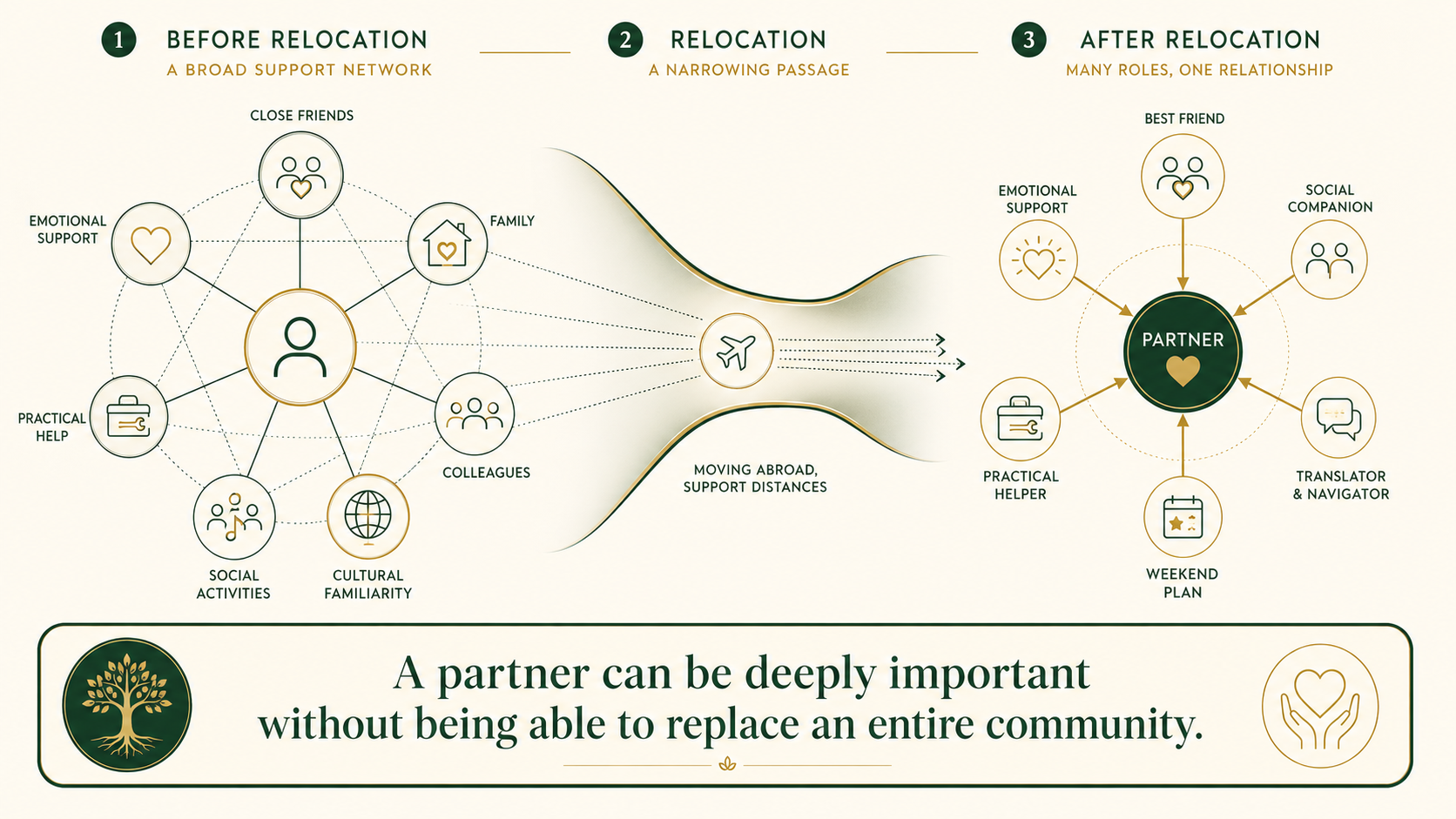
Before you moved, your needs were spread across many people. Humour from one friend, career validation from colleagues, practical help from family, shared history from people who knew you at twenty, intimacy from your partner. Relocation removes all of them except one, and the survivor inherits the whole list by default.
Look at what a partner abroad becomes: best friend, emotional support, weekend plan, translator, cultural guide, practical problem solver, emergency contact and sole connection to the outside world.
No relationship was designed to be all of that. Not because the love is insufficient, but because a person is not a network, and no amount of devotion converts one into the other.
The relationship did not get worse. It got promoted into nine jobs it never applied for.
This is worth saying to each other explicitly, because it reframes the whole problem. The issue is not that your partner is failing to meet your needs. It is that a community's worth of needs is arriving at one address.
When One Partner Integrates Faster
This is the most common shape of the problem. One partner has a job, which delivers colleagues, structure, professional identity, local knowledge and a stream of invitations from day one. The other has an apartment and a list of things to sort out. The same relocation produces two entirely different experiences of the same country.
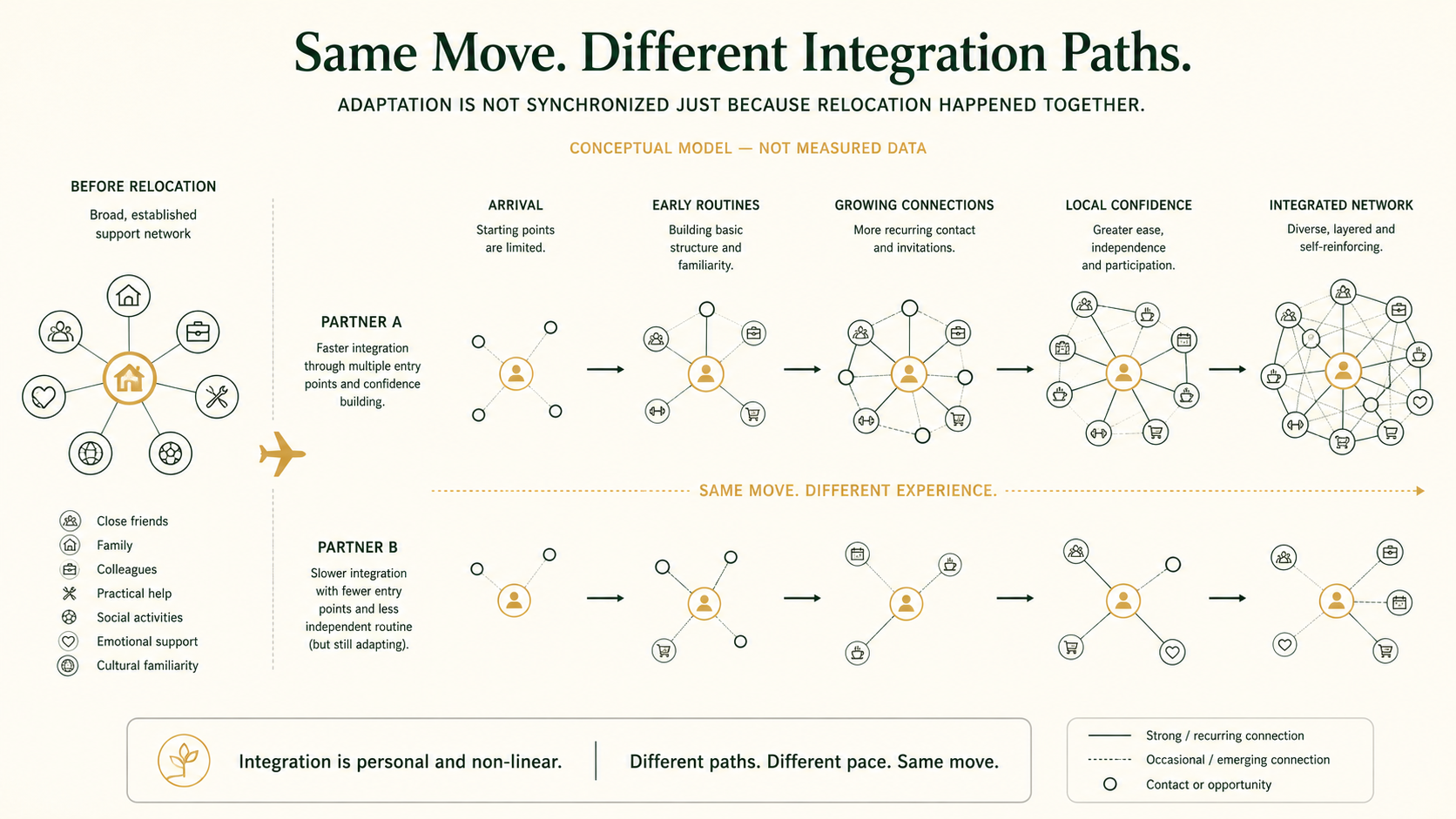
Within a few months the gap is visible.
One of you says I really like it here. The other hears my struggle makes no sense to you. Both are living in the same apartment and in different countries.
Be fair about this. The faster integrating partner is not doing anything wrong, and the advantage is structural rather than personal. An employer handed them a ready made social entry point. Nobody handed the other one anything.
Research on expatriates supports how much that entry point matters. A study of 281 expatriates by Bayraktar and colleagues found that support from local colleagues and contacts was central to how well people adjusted, and that strong local networks partly compensated even for weaker local language ability. The working partner did not just get a job. They got the main mechanism of adjustment.
Where relocation has also cost someone their career, income or professional identity, the loneliness sits on top of several other losses at once, which we cover in our guide for the trailing spouse and accompanying partner.
Why the More Connected Partner Is Also Struggling
The partner with the social life is usually not having an easy time either, and this rarely gets acknowledged. They are carrying their own relocation stress, a demanding new job, and the growing sense that their partner's happiness is now their personal responsibility. That is its own kind of pressure.
What it sounds like from inside: guilt every time they accept an invitation, reluctance to mention that work went well, coming home tired to someone who has been alone since morning and needs three hours of connection, wanting one evening with colleagues and knowing what it will cost at home.
And underneath it, something they usually cannot say: I am also finding this hard, and there is no room for that.
Then their own stress goes unspoken, because it feels indulgent next to their partner's isolation. Two people struggling, one of whom has decided they are not allowed to.
If this article is doing its job, both of you should have recognised yourselves somewhere in the last two sections. Neither position is the villain.
"You Are the Only Person I Have Here"
At the start it sounds like devotion. Later it becomes a weight neither person knows how to put down. There is a real difference between "you are the only person I need" and "you are the only person I have", and relocation quietly converts the first into the second without anyone noticing the switch.
Once that has happened, ordinary independence becomes charged.
Your partner wants dinner with colleagues, or a hobby, or one quiet evening alone. Reasonable requests, all of them. But if they are your only source of connection, their night out does not leave you with a free evening. It leaves you with nobody.
So you resist, and it comes out as an argument about Friday, when it is actually about the fact that you have no life here that belongs to you.
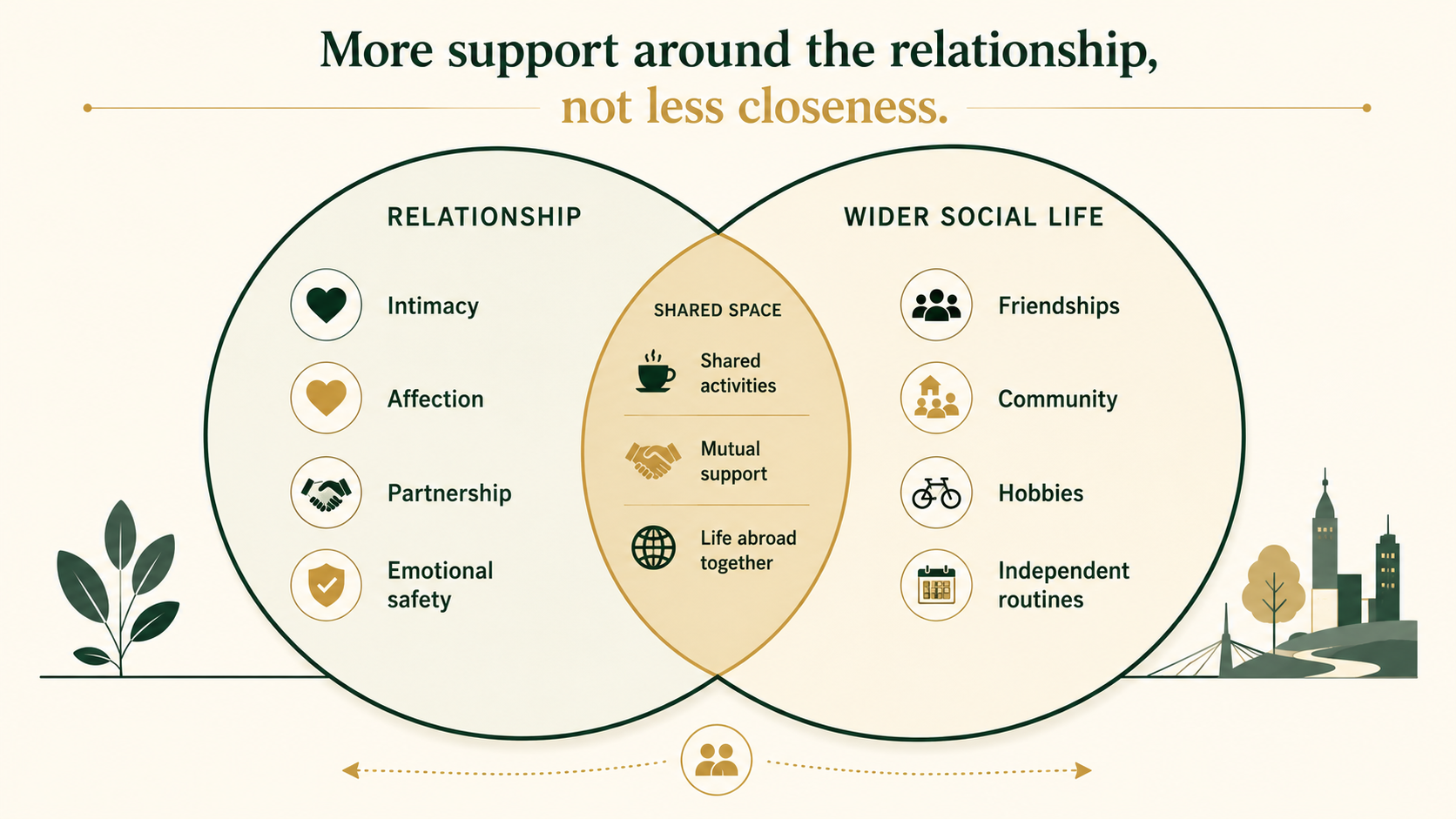
The goal is not to become less close. Nobody needs to love their partner less. The goal is narrower and more achievable:
Let the relationship be central without requiring it to be everything. That is not distance. It is what makes the closeness sustainable.
Is This Loneliness, or Is Something Wrong With Us?
This is the question that keeps people awake, and it is genuinely hard to answer from inside. A relationship carrying an entire social world produces symptoms that look almost identical to a relationship in trouble, which is why so many expat couples start doubting the relationship itself.
These questions are not diagnostic. They are meant to help you ask a better one.
| What you notice | What it may actually be |
|---|---|
| You miss your partner even though you see them constantly | You need emotional connection, not more hours together |
| You resent their independent plans | Your own social world may be too small |
| Every evening feels repetitive | Loss of wider stimulation and community |
| You expect your partner to meet every social need | The relationship has absorbed a community's job |
| You feel unseen even when you are together | Emotional loneliness inside the relationship |
| Almost all your conversations are logistics | Relocation management has replaced connection |
That last row deserves attention. Expat couples spend enormous time on visas, bills, schools, appointments and flights. It feels like closeness, because you are collaborating constantly.
Ask yourselves the honest version: when did we last spend an evening together that was not about managing our international life?
When Loneliness Turns Into Resentment
Loneliness rarely announces itself. It usually arrives disguised as irritation, jealousy, criticism, arguments about social plans, or a growing dislike of the country itself. The fight is about who is going out on Saturday. The actual content is usually something much harder to say out loud.
Underneath most of those arguments is a sentence like: I am frightened that I do not have a life here that belongs to me, and watching you have one makes that unbearable.
That is very difficult to say, so it comes out as you always choose everyone else.
The same runs in reverse. The connected partner's irritation is often about carrying responsibility for someone else's happiness with nowhere to put their own strain.
Naming the real thing once is worth more than ten reasonable arguments about scheduling.
If withdrawal, low mood or a sense that connection is no longer possible has spread beyond the relationship, that is a broader pattern worth reading about in chronic loneliness abroad.
Why Spending More Time Together Does Not Fix It
Because the missing thing is not couple time. If the problem is social loneliness, more hours with the person who was never the gap will not close it, and both partners end up frustrated: one still lonely, the other feeling that nothing they give is ever enough.
You can eat every dinner together, share every weekend, watch a hundred evenings of television side by side and still feel profoundly alone. Proximity is not the variable.
This is also where couples make a specific mistake. The lonelier partner asks for more time. The other provides it. Nothing improves. Both conclude something is wrong with the relationship.
Nothing is wrong with the relationship. The prescription did not match the diagnosis.
More couple time cannot fix a gap your partner was never standing in.
The other half of this is real: some expat couples genuinely have lost emotional connection under the weight of logistics. If you have plenty of time together and still feel unmet inside it, that is emotional loneliness, and it does need attention as a couple. Most people abroad have some of both, in different proportions.
What Actually Helps
The work runs on two tracks at once, and skipping either one is why most attempts fail. One partner needs to build a life outside the relationship, and the couple needs connection that is not administration. Neither substitutes for the other.
Name the specific need, not the symptom. "You never spend time with me" hides at least five different problems. Try to identify which one is true: I do not have enough connection outside us. I feel like an outsider here. I miss being known. I am scared you are building a life I am not part of. Each one has a different solution.
Sort the needs by address. Emotional intimacy, affection, partnership and shared decisions reasonably belong to the relationship. Friendship, professional identity, hobbies and community mostly need to come from elsewhere. Not rigidly, but roughly, because unsorted needs all land in the same place.
Start with one independent, recurring thing each. Not a full social life. One repeating commitment that belongs to you alone. This matters more for the isolated partner, but it matters for both, and it takes the pressure off in a way that no conversation can. The practical mechanics of building that are in our guide to making friends abroad.
Be realistic about the timeline. Real friendship takes far longer than people expect, well over a hundred hours of shared time for genuine closeness. The isolated partner is not slow. They are early, and the connected partner should know that so they do not quietly wonder why it is taking so long.
The established partner can open doors but cannot walk through them. Introductions, explanations, invitations, acknowledgement that this is genuinely hard: all valuable. Building belonging on someone else's behalf: not possible. Both people need to release that expectation.
Protect one thing that is not logistics. A weekly walk, a standing dinner, one evening where visas and school forms are banned. Small, repeated, and specifically not administrative.
Allow different adaptation speeds without treating it as a verdict. Nobody has to love the country at the same rate. The difference should be acknowledged rather than argued about or minimised.
If the underlying picture is that one of you has almost no independent local life at all, the structural side of that is covered in social isolation abroad. If children are involved, the squeeze is usually tighter, since caregiving reduces flexibility, extended family is far away and parent friendships take time to form.
When It Becomes a Stay or Leave Question
Eventually one of you asks whether you should go home, and it lands like an accusation whichever way it comes. The difficulty is that loneliness attaches itself to the country, so it becomes almost impossible to tell whether the problem is the place or the life you currently have in it.
Separate the questions before deciding anything.
Do you dislike this country, or your current social life inside it? If you had two real friendships here, would this feel different? Is one of you staying only because of the other's job? What would each of you be giving up?
A couple can absolutely decide to leave and be right about it. But making that decision during the lonely stage, without ever having tested what this country feels like with a life in it, is deciding on incomplete information.
The broader relationship strain that relocation puts on couples is covered separately in our article on expat couples.
When Professional Support Helps
Be clear about what therapy can do here. It cannot build either of you a social network. What it can do is separate the strands you have been arguing about for months, so you stop treating a loneliness problem as a relationship failure and treating a relationship problem as inevitable relocation stress.
It is worth considering when the same conflict repeats without resolving, when one partner feels responsible for the other's wellbeing, when resentment is building, when one of you wants to stay and the other wants to leave, or when blame has become the default shape of the conversation.
What it actually works on: identifying what each person is genuinely missing, reducing blame, renegotiating expectations that were never explicitly agreed, restoring autonomy without either partner reading it as withdrawal, and talking honestly about unequal adaptation.
Expathy matches expats with psychologists by native language and cultural background, and our psychologists have lived abroad themselves. You will not spend the first three sessions explaining why relocation is hard on a relationship.
That context matters more than it sounds. A therapist who has never moved countries may hear my partner is my only friend as a warning sign about the relationship rather than as the completely predictable outcome of moving somewhere new together.
If you want to work on this as a couple, couples therapy is the route. If one of you is carrying most of the isolation and needs your own space to work through it, online therapy for expats covers that individually. And if what you are feeling is more general than the relationship, our main guide to loneliness abroad is the wider picture.
Final Thought
The most useful thing an expat couple can understand is that these two sentences are not in conflict:
I love you. And: you cannot be my entire world here.
Most couples treat the second one as a betrayal of the first. It is closer to the opposite. A relationship asked to be a partner, a best friend, a social circle, a translator and a community will eventually buckle under an assignment it was never given.
Give the relationship back its actual job. It is a good job, and it is not this one.
Start smaller than a plan. One evening this week where neither of you mentions the paperwork, and one thing in the diary that belongs to each of you alone.
Sources and Further Reading
- De Jong Gierveld and Van Tilburg (2010), European Journal of Ageing, on the distinction between emotional and social loneliness and its relevance to people who have recently moved: https://doi.org/10.1007/s10433-010-0144-6
- Review in Frontiers in Psychology (2025) on emotional and social loneliness as distinct constructs, including the finding that partner presence relates to emotional but not social loneliness: https://doi.org/10.3389/fpsyg.2025.1542961
- Bayraktar and colleagues (2026), study of 281 expatriates on host country social support, local networks and adjustment: https://doi.org/10.1007/s11575-025-00605-4
- Hall (2019), Journal of Social and Personal Relationships, on the hours of shared time required for friendships to form after relocation: https://doi.org/10.1177/0265407518761225
Frequently Asked Questions
Why do I feel lonely when I have a loving partner?
Because loneliness has two forms. Emotional loneliness comes from lacking a close attachment, which a partner does address. Social loneliness comes from lacking a wider network of friends and community, and research finds it shows no relationship to whether someone has a partner. Relocation mainly creates the second kind.
Is it unhealthy if my partner is my only friend abroad?
It is extremely common after relocation and not a character flaw. It becomes a problem when it turns from "the only person I need" into "the only person I have," because then your partner's ordinary independence leaves you with nothing. The aim is not less closeness. It is one independent source of connection.
Why is my partner adjusting to life abroad faster than I am?
Usually because of structure rather than personality. A partner who arrives with a job receives colleagues, routine, professional identity and invitations immediately. Research on expatriates finds local colleague support is central to adjustment. If one of you was handed that and the other was not, different speeds are expected.
Can loneliness create resentment in a relationship?
Frequently, and it often disguises itself. Loneliness surfaces as irritation, jealousy, arguments about social plans or resentment toward the country. The visible disagreement is about who is going out on Saturday. The unspoken content is usually closer to fear that you have no life here that belongs to you.
Should my partner spend less time with friends if I feel lonely?
Reducing their social life rarely helps and usually generates guilt on one side and dependence on the other. It also does not address social loneliness, because your partner was never the missing piece. The more effective move is building one recurring source of connection of your own, in parallel.
Why does spending more time together not fix the loneliness?
Because more couple time cannot fill a gap that was never about your partner. If the missing element is friendship and community, additional hours together leave one person still lonely and the other feeling that nothing is ever enough. Matching the response to the actual type of loneliness matters.
How do I know whether I am lonely or unhappy in my relationship?
A useful test is whether your dissatisfaction is specific to your partner or general to your life here. If you enjoy their company but feel empty around it, if you resent their plans rather than their behaviour, and if your conversations have become logistics, loneliness is likely doing most of the work.
How can expat couples stay connected while building separate lives?
Treat both as one project rather than opposites. Each person takes one recurring commitment of their own, and the couple protects one regular time together that is deliberately not about paperwork, visas or schools. Independence and closeness reinforce each other when both are scheduled rather than left to chance.
When should an expat couple consider therapy?
When the same conflict repeats without resolving, when one partner feels responsible for the other's happiness, when resentment is growing, or when one of you wants to stay abroad and the other wants to leave. Therapy cannot create a social network, but it can separate loneliness from genuine relationship problems.
Need support? We're here.
Book a free 15-min consultation with our expat-specialized therapists.