
Key takeaway
Anxiety abroad rarely stays inside one person. It moves into the household through repeated reassurance, cancelled plans, avoided places and decisions made mainly to lower fear , until a partner quietly becomes the family's safety system. This article shows how that pattern forms, why life abroad accelerates it, what partner accommodation does to both people, how children start adapting around it, and where the line sits between support that builds confidence and accommodation that keeps anxiety in charge . It ends with the practical signs that individual or couples therapy has become the healthier next step, and the earlier that step happens, the less there is to undo .
It starts small. She has a work dinner on Thursday. He asks her not to go, or asks to come, or asks her to promise she will text at every stage of the evening.
She loves him, so she cancels. The night passes calmly. Relief arrives for both of them. Then Friday comes, and the next plan feels harder to keep than the last one.
Nobody did anything wrong. He was frightened. She was kind. But if you asked either of them when the relationship became a three-person arrangement, neither could tell you the date.
Important: Anxiety in a relationship is not a character problem. It is a pattern problem, and patterns can be changed by two people working together.
How Anxiety Enters the Household
Anxiety becomes a household issue when one person's fear starts shaping shared decisions. It shows up as reassurance-seeking, irritability, emotional withdrawal, fear of being alone, and arguments that look like logistics but are really about fear. Life abroad speeds this up, because the usual sources of steadiness are gone.
The behaviours are recognisable once you name them:
- Repeated reassurance-seeking. The same question in slightly different words, several times a week.
- Emotional withdrawal. Going quiet rather than explaining, because explaining feels embarrassing.
- Irritability. Snapping at small things, because the nervous system is already at capacity.
- Fear of being alone. Weekends, evenings and work trips become negotiations.
- Avoiding plans. Invitations declined for reasons that sound practical.
- Depending on the partner to speak, drive, call, book or decide.
Abroad, each of these gets amplified. A language you cannot argue in comfortably. No parent or old friend twenty minutes away. Visa or permit uncertainty running in the background. A healthcare system you do not fully trust yet, which is why so much anxiety while living abroad attaches itself to health and safety questions.
And there is unequal adaptation. One partner has a workplace, a routine and daily contact with the local language. The other may have none of that. Two people can live in the same apartment at completely different stages of settling in, which is a common source of friction between expat couples.
When a Partner Becomes the Safety System
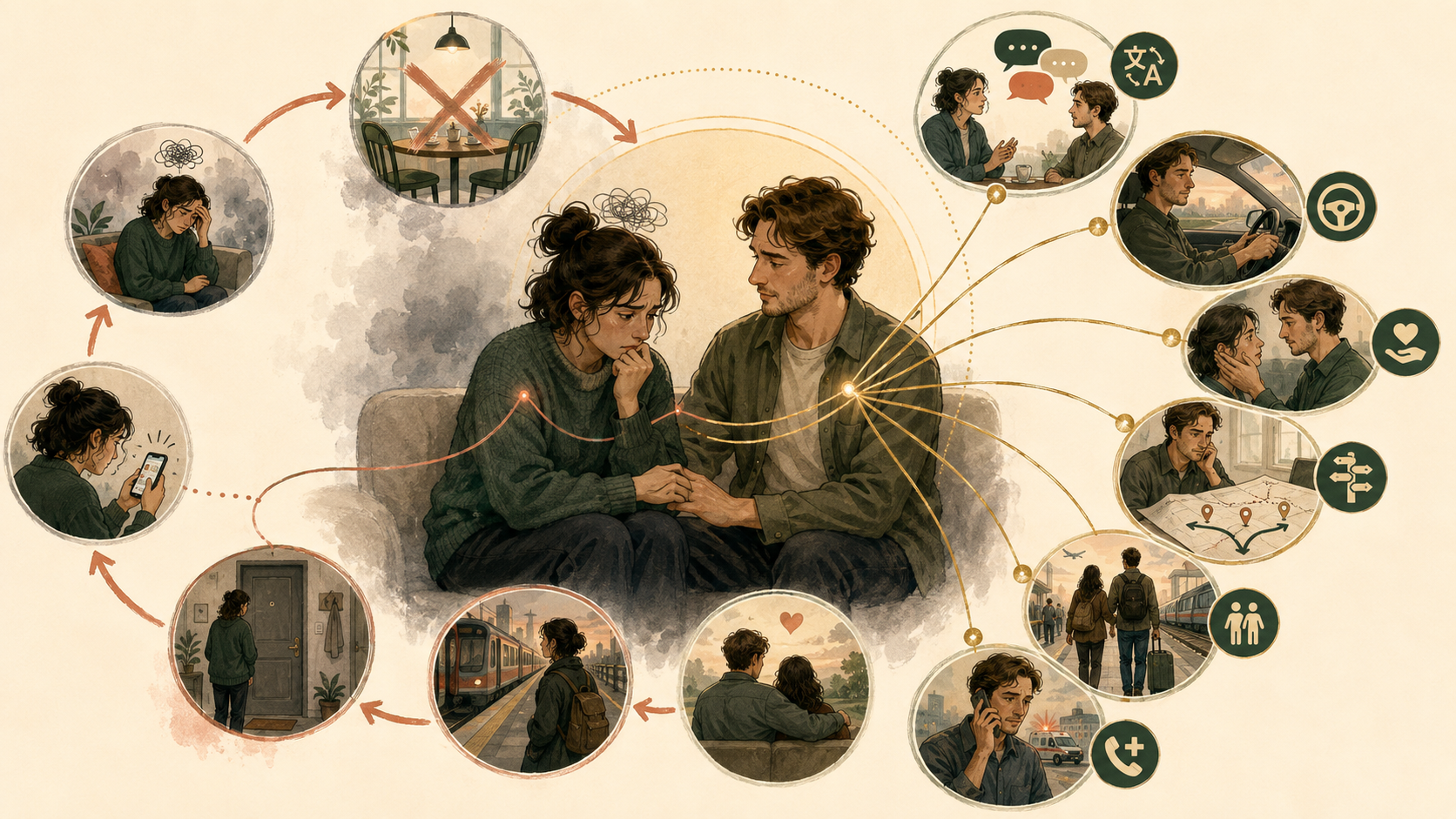
Partner accommodation means changing your own behaviour to reduce your partner's anxiety in the short term. It looks like love, and it usually comes from love. The problem is that it teaches both people that the anxious person could not have coped without the rescue, which makes the next situation harder rather than easier.
In everyday life it looks like this:
- Speaking on your partner's behalf at the doctor, the bank or the town hall.
- Accompanying them to appointments they could attend alone.
- Checking routes, weather, symptoms or schedules repeatedly to calm them.
- Cancelling plans whenever anxiety rises.
- Promising that nothing bad will happen, over and over.
- Taking over the difficult calls, the paperwork, the driving.
Here is the loop:
Anxiety appears
        ↓
The anxious person seeks reassurance or avoids
        ↓
The partner rescues, checks, cancels or takes over
        ↓
Anxiety falls temporarily
        ↓
Both people learn that rescue was necessary
        ↓
Dependence and resentment grow
The research on this is clear and recent. In a 2024 study of 112 adults with generalised anxiety disorder published in Behavioural and Cognitive Psychotherapy, every single participant reported that their partner accommodated their anxiety in some way, and the most common form was providing reassurance. The researchers also found that when partner accommodation did not decrease during treatment, therapy outcomes were worse.
Translated into ordinary language: reassurance is the most common thing loving partners give, and it is also the thing most likely to keep the anxiety exactly where it is.
Important: Accommodation is not a sign that your partner is weak or that you are controlling. It is the most natural response in the world to someone you love being frightened.
What This Pattern Does to Both Partners
Partner accommodation damages both people in different directions. The anxious partner loses confidence and gains shame. The supporting partner loses freedom and gains resentment. Neither chose this, and neither can fix it alone, which is why the pattern persists long after both have privately noticed it.
For the anxious partner, it often feels like: I have become a burden. There is shame in needing someone to make a phone call for you in a country where you are supposed to be a competent adult. There is guilt every time a plan is cancelled, and a growing fear that if this person travelled or simply got tired, you would not manage. When the anxiety also arrives physically, through chest tightness, dizziness or nausea, the dependence deepens further, which we cover in our article on the physical symptoms of anxiety abroad.
For the supporting partner, it often feels like: I am not allowed to be tired. They cancel things quietly. They stop mentioning invitations. They feel trapped, then guilty for feeling trapped, then resentful about the guilt. Setting any boundary feels like abandoning someone who is genuinely suffering, so most do not set one until they are already exhausted.
Both descriptions are true at the same time. Nobody in this pattern is the villain.
How Children May Be Affected
Children notice far more than parents assume. They register cancelled plans, the tension before a trip, the parent who never goes anywhere alone, and the other parent who handles everything. What matters most is not that they notice, but what role they are given as a result.
Children should not become the translator, the rescuer, the messenger or the emotional support person. A child who orders in the local language for a nervous parent, or reassures a parent before a flight, has quietly taken on an adult job.
There is a hopeful finding here. In a randomised trial of 124 children published in the Journal of the American Academy of Child and Adolescent Psychiatry, a treatment working only with parents, by reducing family accommodation, was as effective as individual therapy with the child. Related pressures on family life are covered in our article on parental work stress abroad and children.
Support Versus Accommodation
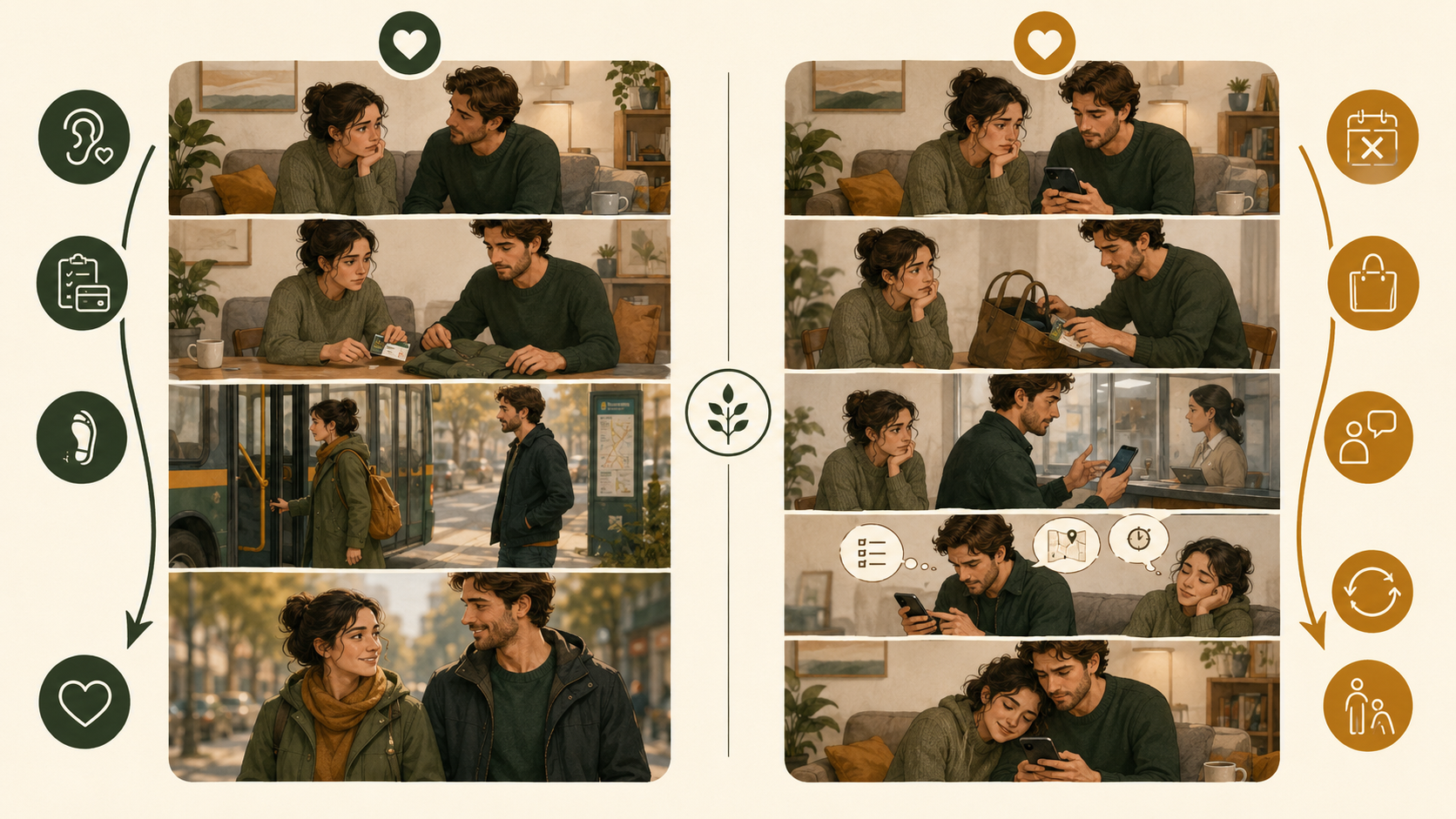
Support and accommodation feel almost identical in the moment. The difference is direction: support leaves your partner more capable afterwards, accommodation leaves them more dependent. The test is simple. Ask whether what you are about to do makes the next occasion easier or harder.
| Support that builds confidence | Accommodation that keeps anxiety in control |
|---|---|
| Listening to the worry once, with warmth | Repeatedly proving that nothing bad will happen |
| Helping them prepare for the appointment | Taking over the appointment |
| Going along this time, less next time | Accompanying them permanently |
| Keeping important plans, adjusting the details | Cancelling whenever anxiety appears |
| Encouraging and supporting therapy | Becoming the only source of safety |
What Helps
Most couples do not need a dramatic intervention. They need to name the pattern honestly, stop treating every moment as an emergency, and change the response gradually rather than overnight. Sudden withdrawal of reassurance backfires and feels like punishment to the anxious partner.
- Name the pattern, not the person. "We have both got into a habit of cancelling" works. "You always ruin our plans" does not.
- Talk when anxiety is low. Never negotiate a boundary during a surge or the hour before a trip.
- Reduce reassurance gradually. Answer once, warmly, then say you love them too much to keep proving something anxiety will never accept as proof.
- Protect both people's independence. One evening out each, one task each, kept deliberately.
- Keep children out of the rescuer role. They can know a parent is anxious. They should not be the treatment.
- Act early. Avoidance and resentment are easier to interrupt in month three than in year three.
If the disagreement has moved on to whether to stay in the country at all, our article on when one partner wants to move back home addresses that directly.
When Therapy Becomes the Healthier Next Step

Therapy becomes the sensible next step when the reassurance stops working and the household has organised itself around preventing anxiety rather than living. Anxiety is one of the most treatable mental health conditions there is, but it rarely resolves through reassurance alone, and couples usually cannot dismantle the pattern while they are still inside it.
Consider professional support when:
- Reassurance never lasts more than a few minutes.
- Plans are cancelled repeatedly.
- One partner genuinely cannot be alone.
- The other partner feels responsible for preventing panic.
- Resentment is quietly replacing closeness.
- The children are adapting their behaviour around a parent's anxiety.
- Major family decisions are being made mainly for immediate relief.
Individual therapy usually fits when anxiety, avoidance, panic or physical symptoms are the main problem. If sudden surges are the central experience, our guide to panic attacks abroad covers that pattern, and anxiety therapy for expats works directly on the avoidance and reassurance cycle.
Couples therapy usually fits when both partners are caught in the loop, when conversations about it end in the same argument, or when the accommodation has become the shape of the relationship.
Therapy is not a guarantee, and it does not replace medical care or solve genuine visa, financial, employment or safety problems. What it changes is the pattern that has grown up around them.
According to the World Health Organization, 359 million people were living with an anxiety disorder in 2021, yet only around 1 in 4 people who need treatment receive it. Most people in this situation are not treatment-resistant. They simply never started.
Important: Book a free 20 minute session with a psychologist who speaks your native language. No commitment and no diagnosis, just an honest conversation about what has been happening at home.
How Expathy Can Help
Expathy matches expats with licensed psychologists who speak their native language, usually within about 30 seconds. Many of our psychologists are expats themselves, so they understand both your cultural background and the pressure life abroad puts on couples and families. You can start with online therapy for expats from home, without navigating an unfamiliar referral system first.
Sources
- World Health Organization, Mental disorders fact sheet: 359 million people living with an anxiety disorder in 2021
- World Health Organization, Anxiety disorders fact sheet: treatment coverage of approximately 27.6 percent
- Partner symptom accommodation in generalized anxiety disorder, Behavioural and Cognitive Psychotherapy, 2024
- Lebowitz et al., Parent-Based Treatment as Efficacious as Cognitive-Behavioral Therapy for Childhood Anxiety, JAACAP, 2020
Frequently Asked Questions
Can anxiety abroad affect a relationship?
Yes, and usually faster than at home. Without nearby family, familiar systems or a shared language, one partner often becomes the other's main source of safety. Plans get cancelled, decisions get made to reduce fear rather than to build a life, and closeness gradually turns into caretaking on one side and dependence on the other.
Why do I need constant reassurance from my partner?
Because reassurance works, briefly. It calms the nervous system for a few minutes, so the brain learns to ask again. Anxiety cannot be satisfied by proof, which is why the same question returns in a new form. The need is real. The strategy is simply one that keeps the anxiety alive rather than resolving it.
Can a partner accidentally make anxiety worse?
Yes, with the best intentions. Speaking for you, cancelling plans, checking things repeatedly or taking over difficult tasks all lower anxiety immediately and raise it later, because they signal that you could not have coped alone. Research on partner accommodation consistently links these caring behaviours to more severe symptoms over time.
How can I support an anxious partner without taking over?
Listen once, warmly, then stop proving. Help them prepare instead of doing it for them. Keep the important plans while adjusting the details. Reduce accompaniment step by step rather than all at once. Say plainly that you believe they can manage this, and that you are not withdrawing your love, only the rescue.
How can parental anxiety affect children?
Children notice cancelled plans, tension before trips and one parent carrying everything. The risk is not that they see anxiety, but that they start managing it: translating, reassuring, or staying home to keep a parent company. Research shows that when adults change how they respond to anxiety, children's outcomes improve significantly.
When is individual therapy the better first step?
When the anxiety itself is the main problem: avoidance, panic, physical symptoms, constant worry or an inability to be alone. Individual therapy targets the cycle directly and gives the anxious partner tools that do not depend on someone else being present. This is usually the fastest route when one person is clearly carrying the symptoms.
When should an expat couple consider couples therapy?
When both partners are stuck in the loop rather than one. Signs include repeating the same argument, resentment replacing closeness, boundaries that never survive contact with anxiety, and a relationship organised around preventing distress. Couples therapy works on the pattern between you, which neither person can usually change alone.
Need support? We're here.
Book a free 15-min consultation with our expat-specialized therapists.