
Key takeaway
Yes, for many people it can. Therapy will not undo the fact that your family is in another country, your job is difficult, or your social life here has not materialised. What it can change are the patterns depression builds around those realities: the withdrawal, the loss of motivation, the hopelessness, the sense that nothing is worth starting. Therapy is not magic, and it is not always the only treatment needed. It is, however, an established treatment for depression.
That is the answer. The rest of this page is about what that actually means for you.
If you are still working out whether what you have is depression, our guide to depression abroad covers that. This article assumes you have got that far and are deciding whether therapy is worth the effort.
What Therapy Can Actually Change
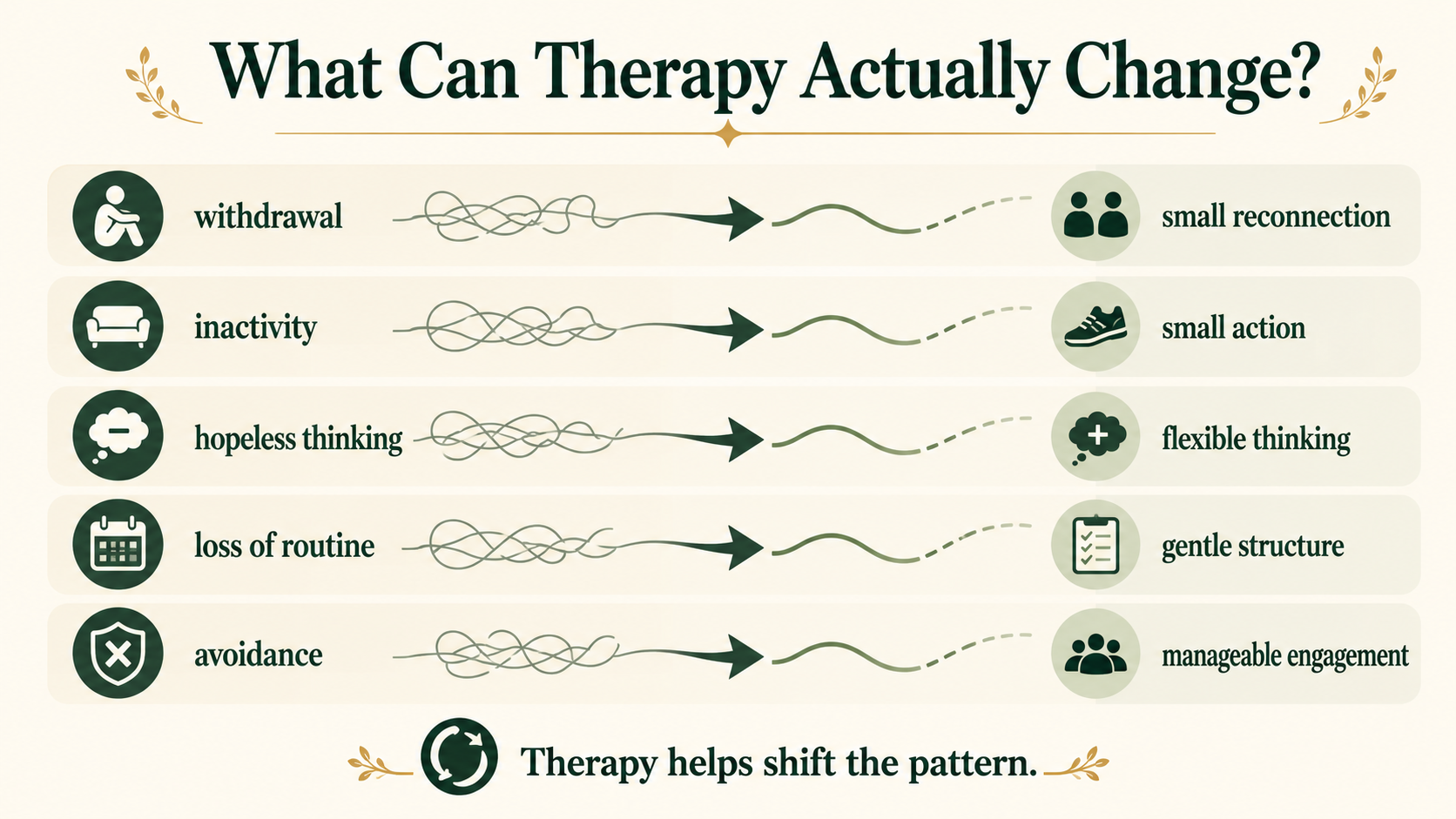
Not your circumstances. What therapy works on is the layer depression adds on top of your circumstances: the shrinking activity, the withdrawal, the thinking that makes everything look permanent. Those patterns are what turn a difficult period into something that keeps deepening on its own.
In practice, that looks like this.
"I know what I should do, but I cannot make myself do it." Depression reduces motivation, and reduced activity then reduces motivation further. Structured therapy works on that loop directly, helping you make small planned changes in behaviour rather than waiting to feel like it first. Waiting for motivation to return before acting is usually waiting for the wrong thing.
"Nothing feels enjoyable anymore." Loss of pleasure is not a minor symptom. A 2024 review combining 20 studies linked it with poorer social and everyday functioning, which is why good therapy for depression focuses on rebuilding engagement rather than only talking about sadness. If this is the dominant experience for you, our article on anhedonia abroad goes deeper.
"I keep withdrawing from everyone." Low mood leads to withdrawal, withdrawal removes the contact and small rewards that would lift mood, and the cycle tightens. Therapy helps you notice that loop while you are inside it, which is remarkably hard to do alone.
"My thoughts make everything feel hopeless." Some approaches work specifically on identifying depressive thinking patterns, testing the assumptions behind them, and building more accurate ways of reading situations. Not positive thinking. Accuracy.
What About the Parts That Are Genuinely Difficult?
This deserves a direct answer, because plenty of people abroad avoid therapy for exactly this reason. Good therapy does not exist to persuade you that real problems are imaginary. If you are isolated, being treated badly at work, or facing discrimination, no competent therapist should be helping you accept that.
What it can help with is separating the strands.
What is genuinely wrong with your situation and might be changeable. What needs a boundary. What needs support. And what is depression colouring everything, including things that were fine last year.
Therapy should help you respond better to reality, not deny it. If a therapist is helping you tolerate something that should change, that is bad therapy, not a limitation of therapy.
It also does not need to talk you into staying abroad. If you are weighing that decision, the point is to make it with a clear head rather than during the worst stretch, which we cover in whether to move home when you are depressed abroad.
Does the Research Actually Support It?
Yes, and this is one of the better-evidenced areas in mental health. Psychotherapy is recognised as an effective treatment for depression across major clinical guidelines and large bodies of research, which is a different thing from a vague claim that talking helps.
NICE guidance treats several structured psychological therapies as appropriate options depending on severity and preference. A 2024 network meta-analysis comparing treatments for a new depressive episode similarly supports multiple effective psychological and pharmacological options.
Two honest qualifications. Not everyone improves with the first therapist or the first approach. And more severe depression is often better treated with a combination of approaches rather than therapy alone.
What the evidence does rule out is the idea that you simply need more willpower or more time.
Depression is not a character problem that you should be able to solve alone. It is a treatable condition with established treatments, and choosing one of them is not an admission of weakness.
What Changes When It Happens Abroad
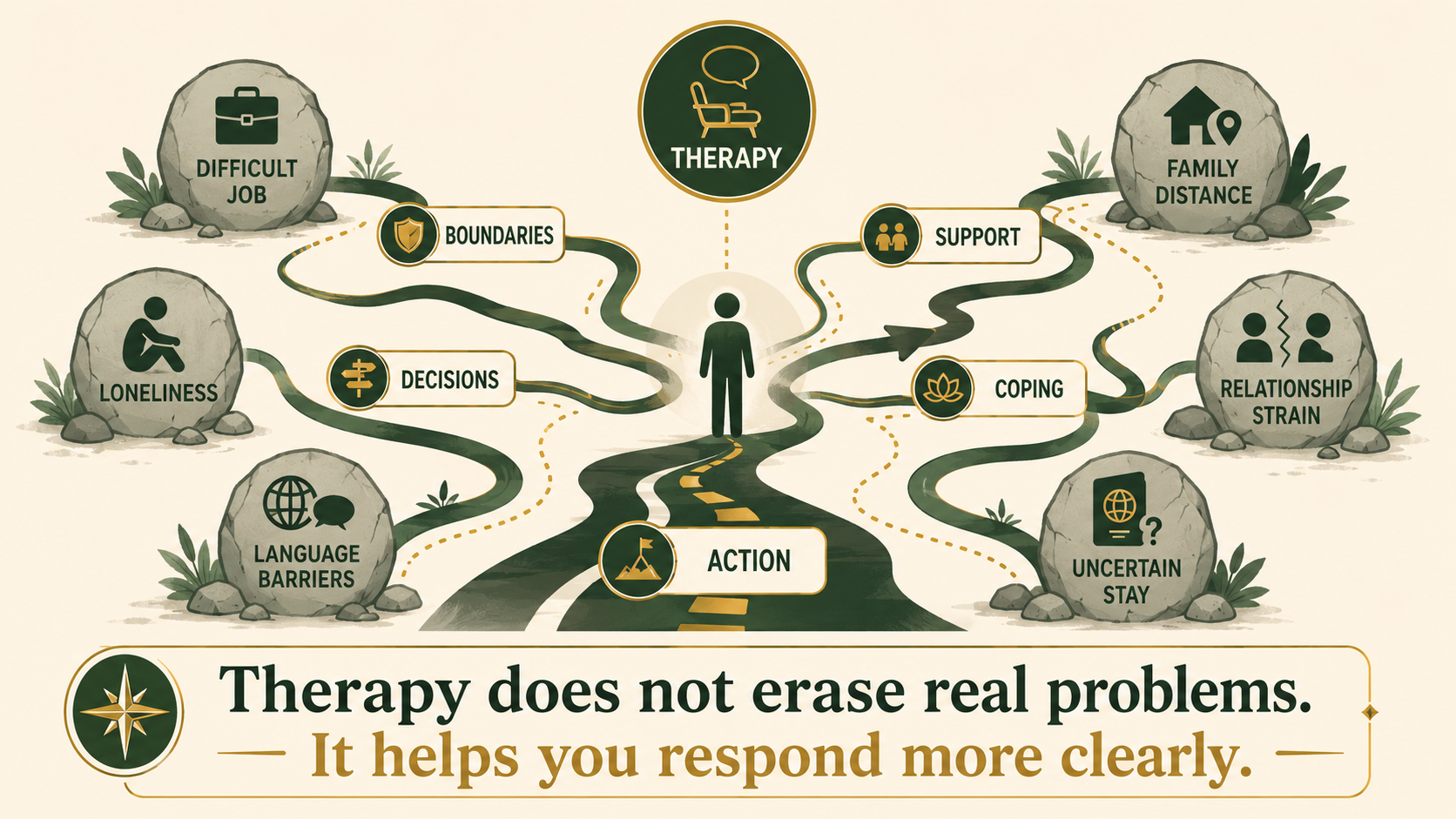
Not the treatment. There is no separate condition called expat depression, and you do not need a different type of therapy because you live in another country. What is different is the context that the therapy has to work with.
You may be recovering while also managing a language you think slowly in, a family five time zones away, a social circle you have not built yet, an identity that changed when you moved, and an unresolved question about whether you are staying.
The treatment is for depression. The context around it is international. That distinction matters, because it means you are not an unusual case requiring something exotic. You are a standard case in a complicated setting.
Does Your Therapist Need to Understand Life Abroad?
Not strictly, and it does change the experience considerably. A therapist who already understands international life simply needs less explaining to, which matters a great deal when you have limited energy and a fifty-minute hour to work with. The difference is time spent on you rather than on background.
Consider what you would otherwise spend sessions establishing. Why a voluntary move can still hurt. Why going home is not simple. Why belonging to two places is disorienting. Why losing professional status in a relocation is a real loss. Why you are exhausted by six every evening.
None of that needs explaining to someone who has lived it. The benefit is contextual understanding rather than guaranteed clinical superiority, and we would not claim otherwise.
Does It Have to Be in Your Native Language?
No. The evidence does not support the claim that therapy must happen in your first language to work. Some people reach emotion more directly in their native language and find it more precise and less tiring. Others prefer a second language, sometimes because the small distance it creates makes difficult material easier to approach.
The useful test is simple.
The best language for therapy is the one in which you can be honest and specific about what is actually happening to you.
For some people that is their first language. For others it is not. It can even differ by topic.
Two Reasons People Talk Themselves Out of It
These two objections stop more people from starting therapy than cost or logistics ever do, and both deserve a direct answer rather than encouragement. Neither of them is unreasonable. Both are also usually based on a misunderstanding of what therapy requires from you at the beginning.
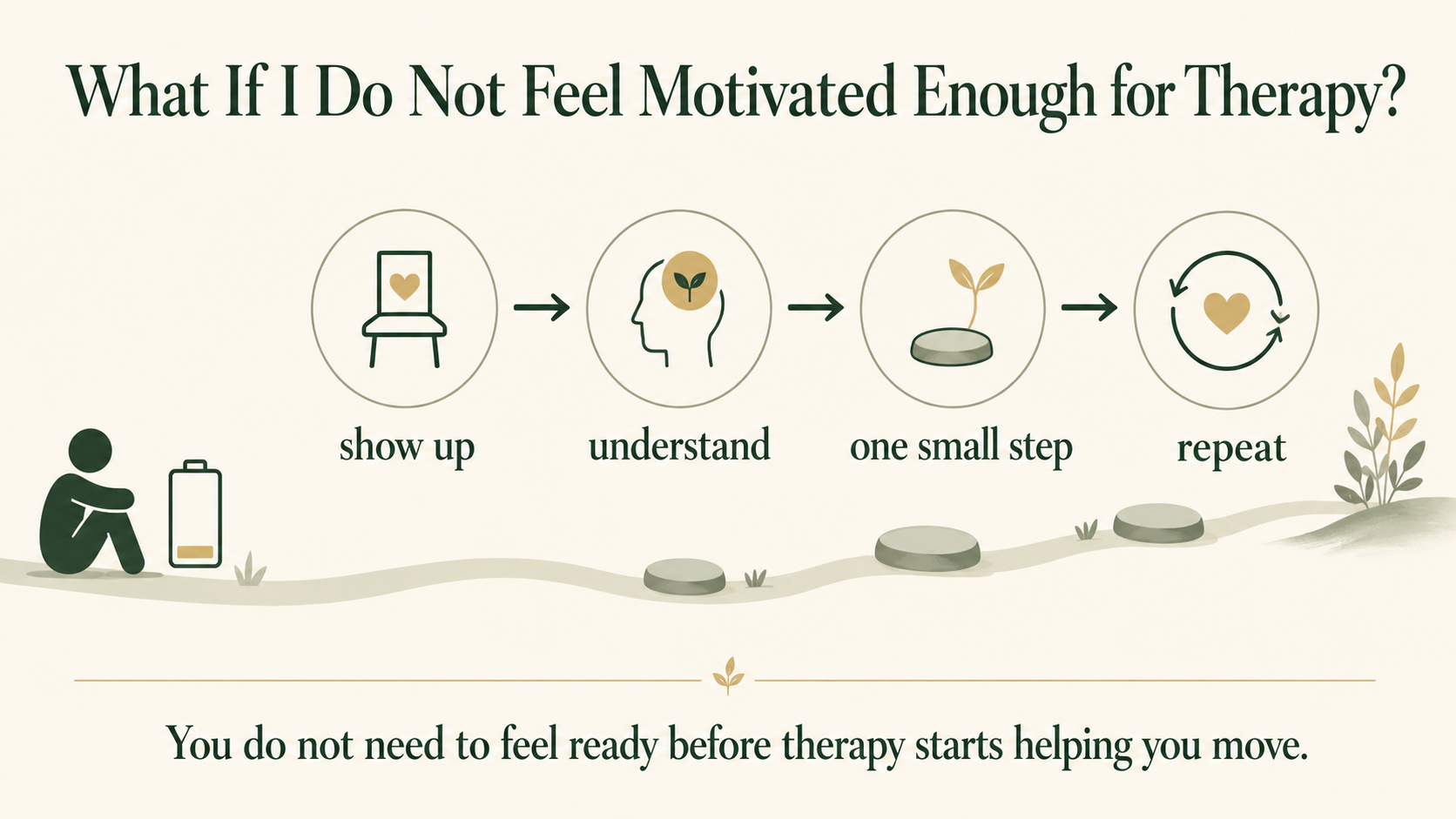
"I do not have the energy for therapy right now." You do not need to arrive motivated, clear about the problem, or ready to change anything. I do not know what to do anymore is a completely adequate starting point. Part of a therapist's job is providing structure precisely when your own motivation and clarity are reduced. Waiting until you feel capable of working on yourself is waiting for the symptom to resolve before treating it.
"I tried therapy before and it did not help." That is information, not a verdict. Fit with the therapist matters enormously. So does timing, the approach used, whether goals were ever made explicit, whether it ended too early, and whether external conditions changed at all. A disappointing experience tells you something did not work. It does not establish that nothing will.
And you do not have to be visibly falling apart to qualify. If you are still working, still functioning and still struggling privately, that is a normal presentation, not a reason to wait, as we discuss in high-functioning depression abroad.
When Therapy Alone May Not Be Enough
Being straight about this matters more than selling. Some people need medical assessment alongside therapy, and for more severe depression that is the standard of care rather than a failure. Therapy can be part of a treatment plan without needing to be all of it.
Worth involving a doctor if symptoms are severe, if things are getting steadily worse, if you cannot function day to day, if there are physical health factors or other conditions involved, or if you want to discuss medication.
And if you are having thoughts of harming yourself, that is not something to work through on a waiting list. Contact your local emergency number, your country's crisis line, or a doctor urgently.
What the First Sessions Are Actually Like
More modest than people expect, and that is not a bad sign. Early sessions tend to be about understanding what has changed, identifying the patterns involved, agreeing what to work on, and starting something small. Nobody should be promising that you will feel noticeably better after a single appointment.
The first useful sign is usually not happiness.
It is that the problem starts to feel understandable and approachable rather than shapeless and permanent. That shift is small, and it is often the thing that makes everything after it possible.
Where to Start
If your question has moved from could therapy help to how do I find someone who understands both depression and living abroad, that is the point at which we can be useful.
Expathy connects people abroad with psychologists who work with international clients, have lived abroad themselves, and can be matched by native language and cultural background. Not because that guarantees a better outcome, but because it removes the part of the process that stops most people: the searching and the explaining.
Explore depression therapy for expats
If the harder question right now is how to reach any treatment at all in your country, our guide to depression treatment access across Europe covers the public and private routes in the UK, Germany, France, the Netherlands and Spain.
Sources and Further Reading
- NICE guideline NG222, Depression in adults: treatment and management: https://www.nice.org.uk/guidance/ng222
- Mavranezouli and colleagues (2024), network meta-analysis of psychological and pharmacological treatments for a new episode of depression: https://doi.org/10.1016/j.eclinm.2024.102780
- Wong and colleagues (2024), review combining 20 studies on loss of pleasure in depression and its links with social and everyday functioning: https://doi.org/10.1016/j.jad.2024.04.086
Frequently Asked Questions
Does therapy really help depression?
For many people, yes. Psychotherapy is recognised as an effective treatment for depression across major clinical guidelines and large bodies of research. That does not mean everyone improves with the first therapist or approach, and more severe depression is often treated with a combination of approaches rather than therapy alone.
Can therapy help if my depression is partly caused by living abroad?
Yes, and it should not involve pretending your circumstances are fine. Therapy can help separate what is genuinely difficult about your situation from what depression is adding on top of it, which usually makes both easier to act on. Good therapy helps you respond to reality rather than deny it.
Can therapy help emotional numbness and loss of motivation?
These are core features of depression rather than side issues, and structured approaches target them directly. Rather than waiting for motivation to return, therapy works on rebuilding activity and engagement in planned steps. Research links loss of pleasure with wider difficulties in everyday functioning, which is why it is treated as central.
Do I need therapy in my native language?
Not necessarily. Evidence does not support the claim that therapy must be in your first language to work. Some people access emotion more easily in their native language, while others find useful distance in a second one, and preferences can vary by topic. Choose the language in which you can be honest and specific.
What if I am still functioning normally at work?
Preserved work performance is common in depression and is not a reason to wait. Work provides external structure that holds behaviour up while motivation, pleasure and social life decline first. You do not need to be unable to function before therapy is appropriate.
What if therapy did not help me before?
Treat it as information rather than a conclusion. Therapist fit, timing, the approach used, unclear goals, ending too early or unchanged external conditions can all explain a disappointing experience. It tells you something did not work for you then. It does not establish that nothing will.
When is therapy alone not enough?
When depression is severe, steadily worsening, or affecting your ability to function day to day, medical assessment alongside therapy is standard rather than a failure. The same applies if there are physical health factors, other conditions involved, or questions about medication. If you are having thoughts of harming yourself, seek urgent help today.
Need support? We're here.
Book a free 15-min consultation with our expat-specialized therapists.