
Key takeaway
Someone suggests therapy after your third silent weekend in a row, and your first thought is entirely reasonable: unless this therapist is planning to become my friend, how exactly does that help? It is the right question. Therapy cannot hand you a social circle, and any article claiming otherwise is selling something. What it can do is work on everything sitting between wanting connection and being able to build it. This article is about which of those two problems you actually have.
Let us start by conceding your point, because it is a good one.
If your week contains almost no human contact, an hour of conversation with a professional will not fix that. You need people, plans, repetition and a life. No amount of insight substitutes for someone to have dinner with.
Anyone who tells you differently is either careless or trying to sell you sessions.
But hold the objection for a moment, because there is a second question underneath it that most people skip. Is the reason you have no close people that the opportunities do not exist, or that something is happening when you try? Those look identical from inside and need completely different responses.
So Can Therapy Actually Help Loneliness?
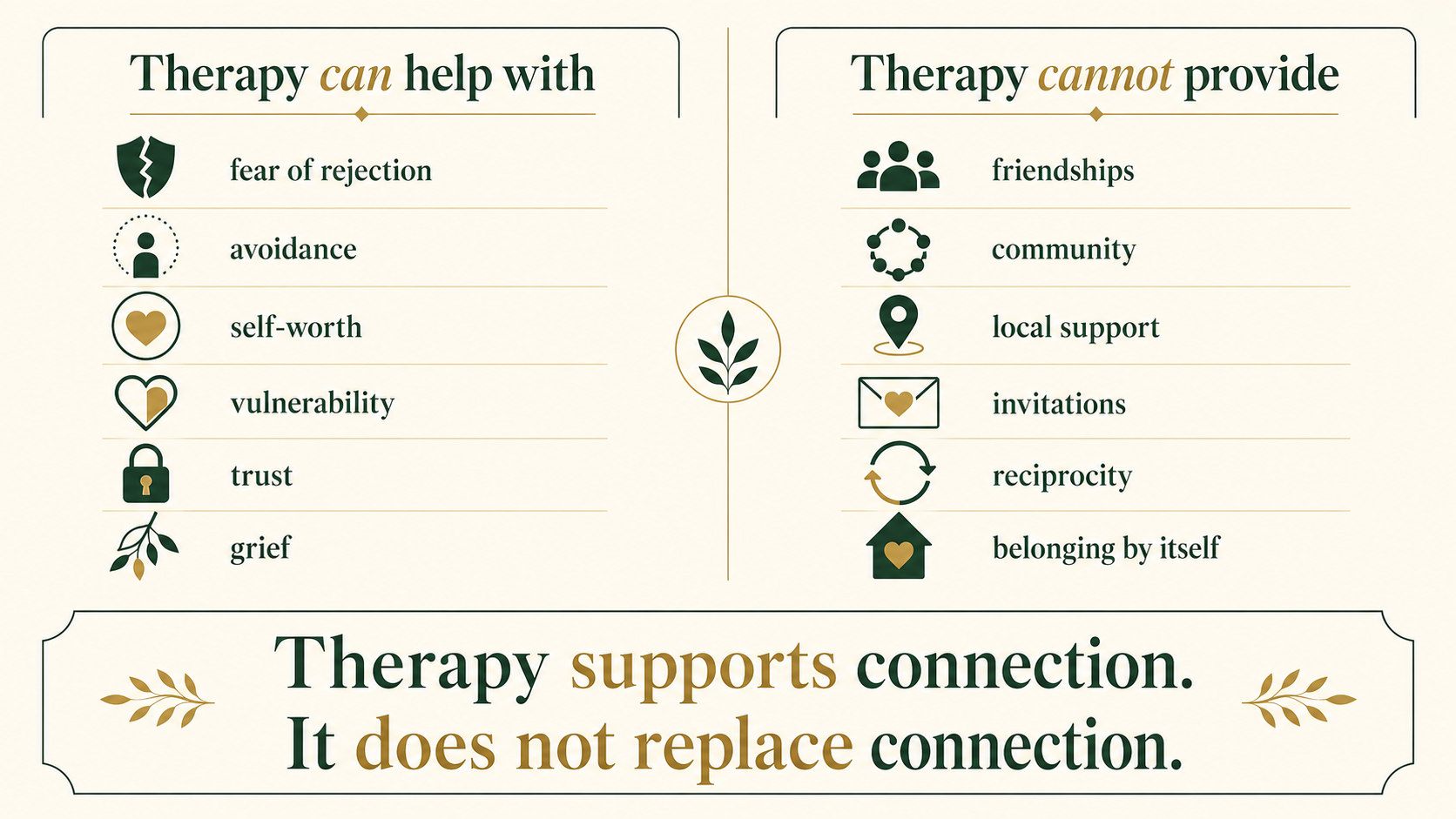
Yes, but not in the way most people assume. Therapy does not produce relationships. It works on the psychological barriers between you and connection: fear of rejection, avoidance, self-worth, difficulty trusting, and the patterns that repeat across friendships. If those barriers are not what is stopping you, therapy is not your first move.
The research is reasonably encouraging on this, with honest limits.
A systematic review and meta-analysis by Hickin and colleagues pooled 28 randomised trials covering 3,039 people and found that psychological interventions significantly reduced loneliness compared with control groups, at a small to medium level of improvement.
More recently, an American Psychological Association meta-analytic review of 280 studies found that among all the approaches tried, psychological interventions were the most effective strategy for reducing loneliness, at a moderate level.
That is a real finding, and it is not a promise. These studies were conducted across general populations rather than on expats specifically, effects vary considerably between people, and "reduced loneliness" is not the same as "no longer lonely."
Therapy has decent evidence behind it for loneliness. It also has a specific job, and that job is not finding you people.
First, Work Out Which Problem You Actually Have
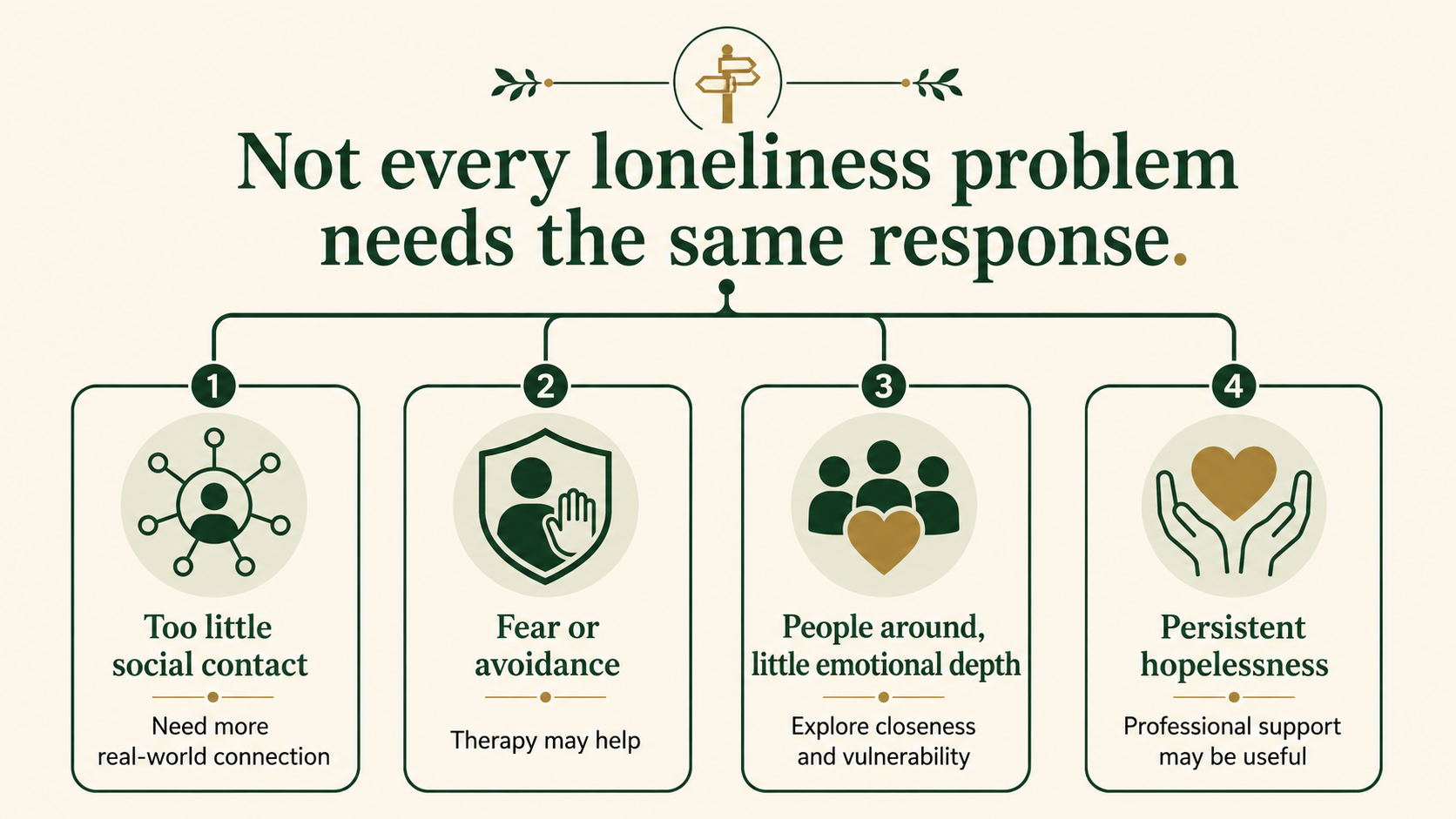
This is the step almost everyone skips, and it determines whether therapy is worth your money. Loneliness abroad comes in at least five shapes, and only some of them respond primarily to psychological work. Read these honestly rather than charitably.
| Your situation | What is mostly missing | Where to start |
|---|---|---|
| Recently arrived, know almost nobody | Opportunity and time | Structure and contact, not therapy |
| People are around, but reaching out feels hard | Confidence, safety in approaching | Therapy is directly relevant |
| Plenty of acquaintances, nobody close | Depth, trust, vulnerability | Therapy is often useful |
| You have stopped believing it will work | Hope, and the pattern behind it | Therapy is likely needed |
| Loneliness sits inside a bigger adjustment struggle | Several things at once | Therapy helps hold it together |
If you are in row one, you do not have a psychological problem. You have a calendar problem, and the honest answer is that you need recurring contact and time before anything else. The structural side of that is covered in social isolation abroad, and the practical mechanics of meeting people are in making friends abroad.
Rows two through five are where a therapist earns their fee.
What Therapy Cannot Do
Being clear about this is the only way the rest of the article is credible. Therapy cannot manufacture friendships, make anyone reciprocate, guarantee belonging, stop your expat friends from relocating, or convert an unwelcoming environment into a warm one. It also cannot supply the practical support network you lost when you moved.
A few more honest limits.
It cannot give you back the friends who knew you at twenty-two. It cannot make small talk in your second language feel effortless. It will not make every social interaction succeed, because some of them genuinely will not.
And it should never be aimed at helping you accept having no relationships.
A good psychological response to isolation is not learning to tolerate an empty life. It is becoming better able to build and use real connection, while changing the conditions keeping you isolated.
If a therapist's plan seems to be helping you feel calm about having nobody, that is the wrong plan.
What Therapy Can Actually Change
Here is the useful framing. Therapy does not work on the relationship you do not have. It works on the space between wanting connection and being able to build, trust or keep it. For a lot of people abroad, that space is where the actual obstacle sits, and they have never looked at it directly.
Specifically:
Working out what is genuinely missing. People arrive saying I need more friends. What they often need is one dependable person, or to be known, or spontaneous plans, or practical support, or belonging to a group. Those require completely different actions. Getting precise about the need changes what you go and build.
Rejection sensitivity. After enough disappointing evenings, a delayed reply starts reading as evidence. A declined invitation becomes proof. Therapy examines those interpretations without pretending rejection never happens, because sometimes it does.
Avoidance. Loneliness produces a strange contradiction: you want people more, and the effort of seeing them feels heavier. You decline things you actually wanted. You tell yourself you prefer being alone, and half believe it. Therapy looks at what the avoidance is protecting you from.
Fear of vulnerability. Some people abroad are excellent at coffee, introductions and networking, and never let anything deepen. Often for understandable reasons: you have already lost friendships to relocation, and staying at arm's length hurts less than doing that again.
Self-worth. This is the shift that matters most. The question quietly changes from why have I not found my people to what is wrong with me. Therapy helps separate your social circumstances from your identity, which is especially important when an entire social role disappeared the day you moved.
Repeating patterns. Always doing the initiating. Always choosing people who are leaving. Withdrawing at the first disappointment. Going surface-level and staying there. Not everyone has these. But if the same dynamic has followed you across two countries and three social circles, the common factor is worth examining.
Grief. Loneliness abroad is frequently grief wearing a different name: for old friendships, family proximity, cultural ease, the social identity you had. Nobody died, so nobody calls it grief, and it goes unprocessed for years.
Why the Evidence Points Here Specifically
This is not a general claim that talking helps. The first major meta-analysis in this field found that interventions targeting maladaptive social cognition, meaning the biased ways lonely people come to read social situations, produced the largest effects in randomised trials. That is precisely the material listed above.
The Masi and colleagues meta-analysis compared four strategies: improving social skills, enhancing social support, increasing opportunities for contact, and addressing maladaptive social cognition. The last one performed best in the strongest study designs.
The authors were careful, and so should we be: that finding rested on a small number of trials and they explicitly called for replication. But later reviews have pointed in a similar direction, and it makes intuitive sense.
Increasing someone's opportunities does very little if they have started expecting every opportunity to disappoint them.
That is the honest case for therapy in loneliness. Not that it replaces contact, but that it addresses the layer that determines whether contact turns into connection.
What It Actually Looks Like
People imagine sitting in a room saying I am lonely on a loop for six months. In practice, therapy for loneliness is mostly a series of specific and slightly uncomfortable questions, followed by small experiments you run in your actual life between sessions.
The questions tend to be things like:
What kind of relationship do you actually miss? When did loneliness start changing how you behave? What do you expect will happen when you reach out? What happens when somebody gets close? Are you safer with people from home than with people here? Are you grieving a version of yourself that only existed in your old country? Are you waiting until you feel confident before you connect? Is one person being asked to meet every social need? Is loneliness quietly making your decision about staying abroad?
Approaches vary. Some therapists work cognitively, examining the predictions you make about other people. Some work relationally, looking at patterns of closeness. Some use acceptance or compassion-focused methods, particularly where shame is involved. No single school has been shown to be best for everyone, so the fit with the therapist matters more than the label.
Therapy Plus Community, Not Therapy Instead of It
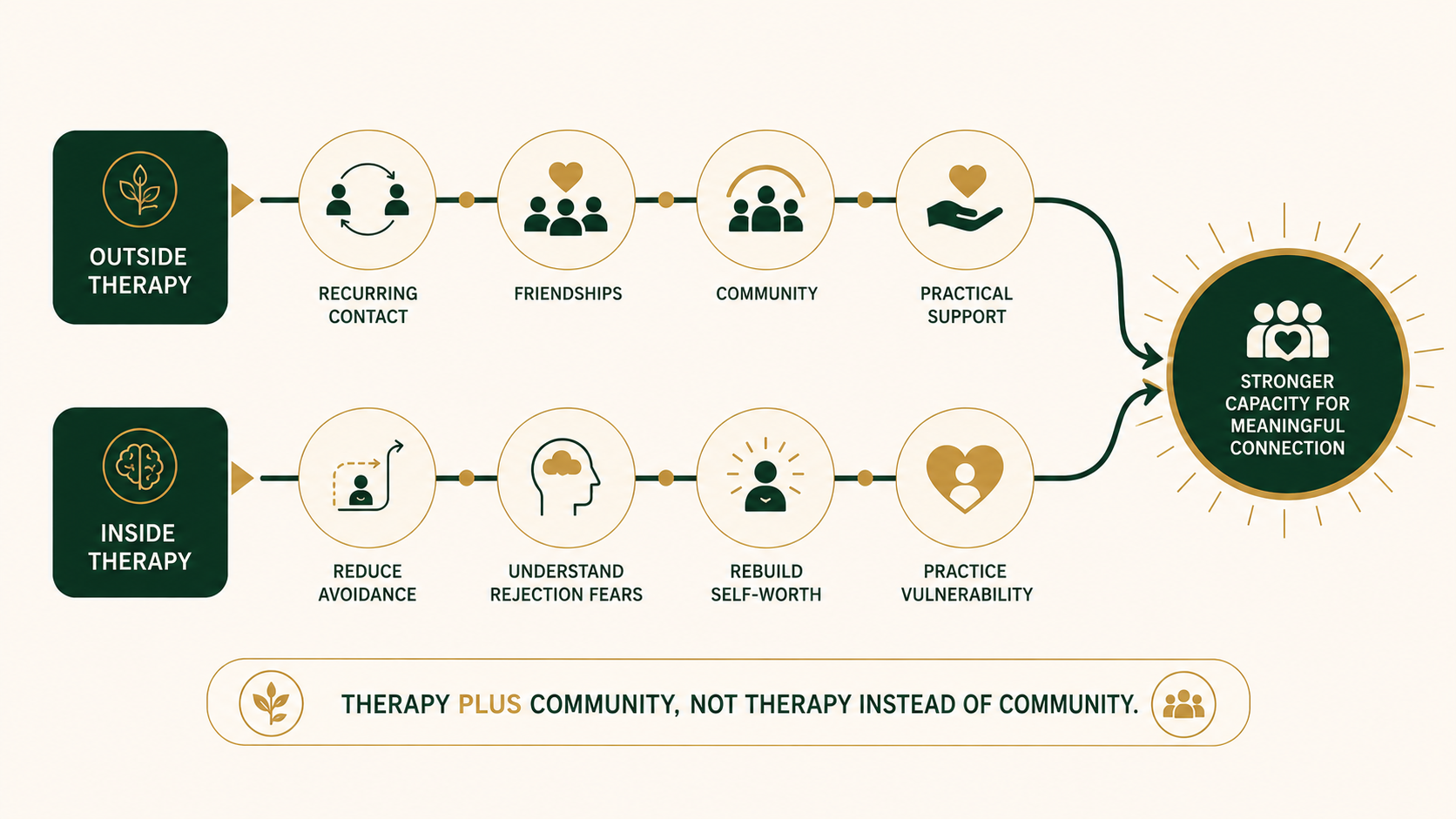
For most people abroad the strongest approach runs on two tracks at once. Track one is building real contact in the world. Track two is working on whatever makes track one hard. Doing only one is why so many attempts stall.
Run only track one, and you spend a year attending events while quietly convinced nobody wants you there.
Run only track two, and you gain excellent self-understanding and still have nothing in your diary on Saturday.
The question is not therapy or community. For most people the answer is both, and the therapy is what makes the community-building actually work.
When Therapy Is Probably Not Your First Move
Some situations do not call for a psychologist. If you arrived four months ago, know almost nobody yet, and are still actively trying things, what you likely need is time and recurrence rather than treatment. Loneliness at that stage is a reasonable response to circumstances, not a symptom.
Similarly, if your environment genuinely offers very few opportunities for repeated contact, changing the environment matters more than examining your feelings about it.
If your closest friend just relocated and you feel terrible, that is grief. It may pass on its own.
And a lonely week is a lonely week. Not every painful feeling requires a professional, and treating ordinary sadness as pathology is its own kind of harm.
Therapy becomes relevant when loneliness stops being only something happening around you and starts being something changing inside you.
When It Is Worth Considering
There is no month count that makes therapy appropriate, and anyone offering one is guessing. The signal is a shift in kind rather than duration: loneliness that has begun affecting what you believe, how you behave and how you function.
Worth taking seriously if several of these fit:
- Reaching out feels pointless before you have even tried
- You have withdrawn from opportunities you actually wanted
- Your self-worth has dropped alongside your social life
- Anxiety around people has grown noticeably
- Sleep, motivation or daily functioning have slipped
- One person has become your entire support system
- It keeps repeating despite genuine chances to connect
- Trust or vulnerability feels harder than it used to
- You are questioning whether life abroad is sustainable
If the pattern has become established and self-reinforcing, that specific dynamic is covered in chronic loneliness abroad.
Individual or Couples Therapy?
Both exist and they address different things. Individual therapy fits when loneliness has affected your self-worth, when avoidance or fear is central, or when you are grieving the life you left. Couples therapy fits when the loneliness is happening inside a relationship.
That second case is more common abroad than people expect. If your partner has become your only social world, if one of you integrated far faster than the other, or if you keep having the same argument about independence and social plans, the issue is relational rather than individual. We cover that situation in loneliness in expat relationships.
Some people do both, at different times.
Why Expat-Specific Support Can Matter
There is a practical argument here that has nothing to do with clinical superiority. A therapist unfamiliar with international life will spend sessions learning your context, and you will spend those sessions teaching it. That is expensive in a fifty minute hour.
Consider what you would otherwise have to explain from scratch.
Why leaving was voluntary and still painful. Why your friends keep relocating and you have stopped investing. Why you function well professionally and feel socially lost. Why closeness works differently in your second language. Why just go home is not the obvious solution, and why home may not fully feel like home any more. Why you can miss people intensely without wanting to move back.
None of that is complicated to someone who has lived it.
Expathy matches expats with psychologists by native language and cultural background, and our psychologists have lived abroad themselves. You get the hour for the problem instead of the briefing.
To be careful about the claim: this is not evidence that language or cultural matching produces better clinical outcomes, and we would not tell you otherwise. It is a claim about efficiency and comfort, which are not nothing when the subject is belonging.
If you want to start, loneliness therapy for expats is the specific route, and online therapy for expats covers the wider picture if loneliness is one of several things going on. If you would rather read more about the experience first, our main guide to loneliness abroad is the place to start.
Final Thought
Your original objection was correct. A therapist cannot come to dinner with you.
But the reason you are not at dinner with someone else may not be that dinners are unavailable. It may be that you stopped suggesting them, or that you go and stay carefully on the surface, or that you assume the invitation would be declined so you never send it.
Those are workable. Not quickly, and not by talking alone, but genuinely workable.
Therapy will not give you a social life. It can remove the thing standing between you and one.
If you read the five situations earlier and recognised yourself in the first row, close this page and go put something repeating in your calendar. If you recognised yourself further down, that is worth taking seriously.
Sources and Further Reading
- Hickin and colleagues (2021), Clinical Psychology Review, systematic review and meta-analysis of 28 randomised trials covering 3,039 participants on psychological interventions for loneliness: https://doi.org/10.1016/j.cpr.2021.102066
- Masi, Chen, Hawkley and Cacioppo (2011), Personality and Social Psychology Review, meta-analysis comparing four loneliness intervention strategies: https://doi.org/10.1177/1088868310377394
- American Psychological Association (2025), meta-analytic review of 280 studies on the effectiveness of loneliness interventions across age groups: https://www.apa.org/pubs/journals/releases/amp-amp0001578.pdf
Frequently Asked Questions
Can therapy really help if my problem is that I have no friends?
It depends which problem you actually have. If your life offers almost no opportunity for contact, the solution has to include real world change, and therapy alone will not deliver it. If opportunities exist but reaching for them feels impossible, therapy addresses exactly that, and the evidence supports it.
How does therapy help loneliness?
By working on the psychological layer between wanting connection and building it: expecting rejection, avoiding social effort, fear of vulnerability, dropping self-worth, unprocessed grief for the life you left, and patterns that repeat across friendships. It also helps define precisely what kind of connection you are missing, which changes what you go and build.
Is loneliness a reason to go to therapy?
Loneliness on its own is a normal human experience, not a diagnosis, and a lonely stretch after moving abroad rarely needs treatment. It becomes a reason when it has started changing your behaviour and beliefs: withdrawing from things you want, expecting rejection, or feeling that something is wrong with you.
Does research show therapy reduces loneliness?
Reasonably, yes. A meta-analysis of 28 randomised trials with 3,039 participants found psychological interventions significantly reduced loneliness compared with control groups, at a small to medium level. A 2025 review of 280 studies found psychological approaches were the most effective strategy overall. Most of this research was not conducted on expats specifically.
What type of therapy is best for loneliness?
No single approach has been shown to be best for everyone. The earliest major meta-analysis found interventions addressing the biased ways lonely people read social situations produced the strongest effects in randomised trials. In practice, cognitive, relational, acceptance and compassion-focused methods are all used, and therapist fit matters more than the label.
Can therapy help me make friends?
Not directly, and be wary of anyone who says otherwise. It can make friendship easier to build by reducing the fear, avoidance and self-criticism that get in the way, and by helping you identify what you actually need. The meeting of people still has to happen in your real life.
How do I know whether I need therapy or simply more social contact?
Ask whether the opportunities exist. If you genuinely do not know anyone yet and are still actively trying, you probably need time and recurring contact. If chances to connect exist and something inside stops you taking them, or if you have concluded it will not work, that is the therapy-shaped version.
Can couples therapy help if my partner is my only friend abroad?
It can, particularly when one partner has become the other's entire social world, when one of you integrated much faster, or when the same argument about independence keeps recurring. Couples work cannot create a social network either, but it can stop a loneliness problem being mistaken for a failing relationship.
Need support? We're here.
Book a free 15-min consultation with our expat-specialized therapists.