
Key takeaway
Your relocated hire is hitting targets, joining every call and getting good reviews. Nothing in the dashboard looks wrong. But they stopped coming to lunch four months ago, they decline every social invitation, and nobody has heard them mention a weekend since spring. Then one day they resign, or say they cannot keep doing this, and everyone is surprised. This article is about why performance is the last thing to go, and what you might notice before it does.
The surprise is the part worth examining.
When an organisation is genuinely blindsided by an international employee's resignation or breakdown, it usually means performance was the only signal being monitored. And performance, for this particular problem, is close to the least sensitive instrument available.
By the time work slips, a lot has usually gone already.
What "Hidden Depression" Means Here
It is a descriptive phrase, not a diagnosis. Hidden depression describes depressive symptoms that are not visible in someone's outward job performance, and terms like high-functioning or smiling depression are the same thing: useful shorthand that appears in no clinical manual. No employer can identify depression from behaviour, and none should try.
What HR can reasonably do is notice change and open a door.
The distinction matters for a practical reason. If your working model of depression is someone visibly falling apart, you will screen for the wrong thing. The employees most likely to be missed are the ones who look like your strongest performers.
The broader clinical picture, for context rather than for assessment, is in our guide to depression abroad.
Why Performance Is a Poor Screening Signal
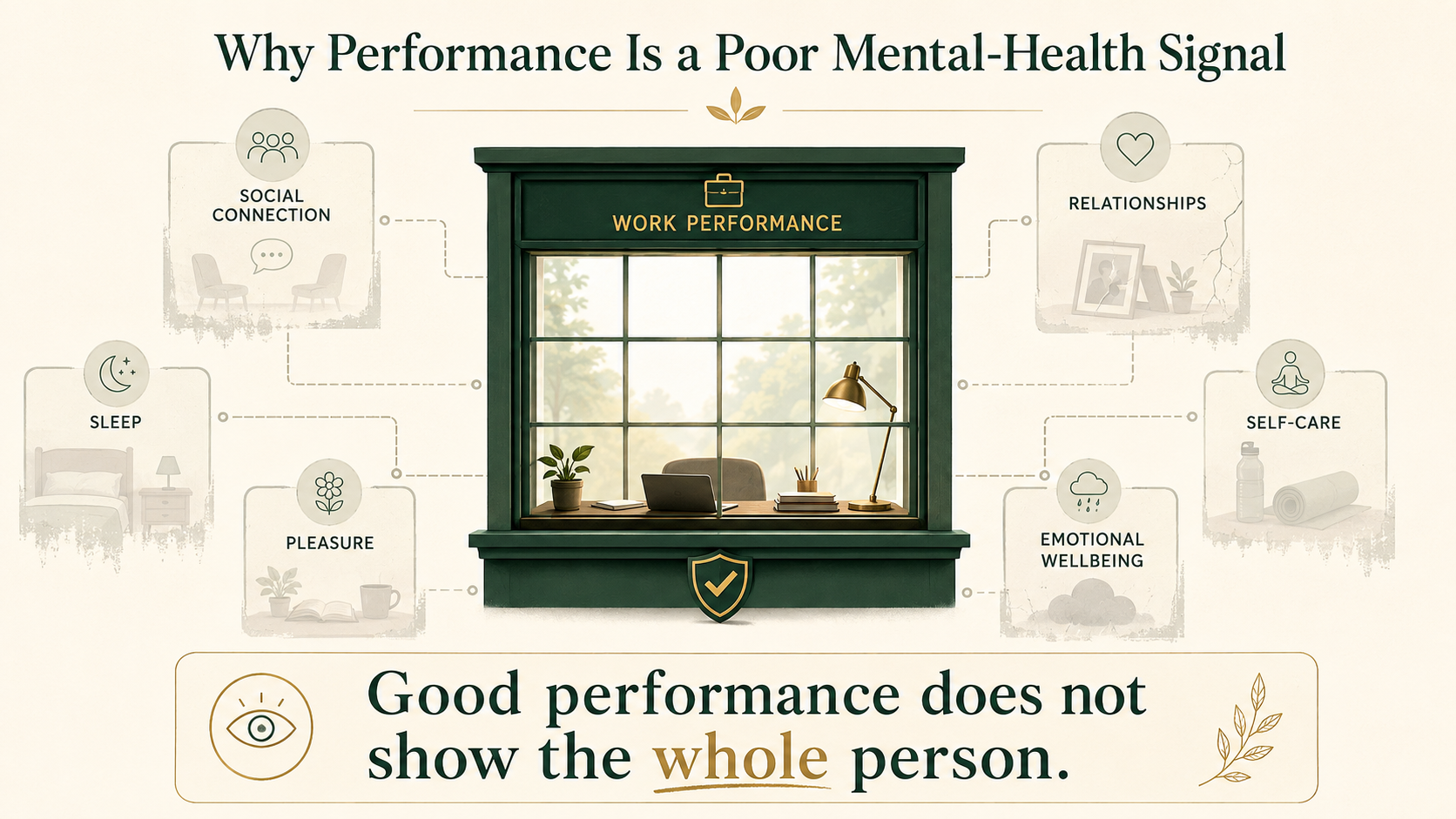
Because work is the part of life with the most external scaffolding. Deadlines, meetings, colleagues expecting replies, defined tasks and a salary keep behaviour moving without requiring any internal motivation, which is exactly what depression removes first. Everything that runs on self-generated drive declines earlier and invisibly.
Think about what actually needs personal motivation to happen.
Friendships. Exercise. Cooking. Hobbies. Exploring the country. Building any kind of community. Answering a friend's message on a Saturday.
None of those have a deadline attached, and none of them are visible to you. Meanwhile the meeting at nine happens because it was in the calendar, and from your side that looks like a person who is fine.
A 2024 review combining 20 studies found that loss of pleasure in depression is linked with wider difficulties across psychological, social and everyday functioning. In workplace terms: an employee can retain the competence to do the job while losing the capacity to enjoy anything around it. Skills stay. Everything else erodes, a pattern we cover in more depth in our article on anhedonia abroad.
That is not a reason for suspicion about high performers. It is a reason to stop treating output as a wellbeing indicator. The employee's own experience of this pattern, useful context for anyone managing it, is described in our article on high-functioning depression abroad.
What You Might Notice Around the Edges
Not symptoms, and not a checklist. What is visible to an employer is change from that person's own baseline, particularly several changes appearing together over weeks rather than one bad fortnight. Any single item below has a dozen innocent explanations.
Things that may warrant a conversation:
- Withdrawing from optional social contact they used to join
- Noticeably lower energy, or visible effort to produce ordinary output
- More irritability than is characteristic for them
- Reduced concentration, or difficulty with decisions that used to be routine
- Going quiet in settings where they used to contribute freely
- Mentioning poor sleep repeatedly
- Struggling more with unstructured work than with structured tasks
- More sick days, or none at all combined with visible exhaustion
- Saying they feel flat, disconnected or unsure they can keep living here
- Talking suddenly about leaving the country
Look for change from that person's baseline, not for a stereotype of what depression is supposed to look like. The stereotype is why most cases get missed.
What You Will Never See
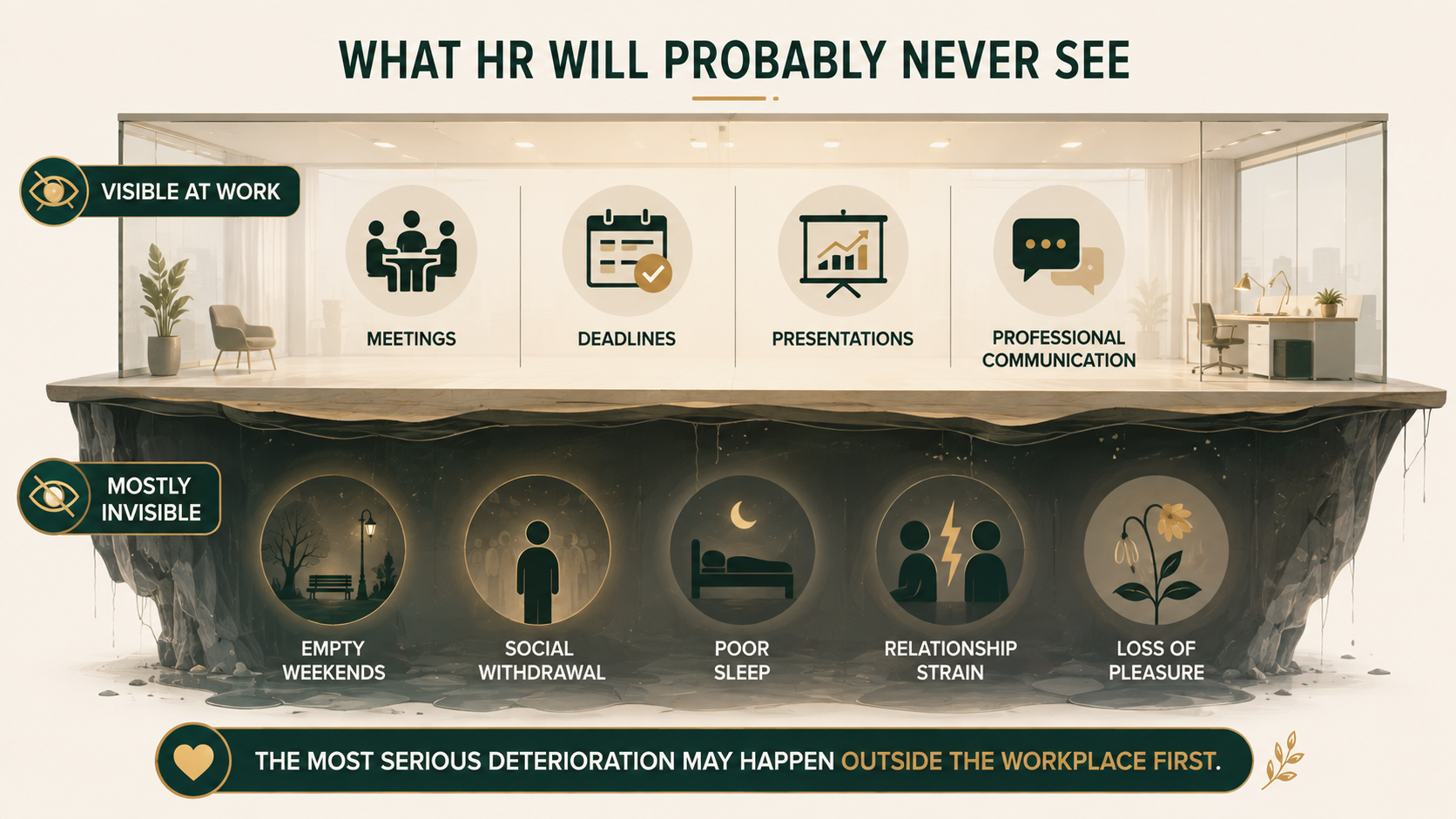
This is the half of the picture that determines everything, and none of it is available to an employer. The workplace may be the most structured and socially connected part of an international employee's entire life, which makes what you observe deeply unrepresentative.
Outside the office there may be a Sunday spent recovering enough to function on Monday, an apartment where nobody has visited in months, cancelled plans, a partner absorbing everything at home, no local friendships at all, and no idea how to access healthcare here.
You see the eight hours that work. You do not see the sixteen that do not.
This is why an international employee performing well tells you considerably less than the same signal would for a local hire with family in the same city, twenty years of friendships and a doctor they have had since childhood.
Why International Employees Are Especially Hard to Read
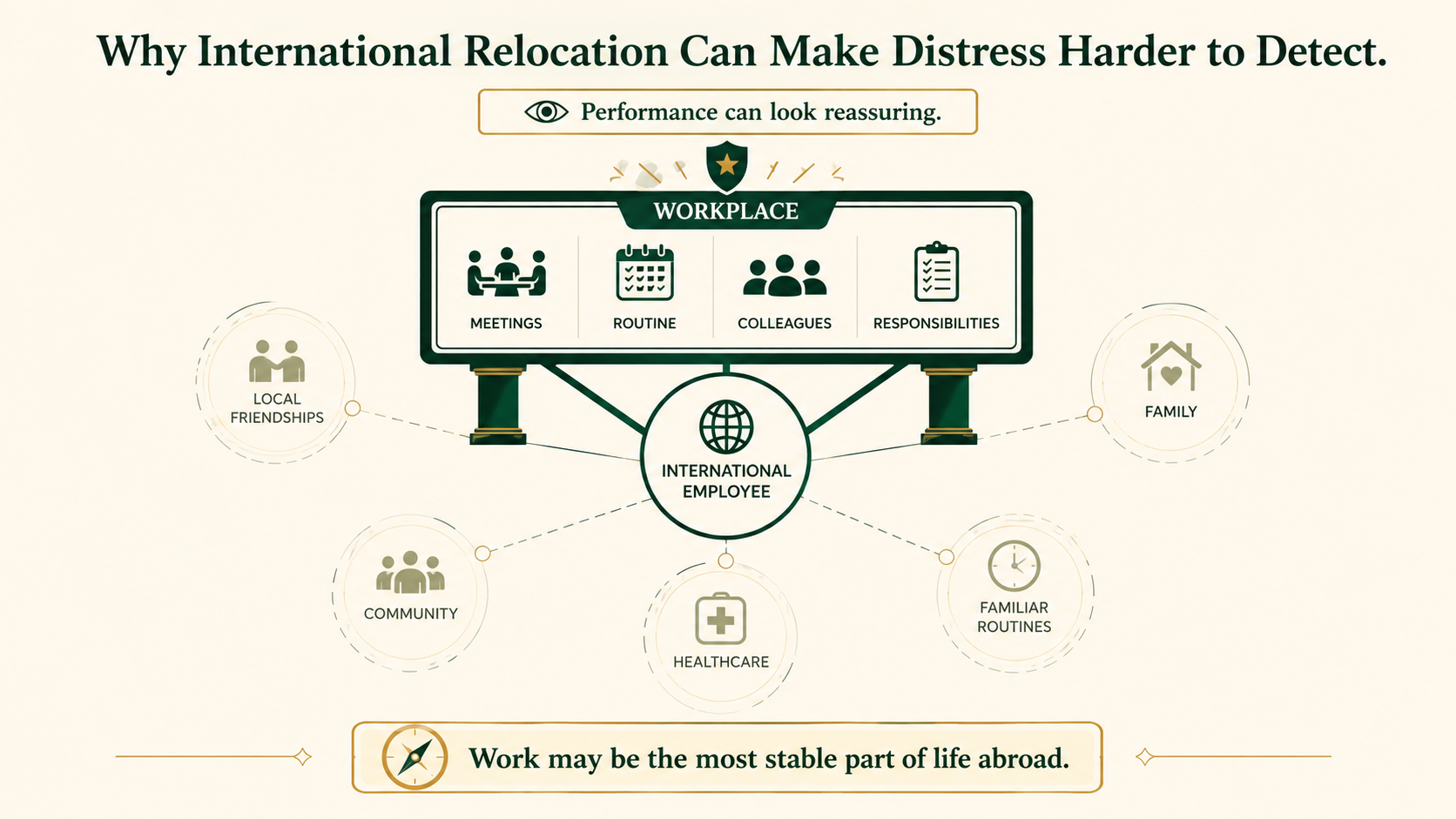
Because you have no comparison. The manager in the host country never met this person before relocation, so the quiet version is the only version they know. Someone who was energetic, funny and highly social at home can present as reserved from day one, and nobody registers a change because nobody saw one.
Three other factors compound it.
Support outside work may not exist. They left family, close friends, community, familiar healthcare and practical help. You see them daily without knowing there is almost nothing behind them.
Work may be the entire structure of their life. Colleagues, routine, purpose and identity all come from the job. That makes strong performance look reassuring when it may be the last functioning structure they have.
Language and culture make disclosure harder. Describing emotional difficulty in a second language is genuinely hard. So is knowing how disclosure is received here, whether it affects a visa-linked role, and how the health system works.
Adaptation itself carries real weight. A 2024 review of 26 studies covering more than 7,000 international students found a meaningful relationship between the stress of adapting to another country and depressive symptoms. Those were students rather than employees, so the number does not transfer. What transfers is the mechanism: unfamiliar norms, another language, rebuilding a social network from nothing, new institutions, and the loss of familiar status and identity.
Global mobility teams also tend to assume adjustment improves steadily with time. Evidence from longitudinal migration research complicates that. A meta-analysis of 20 longitudinal studies covering 8,156 refugees and asylum seekers found pooled depression prevalence did not simply decline year on year. That population is very different from a corporate assignee, and the figures do not apply. The narrow lesson is that post-migration distress does not automatically resolve with time, so year two is not reliably easier than year one.
Depression or Burnout?
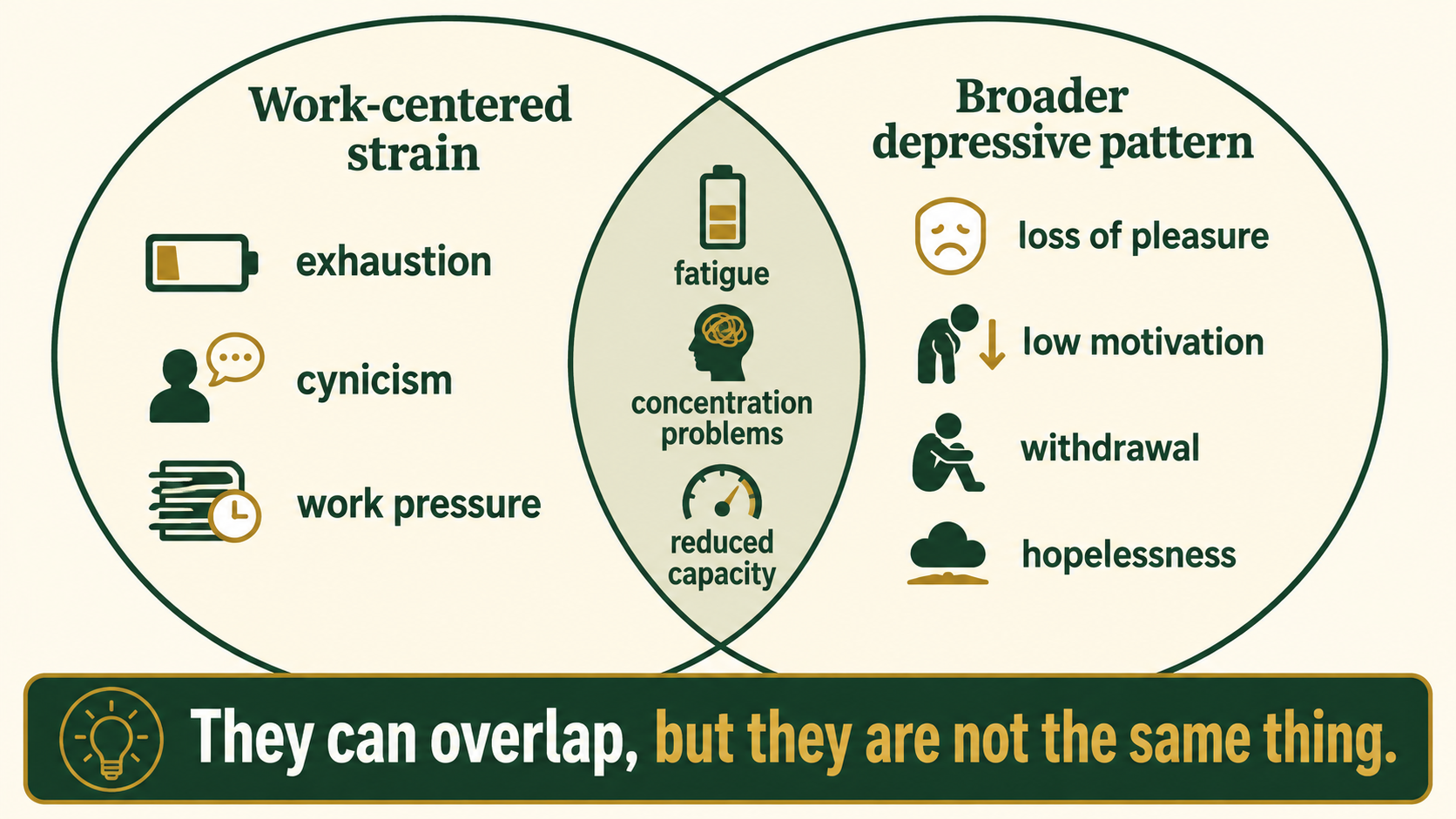
These two get conflated constantly in HR conversations, almost always in favour of burnout, because burnout feels more manageable, less clinical and more clearly the organisation's business. The most useful practical distinction is what happens when work is genuinely removed from the picture for a while.
| What you observe | More consistent with |
|---|---|
| Distress clearly tied to chronic workload and work conditions | Occupational strain |
| Motivation and pleasure gone across both work and private life | Depression deserves consideration |
| Clear improvement during genuine time away from work | Occupational strain |
| Weekends, relationships and hobbies also feel empty | Something broader than burnout |
The World Health Organization classifies burnout as an occupational phenomenon rather than a medical condition. That boundary is genuinely useful, and it cuts both ways.
Reaching for burnout as the default explanation is comfortable because it implies the fix is a holiday and a workload conversation. Sometimes that is right. Sometimes it means an employee gets two weeks off, returns unchanged, and everyone concludes they are simply not coping with the role.
This is not a diagnostic tool, the two frequently coexist, and no manager should be labelling either.
Why "They Are Still Delivering" Is Dangerous Reassurance
Because it inverts the actual sequence. Depression does not damage all areas of functioning at once, and work is typically the last to go, not the first. Waiting for output to drop means waiting until the situation is well advanced.
The assumptions worth retiring:
If it were serious, their performance would show it. Frequently untrue, and untrue longest in conscientious people.
They would take sick leave. Many will not, particularly where a visa, a probation period or a reputation as the reliable international hire is involved.
They would tell us. Most do not. That is not evasion, and the reasons are covered below.
They still travel and present, so they must be fine. Those are structured, externally scheduled activities, which is exactly the category that survives longest.
The absence of a performance problem is not evidence of the absence of a mental health problem.
There is an organisational cost to detecting this late, and it rarely appears as a mental health line item. It appears as an assignment ending early, a senior hire resigning for reasons given as family or career, a replacement search in a specialised role, and knowledge walking out of the building. Nobody resigns citing depression. They cite something more comfortable, and the record shows a normal departure.
To be straight with you: there is no reliable statistic for how many international employees are experiencing hidden depression, and anyone quoting one is inventing it. Corporate expatriate research has largely measured assignment adjustment, job exhaustion, engagement and intention to leave rather than clinical depression. That gap is worth knowing precisely because it means your own data will not surface this either.
Why They Have Not Told You
Silence is not evidence that nothing is wrong. International employees have specific and often entirely rational reasons for not disclosing distress at work, and none of those reasons require your organisation to be a bad employer or your managers to be unapproachable. Several are structural.
The common ones: uncertainty about how confidential disclosure really is, fear of career consequences, not wanting to appear unable to handle the relocation they were selected for, cultural norms around discussing mental health, immigration status tied to employment, no vocabulary for the experience in a second language, and a genuine belief that they just need a bit more time.
Employees are also entitled to privacy. Nobody owes their employer a diagnosis, and the goal is not to extract one.
The realistic aim is narrower and more achievable: make it safe and unremarkable to raise a concern, so that someone who wants to say something has somewhere to say it.
What Not to Do
Keep the boundaries clear, because in this area most of the damage is done by good intentions rather than indifference. Do not diagnose, do not interrogate someone about symptoms, and do not treat one quiet week as evidence of anything at all. Your job is noticing patterns, not assessing them.
Also worth avoiding: assuming poor performance must appear first, labelling everything burnout, making assumptions based on someone's nationality, dismissing distress as culture shock that will pass, and treating access to therapy as a substitute for fixing genuinely harmful working conditions.
Notice patterns, open a door, do not play clinician.
When a Pattern Deserves a Conversation
Keep the first step small and human. Speak privately, describe what you have actually observed rather than what you suspect it means, ask an open question, and listen without steering. Make the available support routes clear, and escalate immediately if there is any safety concern.
The difference is in the phrasing.
I have noticed you seem much quieter than usual, and you have mentioned being exhausted a few times. I wanted to check how things are going.
Not: I think you might be depressed.
The first invites a conversation. The second requires them to accept a label from their manager, and most people will decline it and become more careful around you.
What happens after that conversation, and how organisations build support that works, is a larger subject than this article. This one is about noticing.
Where International Context Changes the Support
If an employee does reach for help, the support needs to fit the situation. A relocated employee is often managing depression alongside isolation, language strain, identity change, partner adjustment, family distance and cultural change at the same time, and generic provision tends to address only the first item on that list.
The practical consequence is time. An employee with limited energy who spends the first sessions explaining why a successful relocation can still be destabilising, why going home is not simple, and why they have no support network here, is spending scarce capacity on context rather than on the problem.
Expathy supports internationally mobile employees with psychologists matched by native language and cultural background, all of whom have lived abroad themselves. Less of the hour goes to explaining the situation, and more of it goes to the person.
We would not claim that matching guarantees better clinical outcomes, because the evidence does not support that. What it does reduce is friction, and friction is what stops people using support they technically have.
For organisations reviewing what they currently offer international staff, therapy packages for international employees sets out headcount-based access with native language matching and aggregate-only reporting, so individual use is never visible to the employer. The broader picture of what we do for organisations is at Expathy for Business.
The related structural problem, where an employee has almost no social infrastructure outside work regardless of mental health, is covered in social isolation in international employees.
Final Thought
Most organisations running international mobility measure the things that generate documentation. Visa granted, housing arranged, onboarding complete, performance solid. By those measures, a great many relocations look successful right up until they end.
The question worth putting to your own team is uncomfortable and cheap to ask: have we mistaken strong performance for successful adjustment, and would we currently know the difference?
The employee whose work is excellent and whose life outside it has quietly emptied will not show up in any report you already run.
Start by looking at who has stopped joining things, and asking one open question. That is the whole intervention at this stage.
Sources and Further Reading
- Wong and colleagues (2024), review combining 20 studies on loss of pleasure in depression and its links with psychological, social and everyday functioning: https://doi.org/10.1016/j.jad.2024.04.086
- Soufi Amlashi and colleagues (2024), review of 26 studies covering more than 7,000 international students on the stress of adapting abroad and depressive symptoms: https://doi.org/10.3389/fpsyg.2024.1403807
- Handiso and colleagues (2024), meta-analysis of 20 longitudinal studies with 8,156 refugees and asylum seekers on depression over time after migration: https://doi.org/10.1007/s11469-024-01406-w
- World Health Organization on burnout as an occupational phenomenon in the International Classification of Diseases: https://www.who.int/news/item/28-05-2019-burn-out-an-occupational-phenomenon-international-classification-of-diseases
Frequently Asked Questions
Can someone have depression and still perform well at work?
Yes, and it is common. Work provides deadlines, meetings, defined tasks and financial necessity, all of which keep behaviour going without internal motivation. Areas requiring self-generated drive, such as friendships, hobbies and self-care, decline earlier and are invisible to an employer. Performance is often the last thing to slip.
What does hidden depression look like in an employee?
Usually not like distress. More often it appears as gradual withdrawal from optional social contact, lower energy, more visible effort to produce the same output, reduced concentration, irritability that is out of character, or comments about exhaustion and poor sleep. It is a change from that person's baseline rather than a recognisable picture.
What should HR notice if performance has not declined?
Changes at the edges, particularly several appearing together over weeks. Withdrawal from optional team contact, going quiet where they used to contribute, difficulty with unstructured work while structured tasks stay fine, or sudden talk about leaving the country. None of these prove anything. Together they justify a conversation.
How can HR tell burnout from depression?
You cannot, and you should not try to diagnose either. A useful indicator is what happens when work is removed: burnout typically improves with genuine time away, while depression tends to persist and affects pleasure, motivation and relationships beyond work. The two frequently coexist, and labelling everything burnout delays appropriate support.
Why might an international employee not ask for help?
Reasons include uncertainty about confidentiality, fear of career consequences, not wanting to appear unable to handle a relocation they were chosen for, immigration status tied to employment, cultural norms around mental health, difficulty describing emotional experience in a second language, and simply believing they need more time to settle.
Should a manager ask an employee directly whether they are depressed?
No. Describe what you have observed and ask an open question about how things are going. Naming a diagnosis puts the employee in the position of accepting or rejecting a label from their manager, which usually closes the conversation. Notice patterns, open a door, leave clinical judgment to clinicians.
Does relocation increase the risk of depression?
The honest answer is that relocation changes the conditions rather than causing depression directly. It can remove social support, familiarity and established identity while adding acculturative stress and practical difficulty. There is no reliable statistic for depression among international employees, because corporate research has largely measured assignment adjustment rather than clinical outcomes.
Can an employee struggle even when the assignment looks successful?
Frequently. Visa, housing, onboarding and performance are the things organisations measure, and all four can be in order while the employee has no local friendships, no support network and no capacity outside working hours. A successful relocation on paper and a struggling person are entirely compatible.
Need support? We're here.
Book a free 15-min consultation with our expat-specialized therapists.