
Key takeaway
Your international hire is performing well. Good reviews, delivers on time, joins the calls, occasionally has lunch with the team. On Friday at half past five everyone else leaves for partners, families and weekend plans built over fifteen years in this city, and your employee closes the laptop with nobody to see until Monday. Nothing has visibly gone wrong, which is precisely why most organisations never detect it. This article is about recognising social isolation in relocated employees, and why professional functioning is a poor proxy for successful relocation.
Most relocation programmes measure the things that generate paperwork.
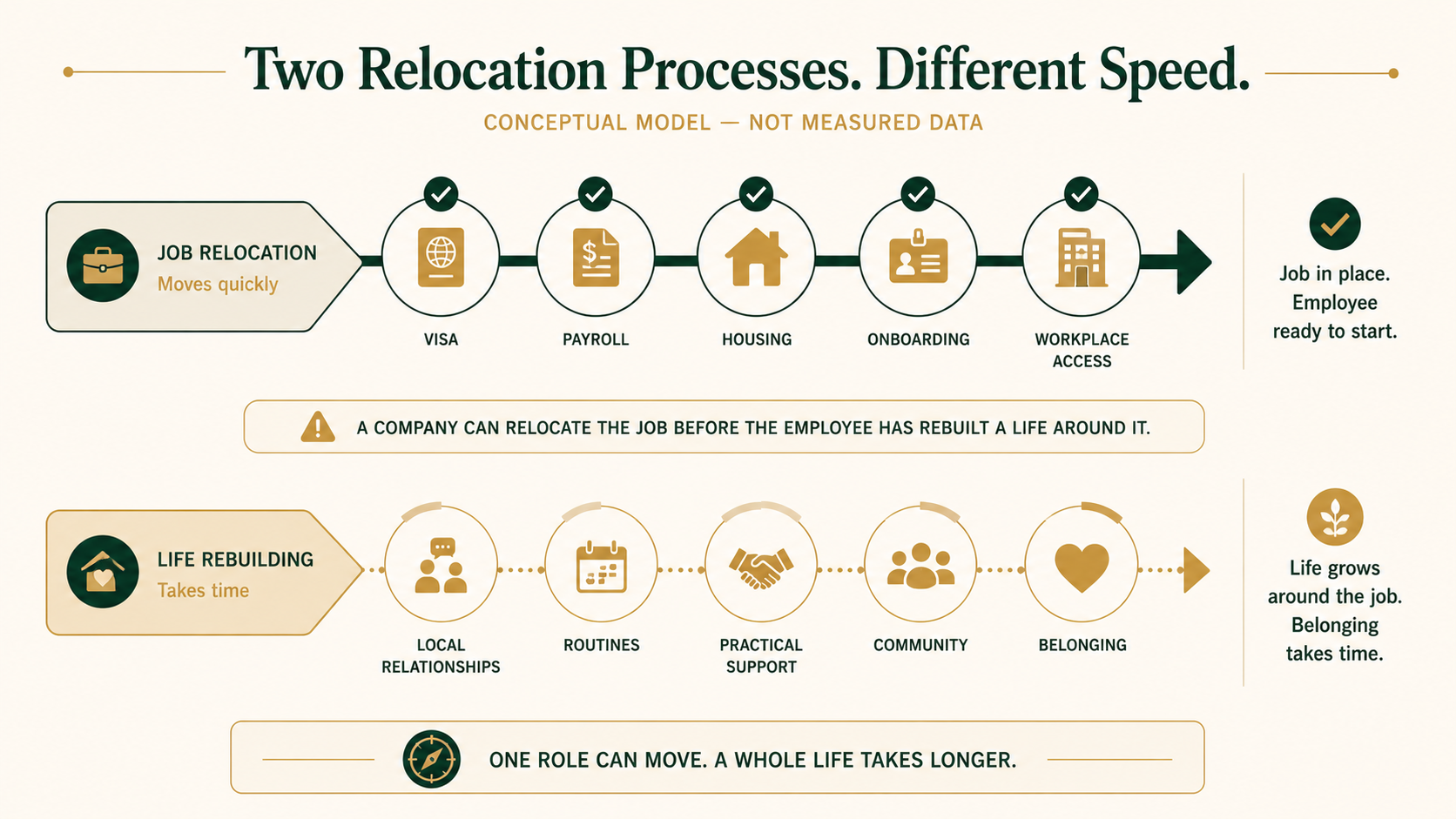
Visa approved. Housing secured. Payroll running. Onboarding complete. Employee performing. By every metric the organisation tracks, the relocation succeeded.
What none of those metrics capture is whether the person has built anything resembling a life around the job.
That gap is not a soft concern. It is the difference between an employee who stays four years and one who quietly starts reading job listings in their home country during their second winter.
What Social Isolation Actually Means for a Relocated Employee
Social isolation is structural, not emotional. It describes the objective state of someone's social world: how much recurring contact they have outside work, whether anyone locally could help in a crisis, and whether they belong to any repeating environment. It is measurable in a way that feelings are not, and it can coexist with excellent performance.
For a relocated employee it usually looks like some combination of:
- Almost no interaction outside working hours that is not transactional
- No recurring commitment where the same people appear each week
- Nobody in the city they could reasonably call for practical help
- Every meaningful relationship located in another country
- No connection to a neighbourhood, sport, community or group
None of these are complaints. They are facts about a calendar, and that is what makes them something an organisation can actually notice and respond to.
Social Isolation Is Not the Same as Loneliness
These get used interchangeably and should not be. Loneliness is subjective, the felt gap between the connection someone wants and what they have. Social isolation is objective, the actual structure and frequency of their contact. The two often overlap but they are genuinely distinct, and confusing them leads HR to the wrong response.
The practical consequences for you:
An employee can have a socially rich role, constant colleague contact and still feel lonely. Another can have a small quiet life and feel entirely fine. A third, most relevant here, can be structurally isolated and not yet describe themselves as lonely at all, which is why asking "are you feeling lonely?" is such an unreliable detection method.
For the subjective side and how it feels from the inside, our guide to loneliness abroad covers it. This article stays on the structural side, because structure is what employers can actually see and influence.
Do not ask whether your employee feels lonely. Ask what their week contains.
Your Company Relocated the Job Faster Than the Life
This is the core mechanism. Relocation removes an entire social system in a single week and replaces exactly one part of it. The employee arrives with a job, a salary and an apartment, having simultaneously lost family, friends, neighbours, routines, community, hobbies, trusted professionals and every source of practical support they had.
Consider what actually got rebuilt on day one, and what did not.
The company handled the visa, the housing, the bank account and the onboarding. Genuinely useful, and all of it professional infrastructure.
Nobody handled the fact that this person no longer has a single individual within 500 kilometres who would notice if they went quiet for a week.
That is not a criticism of relocation packages. It is a description of what they are designed to do. The problem is that organisations then read professional stability as evidence of complete adjustment, when only one of the two systems was ever rebuilt.
The company relocated an employee. The employee has to relocate a life, alone, in their spare time, in a second language.
Why Work Hides It So Effectively
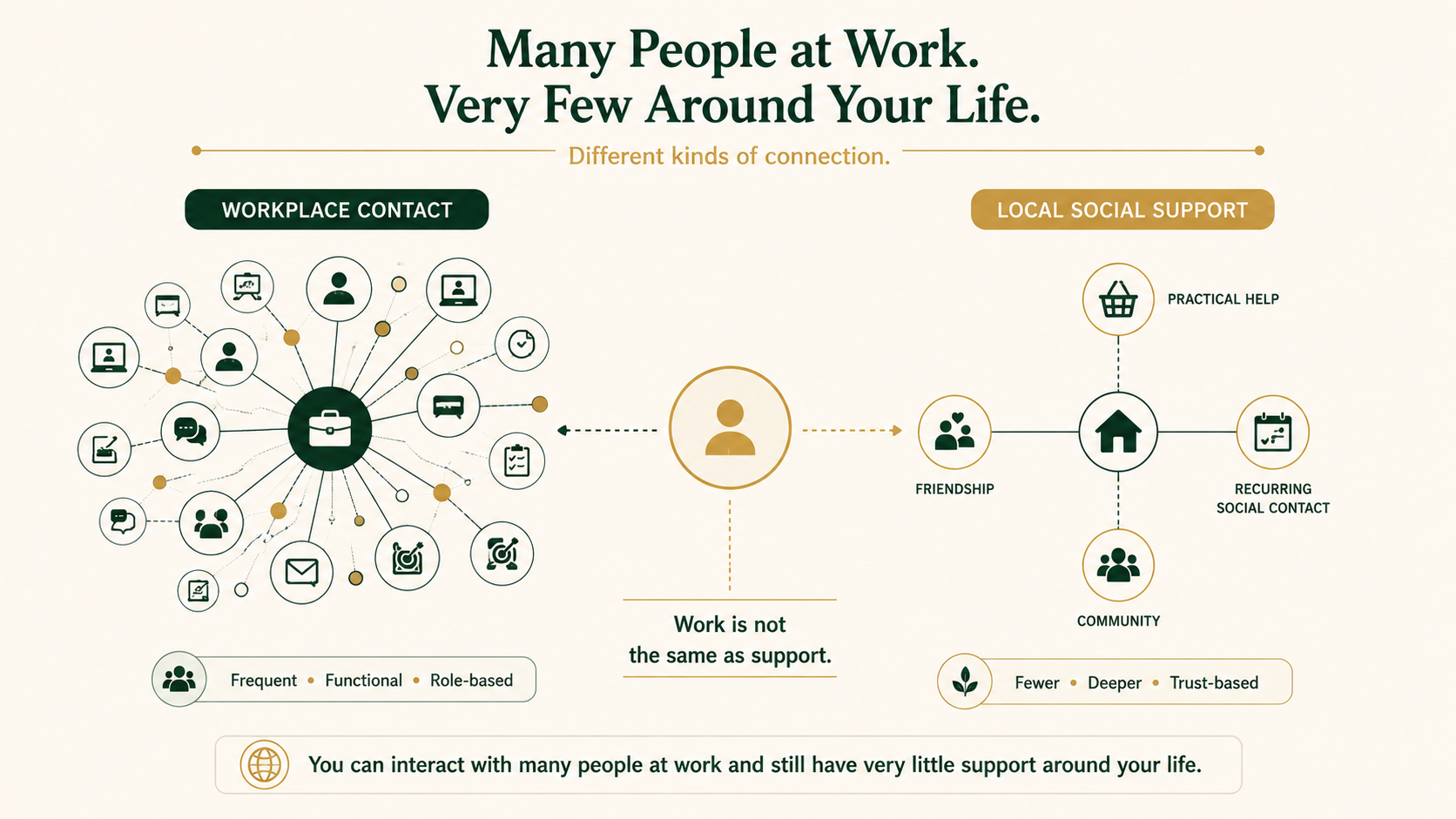
Because eight hours of daily human contact looks like a social life from the outside. The employee attends meetings, exchanges messages, has occasional lunches and appears completely embedded, and none of that contact continues past six o'clock. Work provides the appearance of connection without providing any of its structure.
This is why isolation in relocated employees is so consistently missed.
You see someone in conversation all day. You do not see that every one of those conversations ends when the building empties, that no colleague has ever invited them to anything on a weekend, and that their entire local social capital is contained inside a badge.
Contact at work is not a support network outside work. It is a support network that expires daily at six.
There is a compounding effect here worth knowing. A study of 672 employees and 114 supervisors by Ozcelik and Barsade found that lonelier employees were rated by their supervisors as lower performing, and that a key mechanism was reduced approachability: lonelier people are perceived as harder to approach, which reduces the very contact that would help. That study looked at workplace loneliness in general rather than relocated employees specifically, but the loop it identifies is directly relevant. Isolation makes people slightly less approachable, which produces more isolation.
The Structural Risk Factors
Isolation rarely has one cause. It usually comes from several structural factors overlapping, each independently removing a route into local life. Knowing which apply to a specific employee matters more than any general programme, because each one points somewhere different.
Remote and hybrid arrangements. This is not an argument against remote work. But for a newly relocated employee, the workplace is often the only environment reliably supplying repeated contact, local knowledge, spontaneous conversation and introductions. Remote work is fine for someone with fifteen years of local roots. Combined with recent relocation and no other local structure, it removes the one bridge that existed.
Zero weak ties on arrival. Most people underestimate these. Before moving, an employee had dozens of low intensity connections: a neighbour, a gym regular, a former colleague, the person at the shop, another parent at school. They arrive with none. That is what makes a new city feel anonymous even to someone who is not distressed.
Language. An employee can run complex professional work in the corporate language and still find casual local conversation, group lunches, humour and neighbourhood interaction much harder to enter, which are exactly the settings where informal connection accumulates. We cover the workplace side of this in language barriers for international employees.
Fragmented international teams. A diverse workforce does not automatically produce community. Colleagues commute from other cities, work different hybrid days, travel constantly, rotate out after two years or have established family lives that do not extend invitations. Proximity at work is not social embeddedness.
The gratitude problem. An employee who relocated for an exciting opportunity often finds it very hard to say the job is going well but my life is not. It sounds ungrateful. It risks looking like failure to adapt. So it does not get said, to anyone, for years.
Practical Support, Not Just Companionship
This reframing tends to land with HR audiences faster than anything about friendship. Ask who this employee would call if they were seriously ill, needed collecting after a medical procedure, lost their keys, or received bad news from home at midnight. For many relocated employees the honest answer is nobody within a thousand kilometres.
That is not a wellbeing nicety. It is a resilience gap.
An employee with no local practical support absorbs every ordinary shock alone, at full cost. A minor illness becomes a logistical crisis. A family emergency back home means flying with nobody to hand the keys to. Small problems stay bigger than they need to be, and a layer of low grade vigilance sits underneath everything they do, including their work.
Evidence supports how much this layer matters. A study of 281 expatriates by Bayraktar and colleagues found that support from host country colleagues and contacts was central to how well people adjusted across general, interaction and work domains, and that strong local networks partly compensated even for weaker local language ability. The local network is not a lifestyle extra. It carries load.
What Managers Might Notice
Managers cannot and should not investigate anyone's private life, and nothing here is a substitute for asking. What managers can reasonably notice are observable patterns that make a supportive conversation appropriate. None of these proves anything alone, and most have several perfectly innocent explanations.
Possible signals:
- Consistently eats alone, months after arrival
- Stays late without a workload reason
- Mentions that weekends were spent entirely alone, repeatedly
- Avoids taking annual leave because there is nowhere to go
- Still asking basic local-life questions long after onboarding ended
- Appears socially dependent on one colleague or on the manager
- Reluctant to leave company social events
- Mentions that everyone they know is back home
- Relocation satisfaction drifts down while performance holds steady
These are conversation signals, not diagnostic criteria. The correct response to noticing three of them is a question, not a conclusion.
That last signal is the one worth flagging hardest. Declining relocation satisfaction alongside stable performance is the specific pattern this article exists to catch, because every system you have will report that everything is fine.
Is This Employee Actually Socially Isolated?
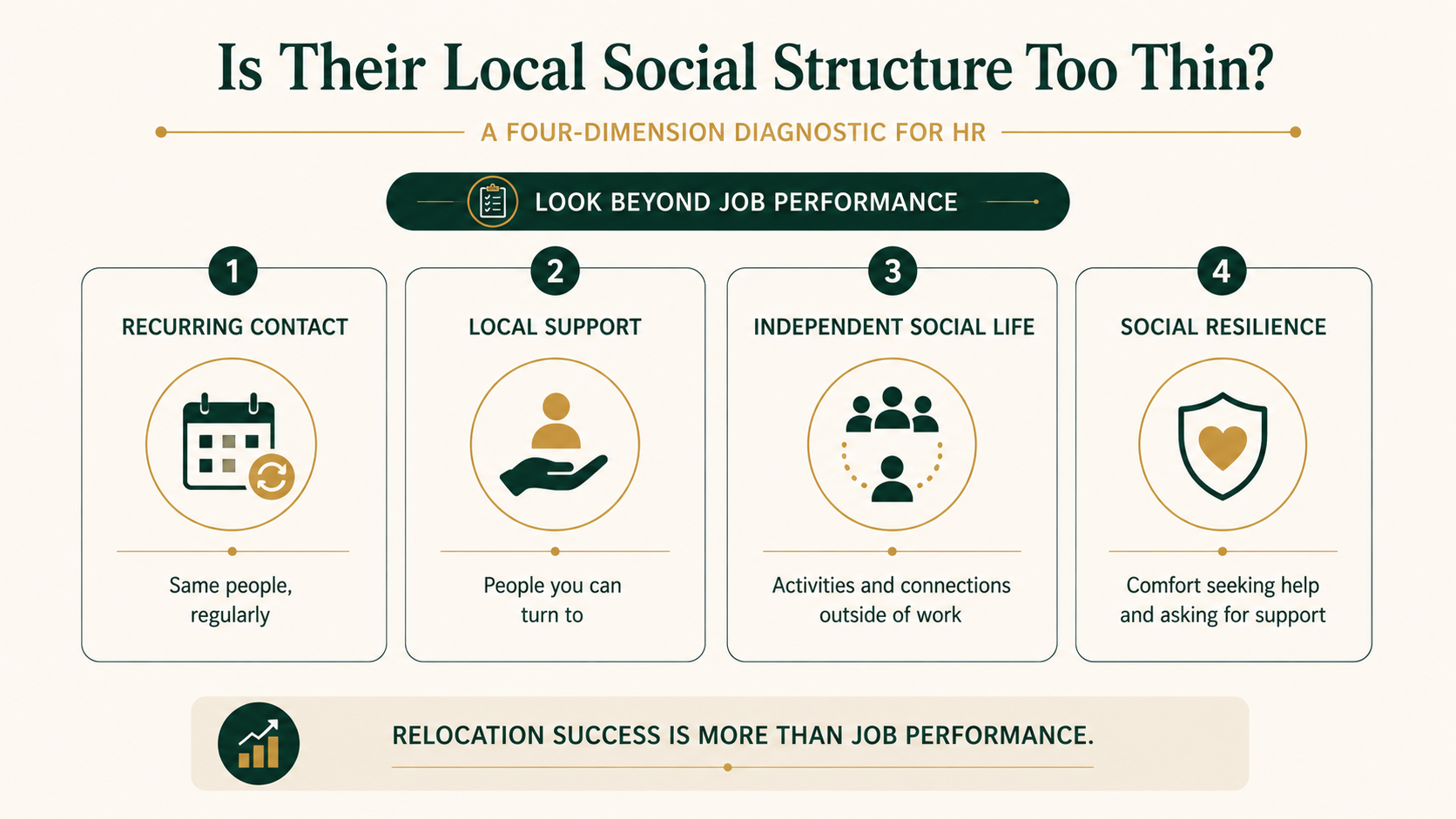
If a conversation is warranted, four dimensions give you a picture without requiring anyone to disclose anything personal. The aim is not to score people. It is to find which layer is missing, because absent recurring contact and absent practical support call for completely different responses.
| Dimension | The question | What thin looks like |
|---|---|---|
| Recurring contact | Do they interact with anyone regularly outside transactional work conversations? | Contact exists only inside working hours |
| Local support | Is there anyone nearby they could call for practical help? | Everyone they would call is in another country |
| Independent structure | Does life outside work contain any repeating places, people or communities? | No commitment that recurs weekly |
| Social resilience | If one colleague left or work went fully remote, would anything remain? | The entire social world runs through one person or one office |
That fourth row deserves attention. Plenty of relocated employees have exactly one social connection, usually a single friendly colleague. That works until the colleague changes team, relocates or leaves, at which point the employee's local social life goes to zero overnight.
What Organisations Usually Get Wrong
Most organisational responses fail in the same predictable ways. The common error is treating isolation as a personal preference problem rather than as a structural consequence of the relocation the company itself arranged. Five specific responses are worth retiring from your vocabulary:
"They should join a club." Places the entire burden on the person with the least local knowledge, least free energy and often the least language confidence.
"We have Friday drinks." An event is not a structure. Optional company drinks help people who already have colleagues they like, and do nothing for someone who has no route into the group.
"They seem fine." Performance reveals nothing about non-work life. That is the entire premise of this article.
"They are introverted." Introversion is not isolation. Someone can prefer a small social world and be perfectly well supported inside it. The question is whether their structure is smaller than they want, not whether it is smaller than yours.
"We hired them for work, not their social life." Fair, up to a point. But when the company moved someone across a border, the company changed their social circumstances as a direct consequence of employment. Ignoring that is a choice, and it is usually a more expensive one than it looks.
Why This Matters for Assignment Sustainability
Be careful with the business case, because the honest version is strong enough without invented numbers. An employee who likes the job but cannot build a viable life around it eventually evaluates the relocation very differently from one who is socially rooted, and that evaluation rarely appears in an exit interview as "I was isolated."
Two evidence points are worth holding.
The largest analysis of migrant adaptation to date, covering 1,114 studies and 571,260 people including business expatriates alongside migrants, students and refugees, found that feeling connected and not being lonely were among the strongest positive correlates of adapting well to a new country. That is a broad and heterogeneous population, so read it as a general adaptation finding rather than an expat-specific number. But the direction is unambiguous.
And in the workplace study noted earlier, lonelier employees showed lower affective commitment to their organisation. Commitment is the thing that determines whether someone renews, extends, or starts looking.
Nobody resigns citing loneliness. They cite family, career development or a better offer at home. All of which are true, and none of which is the whole reason.
Social Isolation Versus Workplace Belonging
These two are often merged and should not be. Workplace belonging asks whether someone feels accepted and valued inside your organisation. Social isolation asks how socially embedded their life is overall. An employee can have an excellent, inclusive team and go home to a completely empty week.
The reverse also happens. Someone can have a full local social life and still feel excluded at work.
The two reinforce each other, but they are different problems with different owners. Belonging is designed by managers, team practices and inclusive onboarding. Isolation is a structural feature of the employee's whole life, of which your organisation controls only one part.
Getting this distinction right prevents the most common mistake in this area: running belonging initiatives and expecting them to solve isolation, then concluding that nothing works.
What to Do Once You Have Identified It
Keep the first response modest, and resist launching a programme. The immediate goal is to make the subject discussable and to check whether your own arrangements are quietly making it worse. Detection is cheap. Redesign can come later, once you know what is actually missing.
Ask about relocation adjustment in check-ins, separately from performance, and specifically about life outside work rather than about feelings. Normalise the topic so employees do not read it as an admission of failure. Check whether remote arrangements are unintentionally removing the only local bridge a recent arrival has. Make sure managers understand that isolation hides comfortably behind good performance. And ensure wellbeing support is visible and easy to reach before anyone is in crisis.
The larger question, how organisations deliberately build belonging and connection for international employees, is a design problem rather than a detection one, and it deserves separate treatment.
When Professional Support Becomes Relevant
Be clear about the limits. A psychologist cannot build an employee a local network, and offering therapy in place of structural connection is a category error. What professional support addresses is the layer that forms on top of isolation when it has been going on long enough.
The distinction worth applying:
If the problem is that someone's life contains too little connection, the response must include structural connection. If isolation has also changed how hopeful, safe or capable the person feels, psychological support addresses that layer.
That second situation is common in relocated employees and rarely surfaces at work. Withdrawal, low mood, a drop in confidence that does not match their actual competence, anxiety that was not there before the move, or the quiet conclusion that they cannot build a life here.
Support works better when the context does not need explaining. An isolated international employee is usually managing relocation, lost support networks, language strain, identity change and work pressure simultaneously. Spending half a session establishing why a successful move can still be destabilising is a poor use of the hour.
Expathy provides mental health support built for internationally mobile people, matching employees with psychologists by native language and cultural background, all of whom have lived abroad themselves.
For organisations wanting this available before an employee reaches crisis point, therapy packages for international employees covers headcount based access with native language matching and aggregate only reporting, so nobody's individual use is visible to their employer. Where relocation support is being reviewed more broadly, our guidance on relocation mental health support in the first 90 days covers the window where this is most preventable.
If it is the employee reading this rather than their employer, the individual side of this experience is covered in social isolation abroad.
Final Thought
The uncomfortable question for any organisation running international relocation is not whether your employees are performing.
It is whether you have mistaken professional functioning for successful adjustment, and whether anyone has ever asked what these people's weeks actually contain.
You moved someone across a border and rebuilt one part of their life. The rest of it, the neighbours, the routines, the person who would drive them home from a hospital, they have to reconstruct alone, in a language they are still learning, after work.
Most of them manage it. The ones who do not usually look completely fine until the day they resign.
Start with one question in the next check-in, and make it about the week rather than the work.
Sources and Further Reading
- Ozcelik and Barsade (2018), Academy of Management Journal, time-lagged field study of 672 employees and 114 supervisors on workplace loneliness, approachability, commitment and supervisor-rated performance: https://doi.org/10.5465/amj.2015.1066
- Bierwiaczonek and colleagues (2025), Nature Communications, meta-analysis of 1,114 studies and 571,260 migrants, international students, business expatriates and refugees on correlates of adaptation: https://doi.org/10.1038/s41467-025-67468-z
- Bayraktar and colleagues (2026), study of 281 expatriates on host country social support, local networks and adjustment: https://doi.org/10.1007/s11575-025-00605-4
Frequently Asked Questions
What does social isolation look like in an international employee?
Structurally rather than emotionally. Typical signs include almost no non-transactional contact outside work, no recurring weekly commitment, nobody locally who could help in an emergency, and every meaningful relationship located in another country. It frequently coexists with strong performance, which is why organisations rarely detect it.
Is social isolation different from loneliness?
Yes. Loneliness is subjective, the felt gap between wanted and actual connection. Social isolation is objective, describing the real structure and frequency of someone's contact. An employee can be structurally isolated without describing themselves as lonely, which is why asking about feelings is an unreliable way to detect it.
Why can an employee with many colleagues still be socially isolated?
Because workplace contact ends when the working day does. Eight hours of meetings and messages resembles a social life from the outside while providing none of its structure. If no colleague relationship extends into evenings or weekends, the employee has professional contact and no local support network.
Can remote work make relocation harder socially?
It can, though remote work is not the cause on its own. For a newly relocated employee the workplace is often the only reliable source of repeated contact, local knowledge and introductions. Remote arrangements combined with recent relocation and no other local structure remove the one bridge that existed.
How can a manager ask about isolation without invading privacy?
Ask about the practicalities of settling rather than about feelings. Questions such as whether they have found things to do outside work, whether they know anyone locally yet, or how the settling in is going, keep the conversation appropriate. The aim is to make the subject discussable, not to gather personal information.
Does social isolation affect relocation success?
The evidence points that way without proving direct causation. The largest analysis of migrant adaptation found connectedness and absence of loneliness among the strongest positive correlates of adapting well, across a broad population including business expatriates. Separately, workplace loneliness research links loneliness with lower organisational commitment.
Should employers be responsible for employees' social lives?
No, and attempting to engineer friendships tends to fail. But when a company relocates someone internationally, it directly changes their social circumstances as a consequence of employment. Recognising that, checking whether company arrangements worsen it, and making support available is different from managing anyone's private life.
What is the difference between social isolation and workplace belonging?
Workplace belonging concerns whether someone feels accepted and valued inside the organisation. Social isolation concerns how socially embedded their whole life is. An employee can have an inclusive team and an empty week, or a full personal life and feel excluded at work. They need different responses.
When should HR offer professional mental health support?
When isolation has begun affecting more than the calendar. If an employee shows withdrawal, low mood, confidence that no longer matches their competence, or has concluded they cannot build a life in the country, psychological support is appropriate. It should complement structural connection rather than substitute for it.
Need support? We're here.
Book a free 15-min consultation with our expat-specialized therapists.