
Key takeaway
You wanted this. You planned it for months, told everyone you were excited, sold things, packed boxes, found the apartment, changed jobs or followed someone you loved. And now there is a thought you would rather not say out loud: I think this was a mistake. This article is about what that thought actually means, because regret after moving abroad is common, it is information worth reading carefully, and it is not automatically a verdict on the decision.
Here is what the last few months may have looked like from inside.
You dread Sunday evenings because another week here is starting. You compare everything to home, unfavourably, without meaning to. You check flights you have no intention of booking. You replay old routines like a film. And you feel quietly embarrassed, because everyone treated this move as exciting and you cannot admit that you are not enjoying it.
Regretting an international move does not prove the move was wrong. It also does not mean you should dismiss your unhappiness as culture shock and wait it out indefinitely.
The useful question is not whether you regret it. It is what, specifically, you regret.
Is It Normal to Regret Moving Abroad?
Yes, and it is far more common than the conversations around you suggest. Almost nobody posts about the month they wanted to go home, so the version of expat life you see from others is heavily filtered while your version includes every bad Tuesday. That comparison alone distorts things.
There is no reliable statistic on how many people regret moving abroad, and anyone quoting one is probably citing a marketing survey.
What is well established is that people adapt along very different trajectories. Some struggle immediately and then settle. Some feel fine for a year and then hit something hard. Some go up and down for years. The old idea that everyone passes through the same neat sequence of honeymoon, crisis and adjustment is not supported well enough to plan your life around.
Which matters practically: your timeline not matching someone else's tells you nothing about whether your decision was right.
Why Regret Shows Up After the Move, Not Before
Because before you moved, you were comparing two things that were never comparable. You weighed the imagined best of the new life against the known limitations of the old one. After moving, that flips, and you start weighing the hardest parts of the new life against your favourite memories of the previous one.
Before the move, your attention went to possibility. The opportunity, the city, the weather, the adventure, the version of yourself you might become.
After the move, you start paying the actual costs, and most of them were invisible from a distance. Distance from family. Routines gone. Career interrupted. Reduced competence in ordinary tasks. Language effort. A social network that has to be built from nothing. Bureaucracy. Money working differently.
Before the move you compared the future abroad with the limits of your old life. After the move you compare the hardest parts of your new life with the best parts of the life you left.
This is not a trick your mind is playing on you, and your regret is not imaginary. It is just an unfair comparison, and knowing that is useful before you draw conclusions from it.
What Kind of Regret Are You Actually Having?
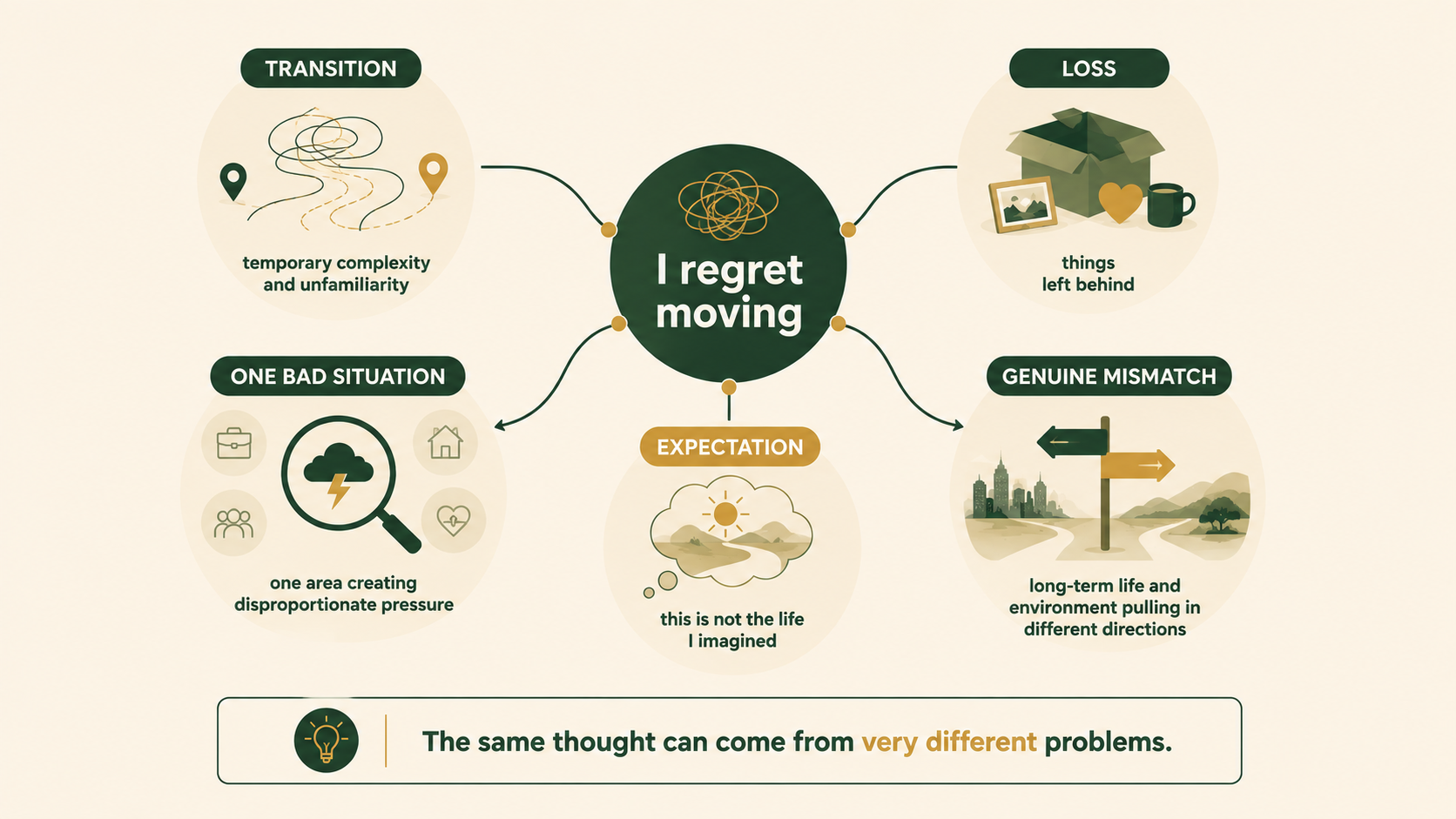
This is the most important section in the article, because these five kinds of regret feel almost identical from the inside while meaning completely different things. Working out which one you are actually experiencing changes everything about what you should do next, and most people never make the distinction at all.
Transition regret. Everything is harder right now. The admin, the language, the starting from zero socially, the fact that nothing is automatic. The diagnostic question: would I still want to leave if the transition burden disappeared? If the answer is no, you are reacting to a workload rather than to a country.
Loss-based regret. I did not realise what I was giving up. Family proximity, old friendships, professional status, a role you had, being easily understood. The move may genuinely have gained things while costing more than you expected. This is grief, and grief is not evidence of error.
Situation-specific regret. One part of my life here is poisoning everything. A bad job. A difficult relationship. A wrong apartment. Money pressure. An isolating neighbourhood. Ask: if that one thing changed, would I still want to leave the country? This is the most commonly missed diagnosis and the most fixable.
Expectation regret. This is not the life I imagined. You expected adventure, ease, transformation, a more interesting version of yourself. Instead you have laundry, commuting and a supermarket. Sometimes the disappointment is not that life abroad is bad. It is that it became ordinary.
Genuine mismatch. I understand this place much better now, and I still do not want this life. This exists, and pretending it does not is how people stay somewhere unhappily for a decade. Values, climate, pace, career ceiling, distance from ageing parents, a culture you respect but do not want to live inside.
All five are legitimate. Only one of them is about the country.
Are You Regretting the Country, or Your Life In It?
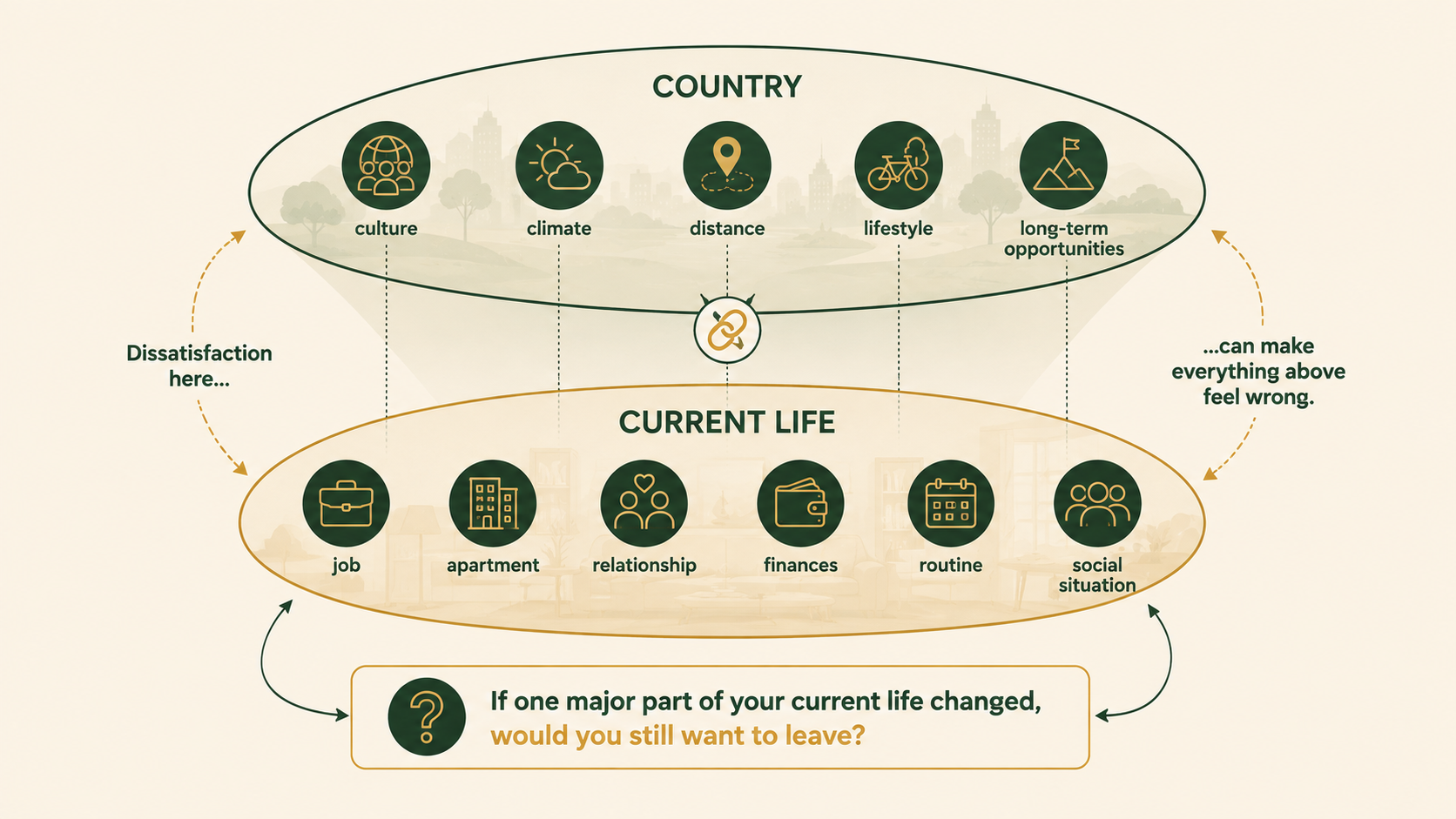
This distinction does more practical work than any other in this article. A bad job, a bad flat or a bad relationship can contaminate an entire country, and the mind rarely files it correctly. It just concludes that being here is unbearable.
Try separating the two lists honestly.
Country-level: culture, climate, legal environment, distance from family, long-term opportunity, the pace and shape of daily life, how you are treated here.
Current-life-level: your job, your apartment, your neighbourhood, your relationship, your social circle, your workload, your finances, your language level, your routine.
Then ask the question: if I kept the country but changed my job, my home and my weekends, would I still want to leave?
Plenty of people who think they hate a country actually hate a job in that country, and they find that out two years after leaving.
If your honest answer is that the country would still be wrong, that is real information and worth taking seriously. If your answer is that things might be fine, you have located the actual problem, and it is a smaller one than emigration.
What Are You Comparing This Life With?
Something worth checking, gently, before you draw conclusions. When life abroad becomes hard, home tends to get quietly edited in your memory. You remember the friends, the food, the effortless conversations and the familiar streets, while temporarily losing access to all the reasons you originally wanted to leave.
This is a well documented feature of how people imagine alternatives to their current situation. Research on counterfactual thinking, including work by Roese and colleagues, finds that regret often centres on imagined alternatives that are constructed rather than remembered accurately.
Nobody imagines the alternative version of their life in full detail, complete with its own bad weeks.

This does not mean your regret is false. It means the comparison needs to be fair before you act on it. Compare your real life here with what your real life there would actually be now, including the job market, the friends who have moved on, the family dynamics and the reasons you originally left.
Compare real life here with real life there, not today's hardest week with your favourite memories.
"How Long Should I Give It?"
There is no honest universal answer, and any article giving you a number is inventing one. Six months, a year and two years are all made up. The real question is not how long you have been here but whether you have had enough stability to gather meaningful information.
Some things worth checking instead of the calendar:
- Has the initial administrative chaos actually settled, or are you still in it?
- Do you have any routines yet, or is every week still improvisation?
- Have you experienced ordinary life here, or only relocation life?
- Is the main source of your unhappiness something that could change?
- Is staying currently costing you your health, your relationship or your finances?
That last one matters most. Nobody is obliged to complete a trial period while something is actively damaging them.
You do not need to reach an arbitrary anniversary before taking your unhappiness seriously. You also do not need to treat the worst month of a hard transition as a permanent forecast.
"Everyone Says I Just Need More Time"
This advice is well meant and only sometimes correct. The useful follow-up question is: what exactly do we expect time to change? Time reliably improves some things and reliably does nothing for others, and the difference is worth being clear about.
Time plausibly improves familiarity, navigation, language confidence, routines, professional footing and social connections, because all of those accumulate.
Time does not automatically fix incompatible values, a job that is harming you, unsafe conditions, a serious relationship problem, a financial situation that does not work, or a lifestyle you fundamentally do not want.
If your regret sits in the first list, patience is a strategy. If it sits in the second, patience is just delay.
Being able to name which one you are in is more useful than any amount of encouragement.
"But I Chose This"
The hardest part of relocation regret is often not the country. It is the shame. The move was your idea, people admired you for it, someone warned you, you spent real money, you left a good job, and you called it a dream out loud. Reconsidering now can feel like a public admission of failure.
Two things need separating here.
A decision can be entirely reasonable given the information you had, and still turn out not to fit you. Those are compatible. You did not have this information before. Nobody does.
And the money, time and effort already spent cannot be recovered by staying longer. That is worth saying plainly: continuing something because of what it already cost you is not the same as continuing because it is right.
Equally, discomfort right now is not on its own sufficient reason to abandon something that may improve. The goal is neither automatic persistence nor automatic exit. It is better information.
What You Can Test Before Deciding Anything
If you can manage it, change one variable in your life here and watch carefully what happens to the regret. This produces far better information than months of thinking, because thinking tends to loop around the same arguments while small experiments actually produce evidence you can use.
Some things that are reversible and worth trying:
Change the routine that is grinding you down, particularly weekends, which is where regret tends to concentrate. Spend real time in a different neighbourhood or another city here, since some people are in the wrong city rather than the wrong country. Deal directly with the specific relationship conflict rather than treating it as background noise. Visit home without treating the trip as a decision, and notice what you actually feel on day five rather than day one. Reconnect with something from your previous identity, a sport, a language, a piece of work you were good at.
And if one part of your life is clearly the problem, test changing that before testing changing countries.
The principle: change one thing, and see whether the regret moves with it. If it does, you have found your answer. If nothing you change makes any difference, that is also an answer.
When Regret Is Pointing at Something Else
Sometimes the regret is not really about the move at all, and is attaching itself to the most obvious explanation available. Three things in particular tend to masquerade as relocation regret, and each one calls for a completely different response than packing up and leaving the country would be.
Loneliness. If the country started feeling wrong at roughly the same time your social life collapsed, the problem may be connection rather than geography. That is a specific and addressable issue, covered in loneliness abroad.
Identity. If what you actually miss is being someone people already understood, rather than the country itself, that is an identity question rather than a location question, explored in expat identity and belonging. And if the feeling is that neither country fully fits you now, that is a different experience again, covered in not feeling at home anywhere.
Depression. This one matters most. If alongside the regret you have persistent hopelessness, loss of interest in almost everything, significant sleep or appetite changes, withdrawal or difficulty functioning, then the question may be larger than which country you live in. Depression makes every available option look bad, including the ones that would be good. Our guide to depression abroad is the right starting point if that describes you.
Changing Your Mind Is Not Failing
There is an unspoken hierarchy in expat conversations where staying is quietly treated as resilience and leaving as giving up. That framing is nonsense, it is not supported by anything, and it keeps a great many people in situations they have already outgrown for the sake of how the decision might look.
Moving back can be a considered decision made by someone with more information than they had before. Staying can be the same. Neither one is braver.
And whatever you decide, the experience does not become worthless if you leave. It taught you what you value, what you miss, what kind of environment suits you, and which assumptions about yourself were wrong. That is genuinely useful, and you could not have learned it from where you were before.
A decision does not have to become permanent in order to have been worth making.
How Therapy Can Help With This
Not by talking you into staying. Therapy is useful here because the categories are genuinely hard to separate alone: grief and mismatch, temporary stress and long-term dissatisfaction, fear and preference, guilt and genuine obligation, an idealised memory and a realistic alternative.
Those distinctions are what the whole decision rests on, and they are exactly what a mind loops on unproductively at two in the morning.
What therapy should not do is deliver a verdict. No therapist should be telling you to stay abroad or to go home. If one does, they have exceeded their role.
There is a practical argument for doing this with someone who has lived internationally. Explaining why a move you chose can still hurt, why leaving feels like failure, and why home is not a simple fallback consumes a great deal of a session with someone who has never experienced any of it.
Expathy connects expats with psychologists who have lived abroad themselves and can be matched by native language and cultural background. Less of the hour goes to context, more of it goes to the actual question.
We would not claim that matching guarantees a better outcome. It does mean starting from the problem rather than the background. If you want to work this through properly, online therapy for expats is where to start.
Final Thought
Notice that this article has not told you whether to stay. That is deliberate, and it is not evasion.
The honest position is that regret is data, and most people act on it before reading it. They either override it entirely and stay unhappy for years, or treat one bad season as proof and leave without knowing what they were actually escaping.
You can regret parts of a move without regretting the whole life you are building. You can also decide, having genuinely looked, that this is not the life you want.
Both of those are available to you. The work is finding out which one is true, and that starts with naming which of the five regrets you actually have.
Sources and Further Reading
- Roese and Epstude (2017), Perspectives on Psychological Science, on regret and counterfactual thinking as comparisons with imagined alternatives: https://doi.org/10.1177/1745691616635640
- Bierwiaczonek and colleagues (2025), Nature Communications, meta-analysis of 1,114 studies on adaptation among migrants, students and expatriates, including variation in adaptation over time: https://doi.org/10.1038/s41467-025-67468-z
Frequently Asked Questions
Is it normal to regret moving abroad?
Yes, and it is far more common than social media suggests, because almost nobody posts about the month they wanted to go home. Regret can appear at any point rather than following a predictable sequence, and people adapt along very different trajectories. Feeling it does not mean the decision was wrong.
How do I know whether moving abroad was actually a mistake?
Start by identifying which kind of regret you have. Transition difficulty, grief for what you gave up, one bad part of your life here, disappointed expectations and genuine mismatch all feel identical from inside but mean different things. Only the last one is really about the country.
How long should I give living abroad before deciding?
There is no evidence-based deadline, and any specific number you read is invented. More useful than the calendar: whether the administrative chaos has settled, whether routines have formed, whether you have experienced ordinary life rather than only relocation life, and whether staying is currently damaging your health, relationship or finances.
What if everyone tells me I just need more time?
Ask what exactly time is expected to change. Time reliably improves familiarity, language, routines and social connection. It does not automatically fix incompatible values, a harmful job, serious relationship problems or a lifestyle you fundamentally do not want. Patience is a strategy for the first list and delay for the second.
How do I know whether I hate the country or just my current situation?
Separate country-level factors, such as culture, climate and distance from family, from current-life factors, such as your job, apartment, neighbourhood and social circle. Then ask whether you would still want to leave if you kept the country but changed the job, the home and the weekends. Many people discover they hate a job, not a country.
Can homesickness make you regret moving abroad?
It can contribute significantly, particularly early on, and missing home is not the same as having made the wrong decision. The clearer signal is whether your dissatisfaction is concentrated on what you left behind or spreads across the whole life you are building here, including things unconnected to home.
Is moving back home a failure?
No. Returning can be a considered decision made with far more information than you had originally, and staying can be the same. Neither is braver. Changing your mind does not retroactively make the original move foolish, and the experience is not wasted if you eventually leave.
Can depression make me think moving abroad was a mistake?
It can, because depression affects how every available option looks, including good ones. If your regret comes with persistent hopelessness, loss of interest in almost everything, sleep or appetite changes, withdrawal or difficulty functioning, the question may be larger than which country you live in and is worth addressing first.
Can therapy help me understand whether my regret is temporary?
It can, provided the goal is clarity rather than a verdict. Therapy is useful for separating things that are genuinely hard to distinguish alone: grief from mismatch, temporary stress from lasting dissatisfaction, fear from preference, and idealised memory from a realistic alternative. No therapist should be telling you whether to stay or go.
Need support? We're here.
Book a free 15-min consultation with our expat-specialized therapists.