
Key takeaway
A student who used to stay behind after class now leaves the moment the bell goes. Their grades are holding. They are not crying, not in trouble, just quietly disappearing from the life of the school. In the same building, one of their teachers is still delivering every lesson and has stopped coming to lunch, and a parent who used to volunteer says the family is having a hard time since the move. This article is about knowing when ordinary adjustment has become something that needs attention.
International schools are unusually good at normalising difficulty, and for understandable reasons.
When arrivals, departures and adjustment are the constant background of your community, "they are still settling in" becomes the explanation for almost everything. Sometimes it is the right one. Sometimes it is how a genuine problem goes unnoticed for a year.
The opposite error is just as common, and just as costly: treating every quiet newcomer as a case.
The skill this article is about is telling those two apart.
Depression Here Is Not Only a Student Issue
Schools tend to look for distress in students and assume the adults are managing. But an international school community contains four groups who have often relocated recently: students, teachers, other staff and parents. All four can experience depression, and each is visible to the school in a different way.
Students are the largest section of this article because schools carry a specific duty of care toward young people.
But the teacher on a two-year contract who left their whole support network behind, the administrator who moved for a partner's job, and the parent who is rebuilding a career and a social life at once are all in the same country, doing the same adjustment, with far less scrutiny.
The people responsible for noticing distress in others are not exempt from it themselves.
The broader clinical picture of depression abroad, for context rather than assessment, is in our guide to depression abroad.
Look for Change, Not a Stereotype
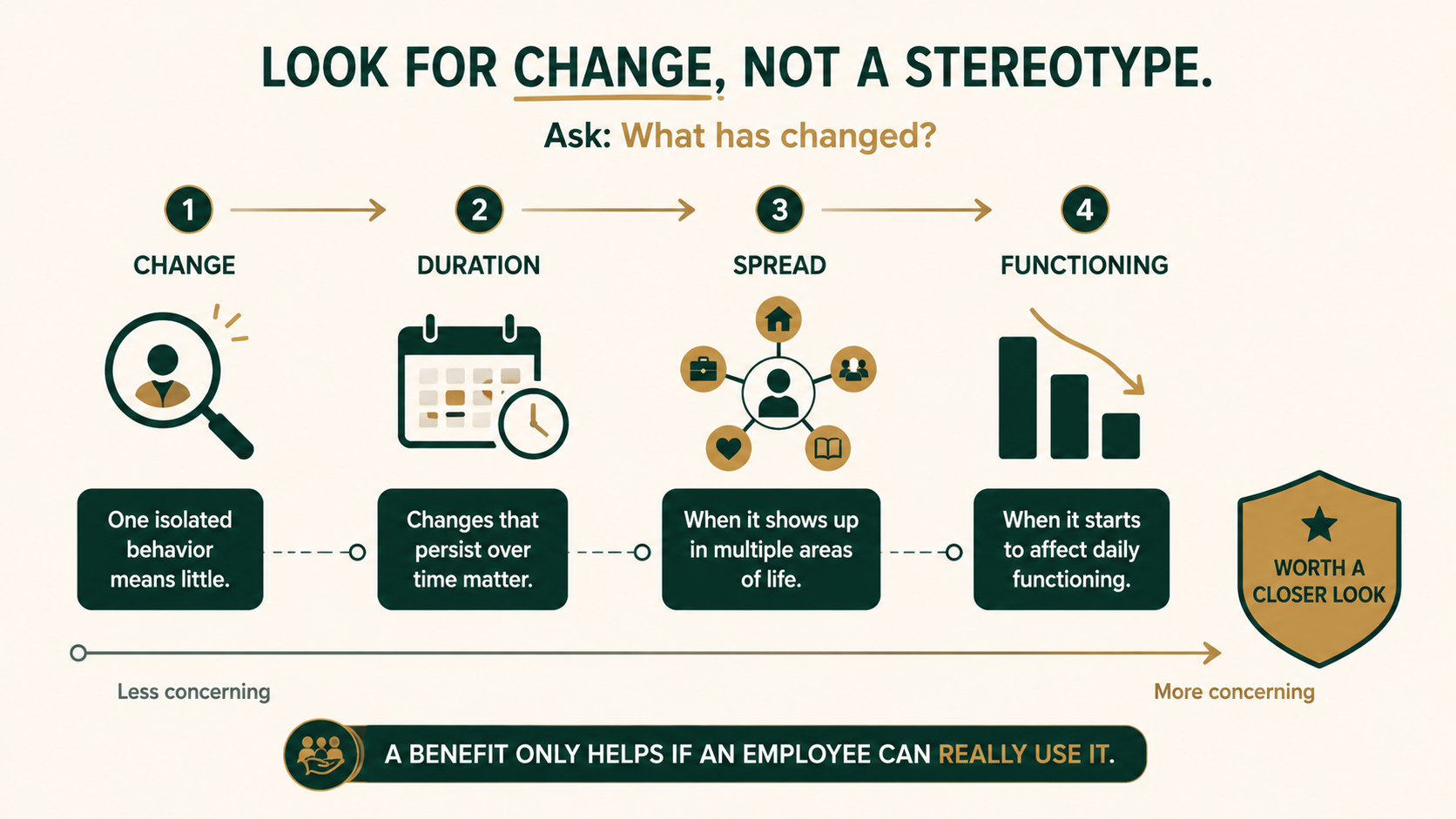
This principle does more work than any list of symptoms. You are not looking for someone who appears depressed. You are looking for a meaningful change from that person's own normal pattern, lasting weeks, appearing in several areas at once, and making ordinary life harder. That is the whole method.
A student who has always been reserved and is still reserved tells you very little.
A student who spent last year in the football team, the drama club and a stable friendship group, and who now leaves immediately, has dropped everything and speaks flatly about the future, tells you considerably more.
The question is not "do they look depressed?" It is "what has changed, how long has it lasted, and how much of their life is it affecting?"
One difficult week is not a pattern. Four consistent weeks across several settings usually is.
What Depression May Look Like in a Student
Rarely like obvious sadness. In young people it shows up more often as withdrawal, loss of interest, irritability, exhaustion, difficulty concentrating and increasingly negative talk about themselves, and any one of those alone has a dozen ordinary explanations. It is the combination and the persistence that matter.
Social withdrawal. Sitting alone when they previously had a group. Disappearing immediately after lessons. Declining things repeatedly, including with old friends they were previously close to.
Loss of interest. Quitting a sport they loved. No longer caring about the club, the instrument, the trip they had been talking about for months. Being visibly unmoved by things that would have mattered last year.
Concentration changes. Rereading instructions. Not finishing work they could easily do. Forgetting routine things. Being present and mentally absent.
Fatigue and sleep. Repeatedly exhausted, sleeping in free periods, arriving late in a way that is new for them.
Irritability. This one is missed constantly, because adults expect sadness. Adolescents with depression are often impatient, defensive, easily overwhelmed or unusually reactive instead. Irritability alone does not indicate depression, but irritability plus withdrawal plus lost interest is a different picture.
Hopelessness and self-worth. Pay particular attention when comments become global rather than specific. I failed that test is normal. I am bad at everything, nothing matters and there is no point are worth noticing and recording.
For general mental health warning signs across an international school community, beyond depression specifically, our article on student mental health warning signs covers the wider picture.
Why Relocation Adjustment Can Look the Same
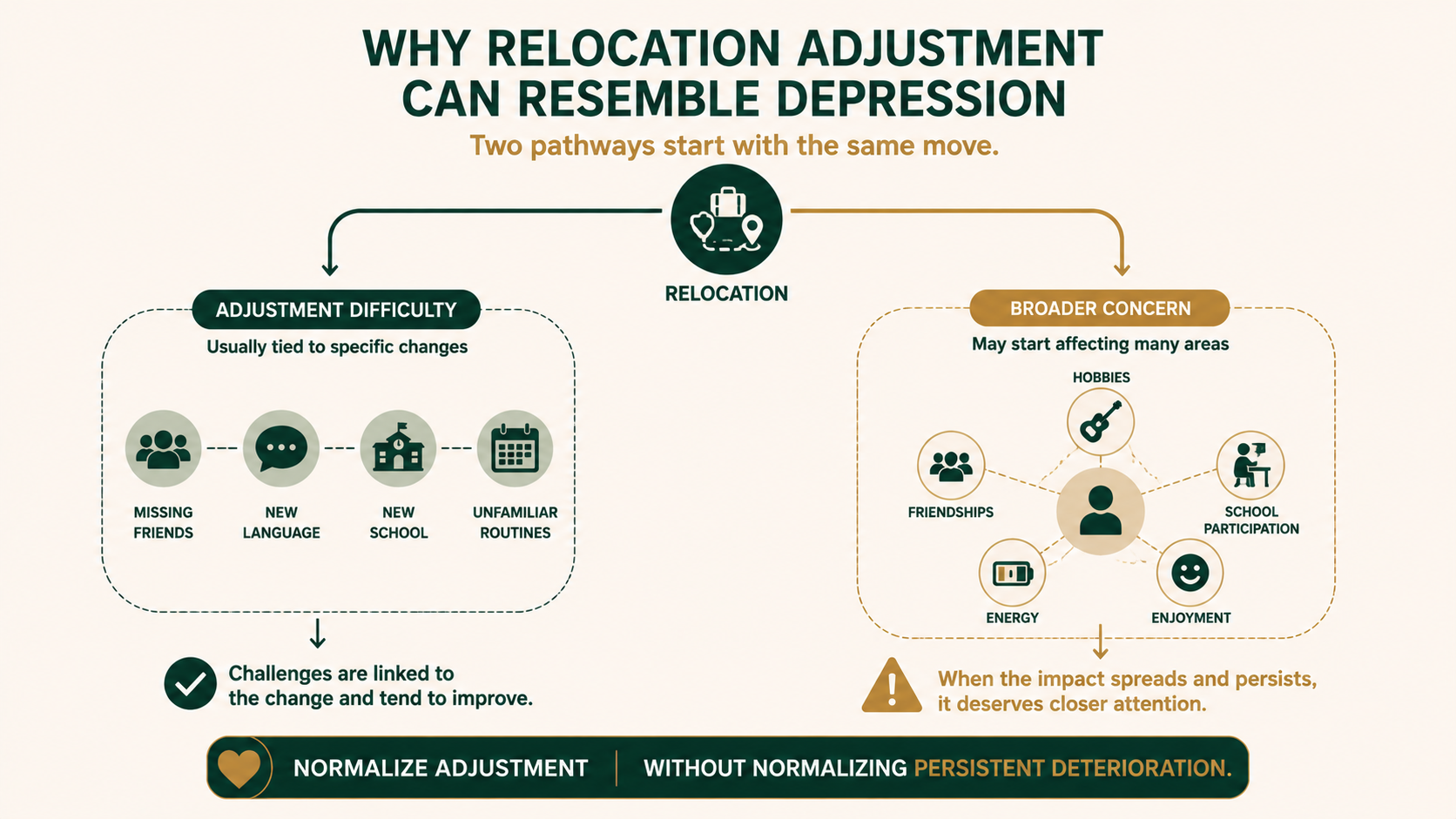
Because it genuinely does look the same at first. A new student may be sad, tired, socially hesitant and struggling academically purely because they have just changed country, language and school, and none of that is depression. Adjustment is painful without being a disorder.
The most useful distinction is whether the difficulty stays attached to something specific or starts to spread.
Adjustment tends to be anchored: I miss my old friends. This school is confusing. I hate that I sound stupid in French. Specific, connected to a real cause, and usually still coexisting with moments of enjoyment.
A broader depressive pattern generalises: I do not want to talk to my old friends either. Football does not matter any more. Nothing sounds good. The difficulty has detached from its original cause and started colouring everything.
That second pattern, especially when it has lasted weeks and is affecting sleep, concentration and participation, is the one that deserves the school's attention.
Why Loneliness After a Move Deserves Attention
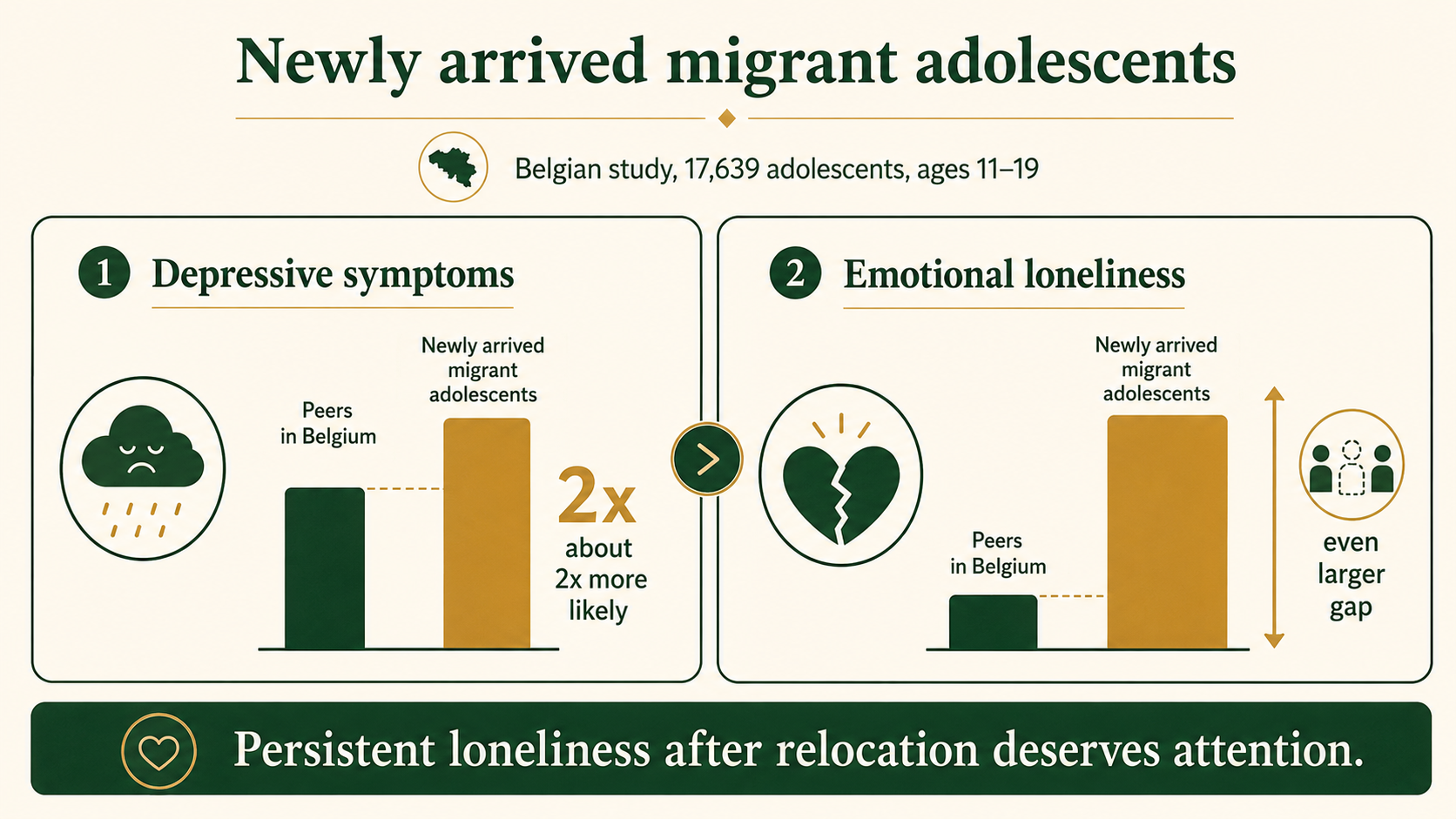
Because peer relationships are central in adolescence, and losing an entire friendship group at once is a genuinely significant event. A student can be surrounded by classmates every day and still feel that nobody here knows them, and persistent loneliness and depression tend to reinforce each other.
The evidence here is worth knowing. A 2024 Belgian study of 17,639 adolescents aged 11 to 19 found that newly arrived first-generation migrant teenagers were about twice as likely to report depressive symptoms as their non-migrant peers. The gap in emotional loneliness was even larger, at roughly three times the odds.
Two honest caveats. Those were migrant adolescents, not international-school students specifically, and the study was cross-sectional, so it cannot show that moving caused anything.
What it does justify is taking persistent loneliness after a move seriously rather than waiting it out. The common school response of "give it a term and they will settle" is reasonable for a few weeks. It is a poor response to a student who has been isolated since September.
What the Wider Evidence Does and Does Not Say
Be careful with the conclusion that a migration background reliably predicts poor mental health, because the largest European dataset does not support it. The picture varies enormously between countries and between individual schools, which is a genuinely useful finding for anyone responsible for running one of them.
A study using data from more than 60,000 adolescents across 29 European countries found that first and second-generation migrant young people reported, on average, more life dissatisfaction and psychosomatic complaints than their peers. But the association varied substantially between schools and between countries, and social support from peers and family moderated it.
Read that as good news about your influence rather than bad news about your students. Migration background alone does not determine a young person's mental health. School context is part of the picture, which means the environment a school builds is not a neutral factor.
There is also evidence often cited about international students. A 2024 review of 26 studies covering more than 7,000 international students found a meaningful link between the stress of adapting to another country and depressive symptoms, with language pressure, unfamiliar educational systems, fear of evaluation and social difficulty among the recurring stressors. Those were mostly university-level students, not children, so treat it as supporting context rather than direct evidence about your school.
Third Culture Kids: What We Know and What We Do Not
Both popular stories about internationally mobile children are stronger than the evidence supports. A 2022 systematic review found the research on third culture children's adjustment limited and heterogeneous, pointing in no single direction. Some report identity, belonging and repeated-separation difficulties. Others develop real cross-cultural flexibility.
So neither third culture kids are damaged by all this moving nor they are naturally more resilient is a safe assumption to bring into a wellbeing conversation.
A student's mobility history tells you what they have lived through. It does not tell you how they are doing.
The practical implication is to treat each student individually rather than through a category. A child on their fourth move may be entirely fine, or may be carrying an accumulation of goodbyes nobody has ever asked about. The mobility history is context, not a prediction. Our article on supporting third culture kids through school transitions covers that territory in more depth.
What Depression May Look Like in an International Teacher
Teachers are the group least likely to be noticed, because the job holds them up. A teacher can continue planning, teaching, marking and reassuring students while their own wellbeing deteriorates, and the classroom performance is often the last thing to slip.
What is distinctive in a school setting, rather than a generic workplace:
They keep the classroom presence and lose everything else. Warm and engaged for five hours, then unable to face the staffroom. The emotional labour of teaching is considerable, and someone running low may spend all available capacity on the students and have nothing left for colleagues.
The school is also their social world. International teachers often arrive with a contract and no other network, so the staff community is their entire social life. Withdrawing from it is not a minor preference. It can mean withdrawing from everyone.
They are responsible for student wellbeing while struggling themselves, which makes disclosure feel professionally risky in a way it would not in another job.
Worth noticing: marked withdrawal from colleagues, lost enthusiasm for work they clearly used to enjoy, persistent exhaustion that breaks do not fix, unusual irritability, difficulty with planning and concentration, and any comment suggesting they are not sure they can continue here.
Nobody is asking colleagues to diagnose a teacher. The broader employer view of this pattern is covered in our article on hidden depression in international employees.
The same applies to counsellors, administrators, coordinators and support staff, who are frequently internationally mobile too. Professional training in mental health does not confer immunity, and school counsellors in particular are often the last people anyone thinks to check on.
One distinction worth holding. A staff member saying this school is exhausting me may be describing occupational strain, which the World Health Organization classifies as an occupational phenomenon rather than a medical condition. A staff member who has also lost pleasure, motivation, social interest and hope in life outside school may be describing something broader. School leaders should not be diagnosing which, only noticing that the second picture is different.
When a Struggling Parent Becomes Part of the Picture
Schools are often the first institution to see that a family is not coping. A parent who has stopped responding, disappeared from the school community, or says plainly that they cannot manage is information about the student's environment, even though the parent is not the school's patient.
The school's job is not to diagnose a parent. It is to recognise that a student's wellbeing sits inside a family system.
It helps to know what that parent may be carrying. A 2025 study of 207 internationally mobile partners found stress and isolation were among the most important factors in their wellbeing. The parent at pickup may be simultaneously rebuilding a career, a social network, a childcare system and a sense of belonging, often without the job that gave their partner an instant community.
Where a parent is clearly struggling, the useful response is to make sure they know support exists, not to counsel them. Our article on parenting abroad with depression is written for exactly that reader if it would help to pass on.
A Simple Recognition Framework
If your community remembers only one thing from this article, make it these four questions. They apply equally well to a student, a teacher, a member of support staff or a parent, and they keep the focus firmly on observation rather than on diagnosis, which is exactly where a school's role sits.
| Question | What you are checking |
|---|---|
| Change | Is this different from this person's normal pattern, rather than their usual personality? |
| Duration | Has it persisted for weeks rather than appearing during one hard fortnight? |
| Spread | Is it showing up in several settings, not just one class, one colleague or one situation? |
| Functioning | Is ordinary participation in school, work or life becoming harder? |
Change plus persistence plus spread plus reduced functioning deserves attention. It does not equal a diagnosis, and it was never meant to.
What Schools Should Not Assume
A short list, because each of these errors is common in international schools and each one costs a student or colleague time. Do not assume that quiet means depressed, that homesick means depressed, that good grades mean everything is fine, or that a confident presentation rules anything out.
Also worth retiring:
- That a smiling, sociable student cannot be struggling
- That an irritable teenager is simply being difficult
- That an exhausted teacher must be burned out
- That a disengaged parent does not care
- That every newcomer difficulty is culture shock which will pass
- That every international move causes psychological harm
- That poor grades are the reliable early signal
And a specific one: do not use nationality as a shortcut for behaviour. Cultural background may shape how distress is expressed and whether it is spoken about. It does not tell you what any individual is experiencing.
Where bullying, exclusion or discrimination form part of the picture, those need addressing in their own right rather than being treated as a wellbeing symptom, and our article on cultural bullying in international schools covers that.
Once You Have Enough Reason to Be Concerned
Keep the next step simple, because this article deliberately ends where your school's response process begins. Do not attempt to diagnose, record concrete observations rather than your interpretations of them, and use the established wellbeing or safeguarding pathway your school already has.
In practice that means: write down what you actually saw and when, rather than what you think it means. Bring it to the person whose role this is, whether that is the counsellor, the safeguarding lead or the wellbeing team. Involve parents or caregivers as your policy and local law require. Involve the appropriate professional rather than trying to manage it within the classroom.
And escalate immediately, not through the usual channels, if there is any concern about safety.
If There Is an Immediate Safety Concern
If a student, teacher, member of staff or parent talks about suicide, describes thoughts of self-harm, says they cannot keep themselves safe, or appears to be in immediate danger, treat it as an urgent situation rather than as something to monitor and review later. The usual timelines do not apply here.
Follow your school's safeguarding and emergency procedures, and involve local emergency or mental health services. For students, follow your safeguarding obligations and involve responsible adults according to your policy and local law. Because international schools operate in many countries, make sure staff know the relevant local emergency and crisis routes where you are, rather than assuming one number applies everywhere.
Immediate safety concerns are not something to watch and see.
Depression is treatable, including in young people, and including when it has gone unnoticed for a long time.
Where Specialist Support Can Help
International school communities carry a particular combination of pressures: repeated relocation, distance from family, language, belonging, identity, contract-driven mobility and parents rebuilding their own lives alongside their children's. Support that already understands that context spends considerably less of the hour establishing it.
Expathy works with international communities and matches people with psychologists by native language and cultural background, all of whom have lived abroad themselves. We would not claim that matching guarantees better clinical outcomes, because the evidence does not support that. What it reduces is the effort of explaining why an apparently successful international life can still be difficult.
For schools looking at what support they can make available to staff and families, Expathy for Business sets out how that works.
Final Thought
The hardest part of this in an international school is not knowing the symptoms. It is holding two things at once: that most adjustment difficulty resolves on its own, and that some of it does not.
Getting that balance right is not about becoming more clinical. It is about noticing change, giving it time without giving it unlimited time, and having somewhere to take a concern when it persists.
The student who quietly disappears from school life, the teacher who stops coming to lunch and the parent who withdraws from the community are all telling you something. Usually it is adjustment. Occasionally it is not.
The four questions above are enough to tell the difference more often than not. Everything after that belongs to the people whose job it is.
Sources and Further Reading
- Devos and colleagues (2024), study of 17,639 adolescents in Flanders on depressive symptoms and loneliness among newly arrived migrant young people: https://doi.org/10.1080/02673843.2024.2395388
- Delaruelle and colleagues (2021), Journal of Youth and Adolescence, analysis of adolescents across 29 European countries on migration background, mental health and social capital: https://doi.org/10.1007/s10964-021-01423-1
- Soufi Amlashi and colleagues (2024), review of 26 studies covering more than 7,000 international students on the stress of adapting abroad and depressive symptoms: https://doi.org/10.3389/fpsyg.2024.1403807
- Aegerter and colleagues (2025), study of 207 internationally mobile partners on stress, isolation and wellbeing: https://doi.org/10.3389/fpsyg.2025.1607178
- World Health Organization on burnout as an occupational phenomenon in the International Classification of Diseases: https://www.who.int/news/item/28-05-2019-burn-out-an-occupational-phenomenon-international-classification-of-diseases
Frequently Asked Questions
What are the warning signs of depression in an international-school student?
Most often withdrawal from friends and activities, loss of interest in things they used to care about, concentration difficulties, persistent exhaustion, irritability and increasingly negative statements about themselves or the future. No single sign means much. What matters is change from their usual pattern, lasting weeks and affecting several areas of school life.
How can a school tell depression from homesickness or relocation stress?
Adjustment difficulty usually stays attached to something specific, such as missing old friends or struggling with the language, and coexists with moments of enjoyment. A depressive pattern tends to generalise, so the student stops caring about old friends too, loses interest in activities unconnected to the move, and describes everything as pointless.
Can a student be depressed even if their grades are still good?
Yes, and this is a common blind spot. Academic performance is externally structured by deadlines and expectations, so it often holds up while social life, interest and self-care decline first. Waiting for grades to fall before becoming concerned usually means noticing very late.
Is social withdrawal always a sign of depression?
No. A student may be quiet by temperament, still adjusting to a new language, or simply not yet part of a friendship group. What is more meaningful is withdrawal that represents a change, that includes people they were previously close to, and that appears alongside lost interest, exhaustion or hopelessness.
Can depression make teenagers irritable rather than sad?
Frequently. Adolescents with depression often present as impatient, defensive, easily overwhelmed or unusually reactive rather than visibly sad, which is why they are sometimes read as difficult rather than unwell. Irritability alone is not enough to suggest depression, but combined with withdrawal and lost interest it changes the picture.
Are third culture kids more likely to become depressed?
The evidence does not support a clear answer in either direction. A 2022 systematic review found research on internationally mobile children limited and heterogeneous, with some reporting identity and belonging difficulties and others developing genuine cross-cultural flexibility. Treat mobility history as context about an individual student rather than as a prediction.
What might depression look like in an international teacher?
Often preserved classroom performance alongside marked withdrawal from colleagues, lost enthusiasm for work they used to enjoy, persistent exhaustion that time off does not fix, unusual irritability and difficulty concentrating on planning. Because the staff community is frequently their entire social world abroad, withdrawing from it can mean withdrawing from everyone.
Can a parent's difficulties affect their child's adjustment at school?
A student's wellbeing exists inside a family system, and schools often see the first indication that a family is struggling. Research on internationally mobile partners found stress and isolation were significant factors in their wellbeing. The school's role is to notice and to make support known, not to assess or diagnose the parent.
When should a school involve a counsellor or safeguarding lead?
When a concern shows change from the person's normal pattern, has persisted for weeks, appears in more than one setting, and is making ordinary participation harder. You do not need certainty to refer. Record concrete observations rather than interpretations and use your established wellbeing or safeguarding pathway.
What should a school do if someone talks about self-harm or suicide?
Treat it as urgent rather than something to monitor. Follow your school's safeguarding and emergency procedures immediately and involve local emergency or mental health services. Ensure staff know the relevant local crisis routes in your country rather than assuming one emergency number applies everywhere.
Need support? We're here.
Book a free 15-min consultation with our expat-specialized therapists.