
Key takeaway
An international relocation can be a complete practical success and still leave the person psychologically unfinished, and that gap is what an identity and belonging workshop is built to address. This article explains what such a workshop actually is, why relocation disturbs several identity anchors at once, why the issue shows up differently in companies and in international schools, how belonging differs from loneliness, why intercultural training rarely reaches this territory, what a good session covers, and what it honestly cannot fix. The core distinction to hold onto: practical adaptation is not the same as psychological integration. Start by asking whether your international staff have settled, or only arrived.
The visa came through eighteen months ago. The apartment is sorted, the commute is automatic, the supermarket no longer requires a translation app. At work she is competent, respected, and running a team.
And at some point in the evening she catches herself thinking that she is not entirely sure who she is here.
This is not a crisis. She is not unwell, not underperforming, not planning to leave. She is simply carrying a question that nothing in her onboarding, her relocation package or her wellbeing benefit was designed to hear.
A completed relocation is not always a completed adjustment.
What is an identity and belonging workshop?
An identity and belonging workshop is a facilitated group session that helps internationally mobile people understand how relocation has affected their sense of self, their professional identity and their sense of belonging, and how to integrate who they were with who they are becoming abroad. It is reflective and practical rather than clinical, and it is designed for groups rather than individuals.
It sits somewhere that most organisational wellbeing provision does not reach. Relocation support handles logistics. Intercultural training handles the environment. Employee assistance programmes handle crisis. The territory in between, where someone is functioning perfectly well and quietly wondering where they fit, usually has nobody assigned to it.
Why can relocation affect identity even when the move went well?
Because identity rests on several anchors at once, and an international move can disturb most of them simultaneously. Place, relationships, language, professional role, daily routines, social status, cultural reference points and the assumed shape of the future all shift together. Practical competence returns quickly. The sense of being recognisably yourself often takes considerably longer.
Consider what actually changed. The person still has their expertise, but not the network that vouched for it. They still have their humour, but not the language to land it. They still have their reputation, but only in a country they no longer live in.
The InterNations Expat Insider 2026 survey, which asked nearly 8,000 respondents of 162 nationalities about life in 31 countries, illustrates the split neatly. The Netherlands ranked among the best countries in the world for working abroad, and 71% of expats there said they were happy with their lives. Making friends with locals and learning the language, meanwhile, were noted as real struggles, which the survey linked to difficulty feeling that the country was home.
Excellent on the job. Still not quite at home. Those two findings sit in the same dataset, about the same people, in the same country.
Adjustment research supports the idea that this is workable rather than fixed. A meta-analysis in the Journal of Cross-Cultural Psychology covering 62 studies and 13,060 people found that while broad personality traits matter for expatriate adjustment, capacities such as cultural empathy, cultural intelligence and emotional intelligence appeared to exert a stronger influence.
Adjustment is not simply a personality someone either has or does not have. That is precisely why reflective work on it is worth doing.
Why this matters for companies with international employees
Because for many international employees, work becomes the most stable and legible part of life abroad, which quietly loads the employer with more identity weight than it realises. The company is where they are competent, understood and part of something. Outside it, the country can still feel like a place they are visiting.
Common patterns HR and Global Mobility teams see without necessarily naming them:
- A senior specialist who contributes less in meetings, not because they know less but because they are working in their second language and half a second slower to the floor
- Someone who belongs firmly to the company and not at all to the country around it
- An employee whose professional identity feels subtly different here, with less authority, different scope, or expertise that does not translate cleanly
- Someone who misses home constantly and has no intention of moving back
That last one confuses people. Missing home and wanting to return are different things, and treating them as the same is how organisations misread a settled, committed employee as a flight risk.
Professional identity is one strand of this and a substantial one in its own right, covered separately in Expathy's article on loss of status after international relocation. A workshop touches it without trying to be a career intervention.
Why this matters for international schools
Because international teachers and school staff are relocating and working in the same place, which compresses two demanding adjustments into one building. According to ISC Research, international schools employed 713,539 staff members globally as of January 2025. For a large share of them, the school is workplace, social life and community all at once.
The specific pressures are worth naming:
A teacher can run a classroom with total authority at 9am and feel entirely foreign in a pharmacy at 5pm. Professional confidence and personal belonging do not travel together.
Then there is the churn. International school communities rebuild themselves every year. Colleagues leave, families leave, friendships that took two years to form disappear over a summer. Staff absorb repeated goodbyes as a structural feature of the job.
And there is the asymmetry nobody plans for: staff are asked to support internationally mobile students and families through transition while personally in the middle of their own. Long-serving teachers, sometimes a decade into a country, can find the question where is home now harder to answer than newcomers do.
Teacher wellbeing generally is under strain. A University of Oxford Wellbeing Research Centre review for the International Baccalaureate notes that teachers report among the highest levels of occupational stress and burnout of any profession. Identity and belonging work does not address burnout, but it addresses a load that international staff carry on top of it. Expathy covers the broader picture in mental health support for international schools.
Identity, belonging and loneliness are not the same thing
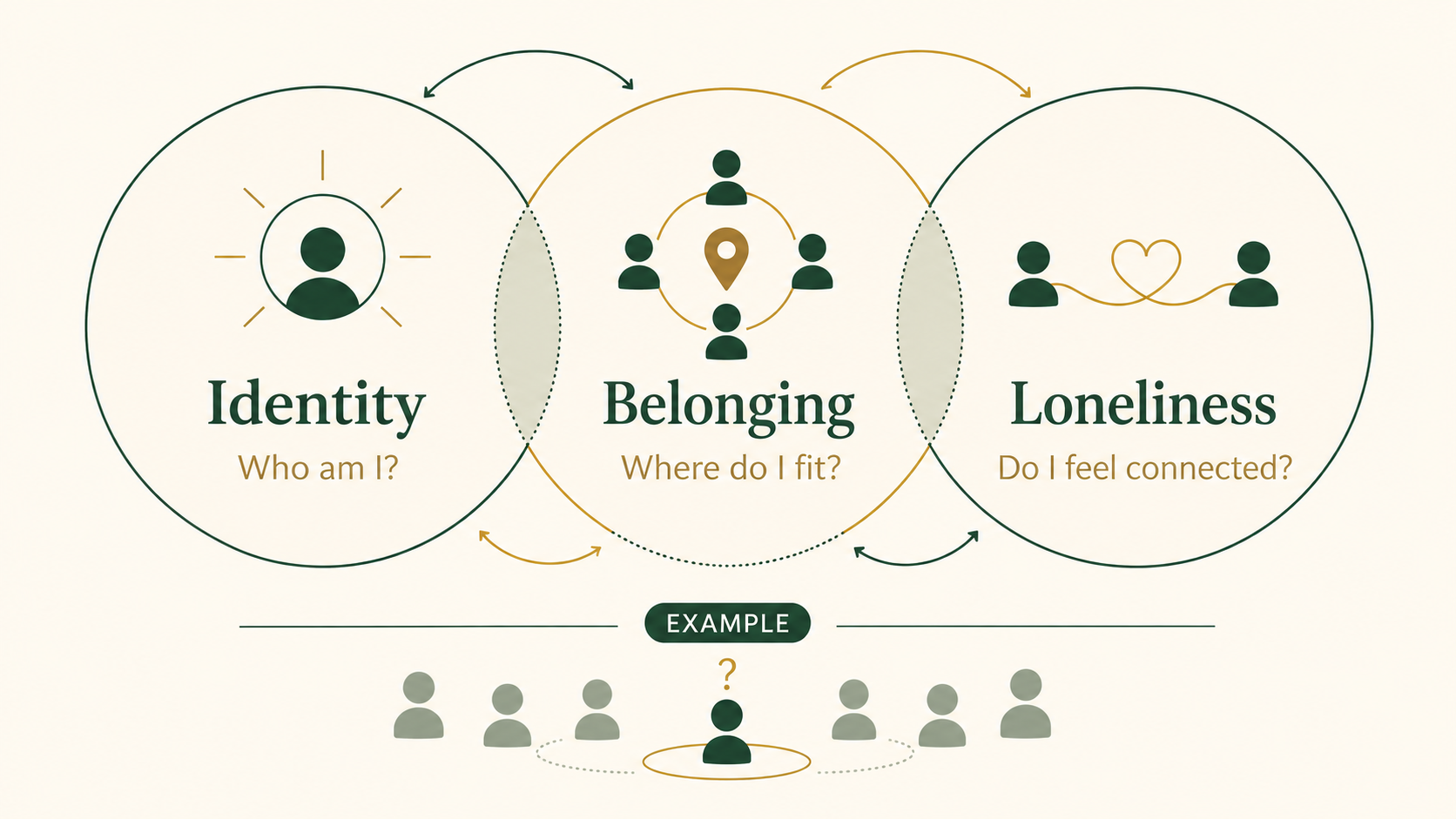
Loneliness is about the gap between the connection you have and the connection you want. Belonging is about whether you fit, culturally and psychologically, in the place you are living. Identity is about whether you still recognise yourself. Someone can have a partner, close friends and a busy calendar and still answer no to the second and third questions.
This distinction matters enormously for programme design, because organisations reliably respond to belonging problems with social events. Drinks. A buddy scheme. A newcomers' group. All useful, none of them an answer to I have friends here and I still do not know where I fit.
Belonging is not a headcount of friendships. Someone with a full social life can still be unsure where they fit.
Where the issue genuinely is isolation rather than belonging, that is different territory, and Expathy addresses it in loneliness abroad.
How is this different from intercultural training?
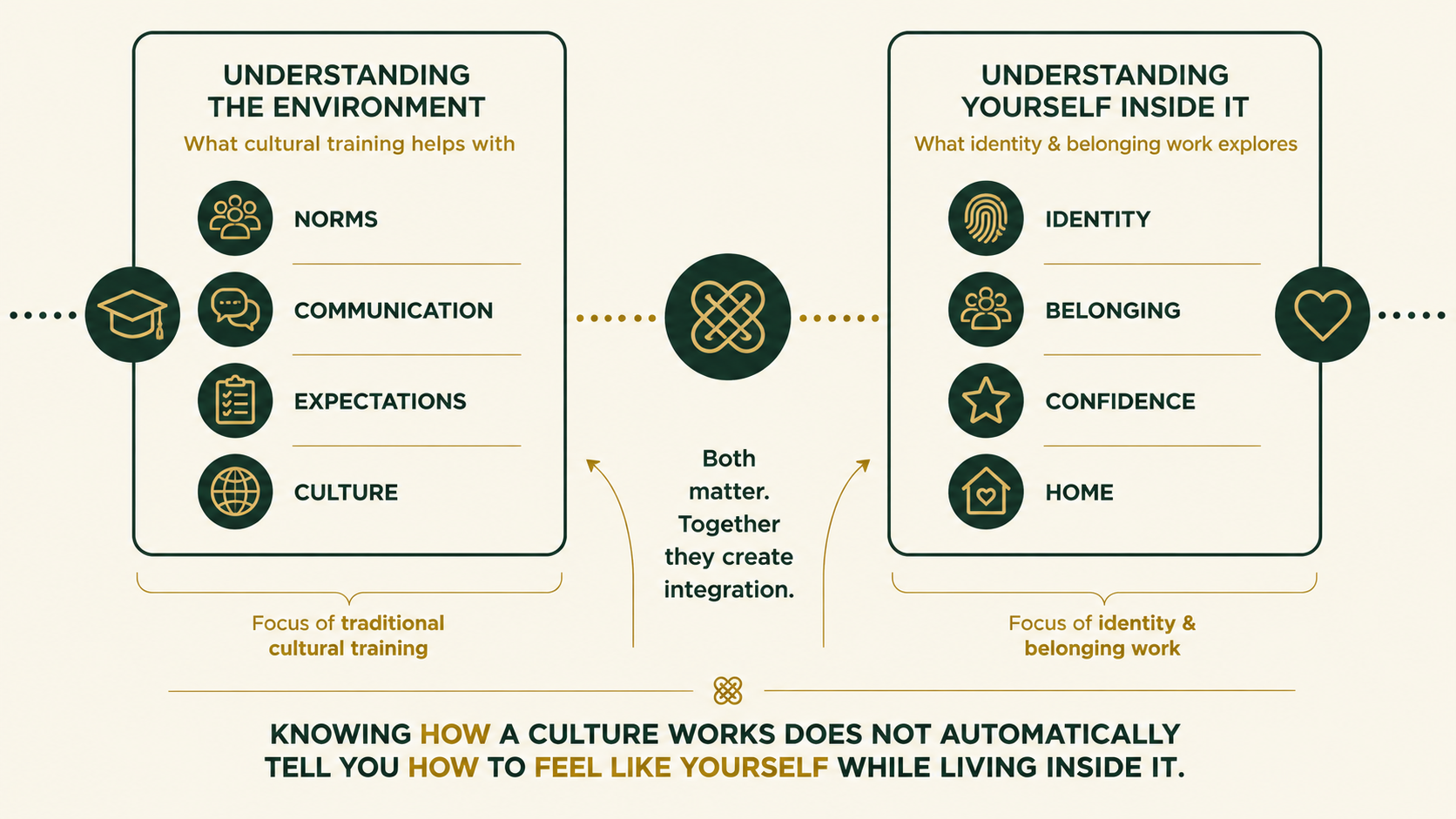
Intercultural training explains the environment. Identity and belonging work examines the person's relationship with that environment. Cultural briefings cover communication styles, hierarchy, feedback norms, meeting etiquette and local expectations. Valuable and necessary. But they answer a question about the country, not a question about the self.
The workshop asks something intercultural training does not:
What is living inside this culture doing to the way I understand myself?
That is why an employee can complete an excellent cultural adjustment programme, understand the local business culture thoroughly, and still be carrying the thing this workshop is for. Expathy's related piece on culture shock and its stages covers the environmental side; this is the other half.
It is also why generic employee wellbeing provision often misses it. The frameworks were built for domestic workforces, where nobody assumed the participant's entire sense of place had been relocated. That gap is examined further in why generic EAPs do not work for expat employees.
What a good identity and belonging workshop covers
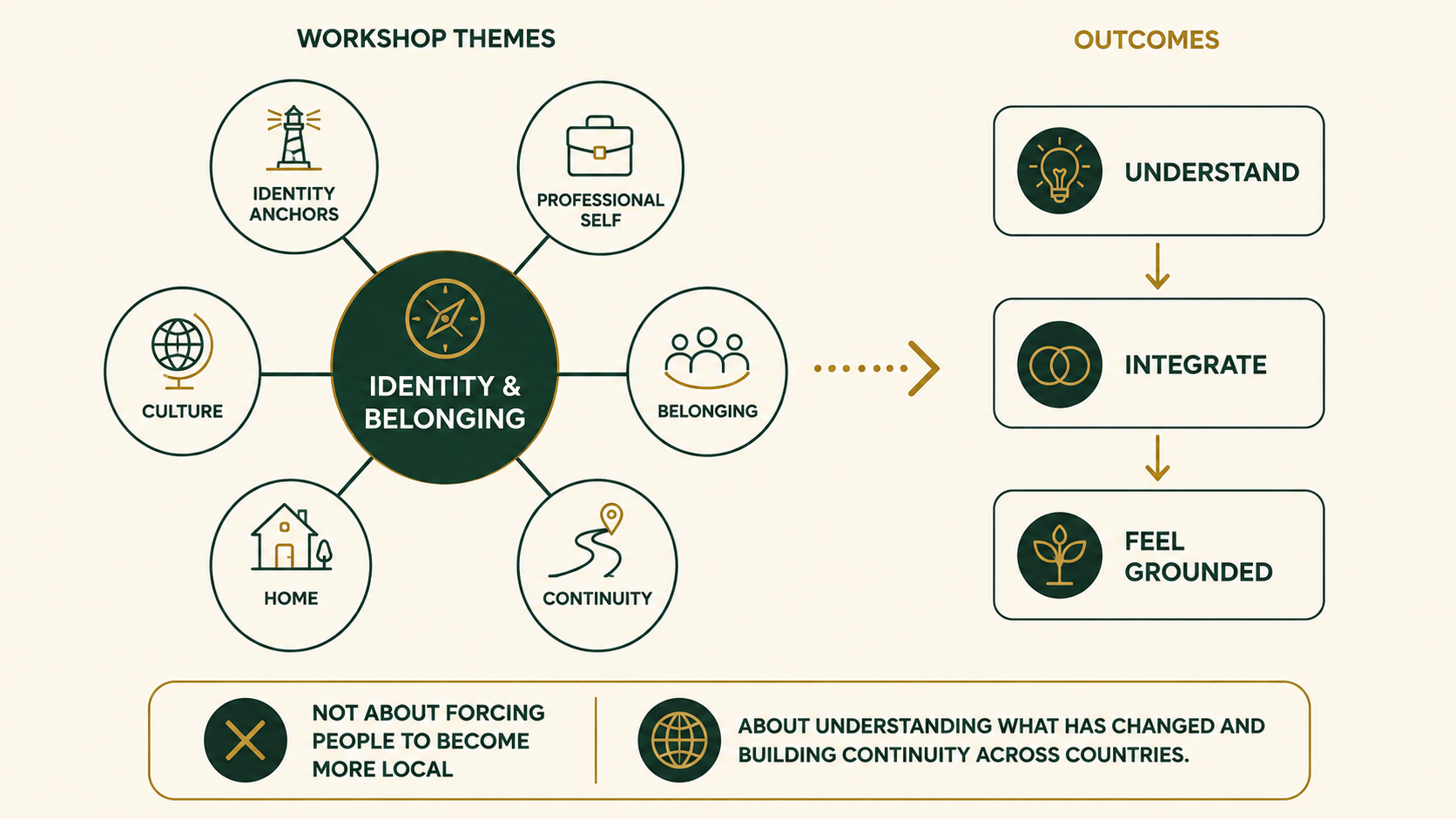
A strong session helps participants understand why relocation affects identity, name which parts of themselves have become less visible abroad, and build continuity between their previous life and their current one, without being asked to choose between the two. It should be reflective and structured, not therapy in a meeting room.
Typical ground:
- Identity anchors. Which sources of self, professional role, language, place, relationships, routines, status, actually shifted, and which are intact.
- Keep, change, add. What from the previous life is worth deliberately preserving, what has genuinely changed, and what has been gained here that would not have existed otherwise.
- Belonging maps. Where belonging currently lives: team, organisation, country, language community, home country, international community. Most people find it is distributed unevenly rather than absent.
- Professional continuity. How professional identity has shifted across systems, and what remains true regardless of local title or scope.
Sessions work best when they are small enough for real conversation, facilitated by someone who has lived the experience rather than only studied it, and framed as a normal part of international working life rather than as a remedial intervention.
One design principle matters more than any exercise: participants must not leave feeling that their belonging is their own responsibility to fix.
What participants and organisations actually get from it
Participants typically leave with language for something they had experienced but never articulated, and a clearer view of what they want to carry forward. For organisations, the value is a form of support that recognises the specific experience of international staff rather than applying a domestic wellbeing template to a globally mobile workforce.
The most common feedback from this kind of session is some version of I thought this was just me. Group format does that work. Hearing a colleague describe the same private confusion changes how someone interprets their own.
There is reasonable evidence that belonging behaves as a workplace-level variable rather than a purely personal feeling. A study of US local public health professionals using the 2024 Public Health Workforce Interests and Needs Survey found that people reporting a stronger sense of belonging within their agency reported better mental and emotional wellbeing. That population is not internationally mobile, so the finding does not transfer directly, but it supports a general point: belonging is measurable, it is connected to wellbeing, and organisations influence it.
Nobody should promise that a workshop improves retention. What it can honestly offer is recognition of an experience most international employees are managing privately.
What a workshop cannot solve
A workshop cannot substitute for fixing an environment that is genuinely exclusionary, discriminatory or unsafe. If international staff are being passed over, talked around, excluded from decisions or subjected to bias, the problem is not their sense of belonging. The problem is the organisation, and no amount of reflective group work is an acceptable answer to it.
It also cannot replace individual mental health support. Some participants will be dealing with something a group session is not designed for, and any credible facilitator should be able to recognise that and signpost accordingly rather than absorb it into the workshop.
And it should never imply that adapting well means becoming more culturally local. Integration is not assimilation, and a session that quietly rewards people for shedding their origins has done the opposite of its job.
Why Expathy
Expathy works specifically on the psychological experience of living abroad, with psychologists who have lived internationally themselves. That matters for this topic more than it does for most, because the material is difficult to facilitate credibly from the outside. Someone who has not experienced the gap between being competent somewhere and belonging there tends to reach for cultural training instead.
We work with companies employing international staff and with international schools, and we can pair workshop delivery with individual support in a person's native language where someone needs more than a group session offers. The broader offer for organisations is set out in Expathy's mental health workshops for international teams, and we are happy to talk through what would actually be useful for your community before anything is scoped.
Frequently asked questions
What is an identity and belonging workshop?
It is a facilitated group session helping internationally mobile employees, teachers and staff understand how relocation has affected their sense of self and belonging, and how to integrate their previous identity with their current life abroad. It is reflective and practical, not clinical.
Why can relocation affect someone's identity?
Because identity is supported by multiple anchors at once: place, relationships, language, professional role, routines, status and cultural reference points. An international move can disturb most of them simultaneously. Practical competence usually returns well before the sense of being recognisably yourself does.
Is belonging the same as loneliness?
No. Loneliness concerns the gap between the connection someone has and the connection they want. Belonging concerns whether they fit culturally and psychologically where they live. Someone with a partner, friends and an active social life can still feel uncertain about where they belong.
How is this different from intercultural training?
Intercultural training explains the host culture: communication norms, hierarchy, etiquette, workplace expectations. An identity and belonging workshop examines the person's relationship with that culture and what living inside it is doing to how they understand themselves. The two are complementary rather than interchangeable.
Who should attend?
International employees at any stage after relocation, international teachers and school staff, and mixed groups of internationally mobile colleagues. Sessions work well for teams where several people share the experience, and for whole-staff settings in international schools.
Is it only useful for people who have recently arrived?
No. Long-term internationals often find it more relevant, not less. Questions about where home is, whether to stay permanently, and what has changed about oneself over a decade abroad tend to surface years after the practical adjustment finished.
Can international teachers and school staff benefit?
Yes, and their situation has particular features: the school is often workplace and social world at once, communities rebuild annually as colleagues and families leave, and staff support mobile students and families while managing their own transition.
Can a workshop address professional identity after relocation?
It can address it as one theme, covering how professional identity shifts across countries and systems and what remains true regardless of local title or scope. It is not career coaching and should not be presented as a substitute for it.
How can companies and international schools support belonging after relocation?
By recognising that support needs do not end when logistics do, by not assuming social events answer belonging questions, by making it normal to discuss adjustment beyond the first six months, and by addressing genuine exclusion at the organisational level rather than treating it as an individual adjustment issue.
Why choose a provider that specialises in international life?
Because the specific material, identity anchors shifting, professional recognition changing across borders, belonging distributed across several places, is difficult to facilitate credibly without direct experience of it. Generic wellbeing frameworks were largely designed for workforces that had not relocated.
Need support? We're here.
Book a free 15-min consultation with our expat-specialized therapists.