
Key takeaway
An employee closes the meeting room door and says they have been struggling with depression. In the next ninety seconds a manager can do several things that make the situation worse: ask for details, promise confidentiality they cannot guarantee, quietly remove the person from important work, or send an EAP link and consider it handled. This article is about what good employer support actually looks like once concern is on the table, and where your role stops.
Recognition is a separate problem, and if you are still at the stage of wondering whether something is wrong, our article on hidden depression in international employees covers that.
This one starts later. The question is no longer what am I seeing. It is what do we do now.
And the honest answer involves less action than most managers expect, applied more carefully.
Your Role Once Someone Has Told You
You are not there to fix them and not there to withdraw. Your job is to protect their privacy, adjust what can reasonably be adjusted at work, make access to proper care genuinely easy, and stay out of the clinical relationship entirely. That is a narrow role, and doing it well is worth a great deal.
Two failure modes account for most of the damage.
Over-involvement: becoming the employee's emotional support, monitoring their mood, taking responsibility for their recovery, requiring updates on how they feel.
Under-involvement: acknowledging the disclosure, sending a resource link, changing nothing, and never raising it again.
The correct position sits between those. You handle work. Clinicians handle depression. You make sure the second one is reachable.
The First Conversation
Keep it private, calm and short. Thank them for telling you, make clear they do not have to share anything they are uncomfortable sharing, and ask what would make work more manageable right now. That is genuinely most of it. The instinct to gather information is the instinct to resist.
Useful things to say:
Thank you for telling me. You do not need to share more than you want to. What would make work more manageable at the moment? Is there any support you would like help getting access to?
Things not to ask: what caused it, whether they are on medication, how severe it is, whether they are sure it is not just stress, and when they expect to be back to normal. Each of those either requests clinical information you should not hold, or signals that you are waiting for this to be over.
Managers need enough information to support the work. They do not need enough information to form a clinical picture.
One thing worth saying explicitly in that first conversation: that telling you will not count against them. Most employees are half expecting it to.
Privacy, and What You Actually Need to Know
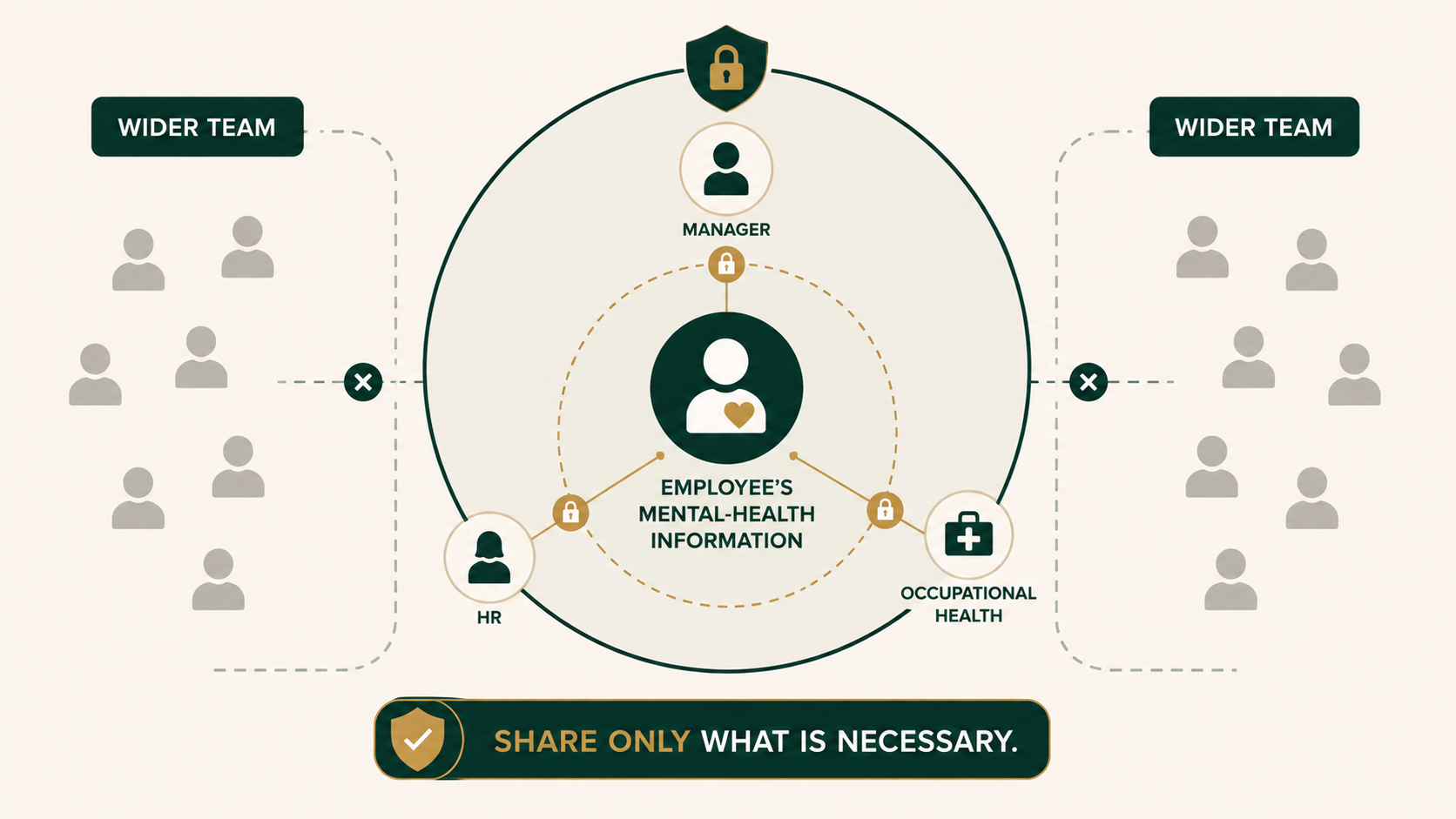
Handle mental health information on a strict need-to-know basis. Managers do not need a diagnosis, and colleagues almost never need to know anything at all. What you need is the practical picture: what is hard at work, what adjustments are agreed, and how long they run for.
Some practical boundaries:
Do not explain an absence by revealing a health condition. Do not discuss it informally with other managers because it seems relevant. Do not keep notes containing clinical detail you do not need. Do not assume the team should be told anything.
Ask instead: what, if anything, would you like your colleagues to know? Some people want a colleague informed so they are not covering alone. Others want nobody told. Both are legitimate, and it is their call, not yours.
Be careful with the word confidential. Managers promise absolute confidentiality constantly and cannot always deliver it, particularly where safety is involved. Say what is actually true: that you will share only what is necessary, only with whoever genuinely needs it, and that you will tell them if that changes. Legal obligations around health data, occupational health and disability vary considerably by country, and your local requirements govern.
Ask What Makes Work Harder
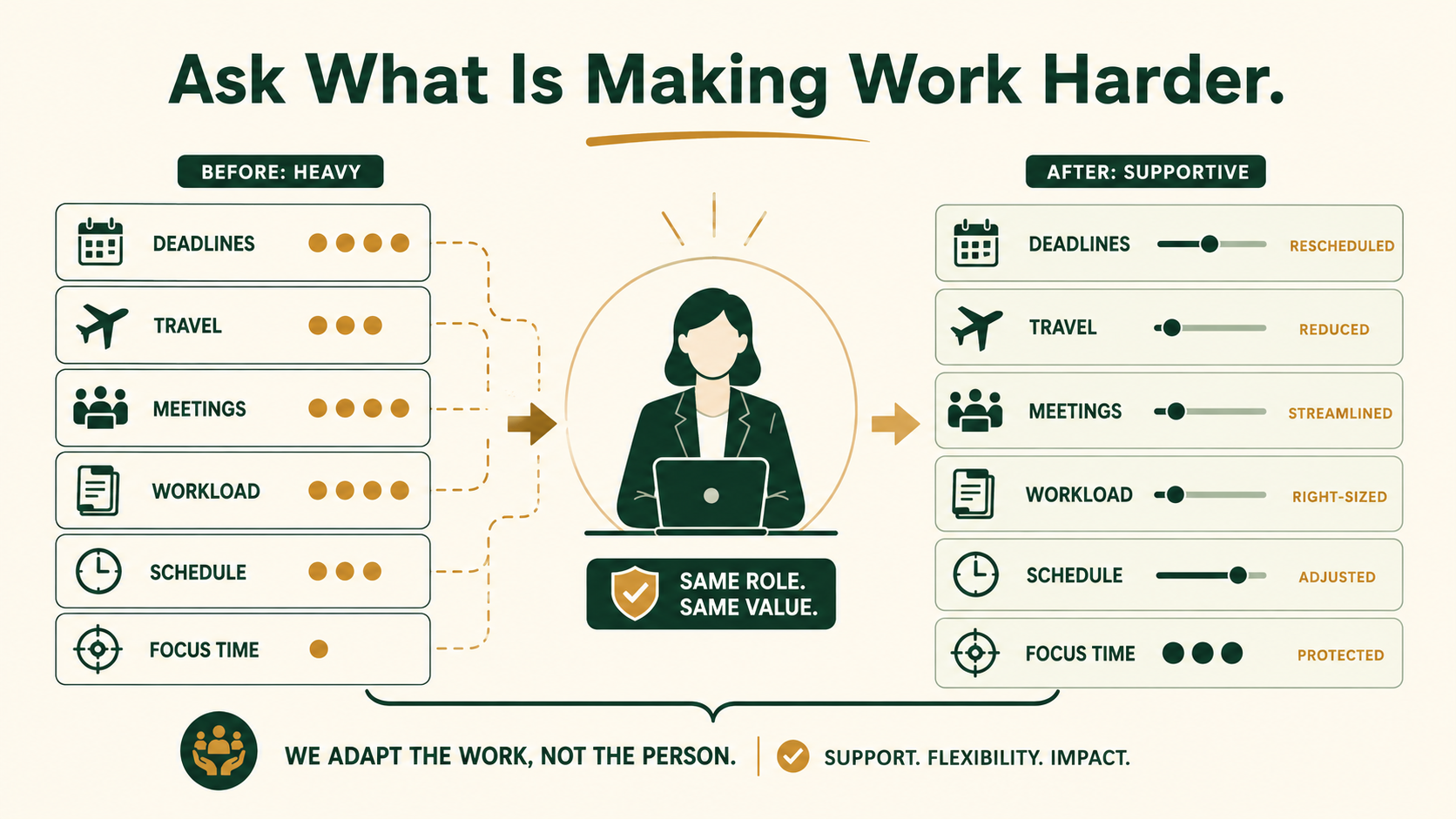
Do not assume the answer is time off, and do not assume it is workload. Ask what specifically is difficult, because depression interacts with the shape of work more than the volume of it. Concentration-heavy tasks, unpredictable schedules, travel and long meetings often cost far more than total hours do.
Things that frequently help, when the employee agrees they would:
- Clearer priorities, so less energy goes to deciding what matters
- Fewer simultaneous deadlines rather than fewer tasks overall
- More predictable scheduling, particularly across time zones
- Reduced non-essential travel for a defined period
- Protected focus time, and written follow-up after complex meetings
- Flexibility around appointments without a negotiation each time
- Temporary redistribution of specific tasks rather than general demotion
Agree what is temporary and when it will be reviewed. Adjustments with no end date tend to become permanent by accident, which serves nobody.
Not every accommodation is appropriate or possible, and pretending otherwise sets up a worse conversation later. Be straight about what you can and cannot change.
Support That Does Not Become Sidelining
This is where well-meaning organisations do real harm. After a disclosure, managers frequently start protecting someone out of the interesting work, the visible projects, the travel and the promotion conversations, without ever discussing it. The employee experiences it as a career penalty for having been honest.
The rule is simple and worth stating in manager training: ask before protecting.
Would reducing travel help at the moment? is a completely different act from we have decided you should not travel for now. The first respects that they know their capacity. The second removes their agency and tells them what disclosure costs here.
The same applies to development opportunities, stretch work and succession conversations. Someone with depression is not someone whose career has paused, and treating them as fragile is its own kind of exclusion.
If disclosure quietly costs people opportunities, your organisation will stop hearing about problems long before it stops having them.
"We Have an EAP" Is Not the Same as Access
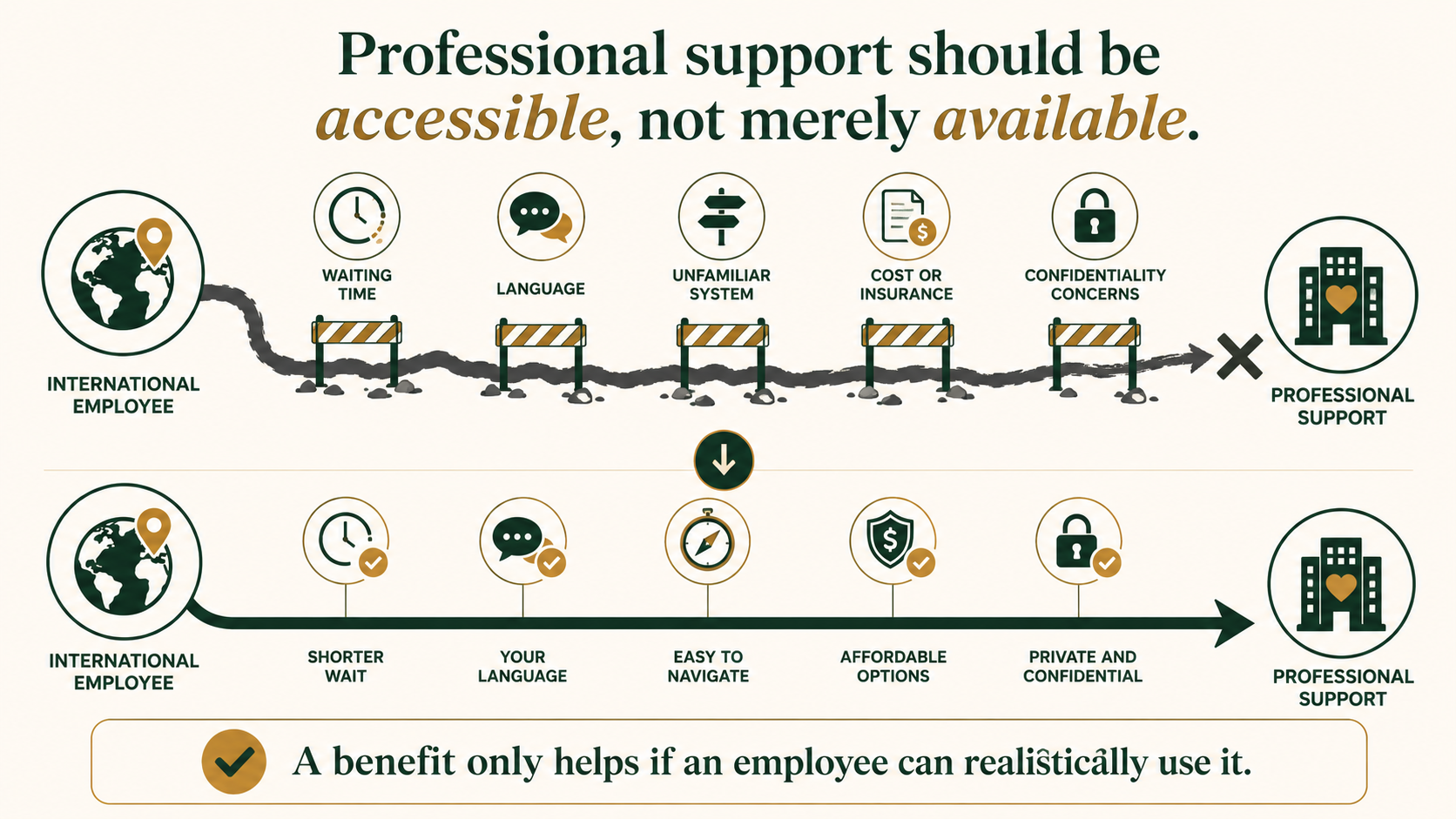
A benefit exists on paper only if the employee can realistically use it. For international employees, the gap between provision and access is usually much wider than employers assume, and it is the single most fixable thing in this entire article.
Consider what stands between a relocated employee and a first session: waiting times, a therapist directory in a language they read imperfectly, uncertainty about whether the provider works across borders, an unfamiliar health system, insurance they do not fully understand, no idea whether their employer sees usage data, and no vocabulary for what they are experiencing in the local language.
The World Health Organization identifies language and lack of knowledge about available services as significant barriers to accessing mental health care among migrant populations. That evidence base is broader than corporate mobility, but the barriers are recognisable to anyone who has tried to find a therapist in a country they moved to eighteen months ago.
Worth auditing honestly:
- How quickly can someone actually get a first appointment?
- Is support available in languages your international staff would choose?
- Can it be accessed from abroad, or while travelling?
- Is usage genuinely invisible to managers and to HR?
- Does the provider understand relocation, or only clinical presentation?
- Are partners included, where that is relevant?
None of that requires a new budget line to find out. It requires asking your existing provider four questions.
What the Evidence Says About Language and Cultural Fit
Be careful in this area, because it attracts a great deal of overclaiming from vendors and well-meaning internal advocates alike. There is no good evidence that therapy delivered in someone's first language produces better clinical outcomes for everyone. What the research does support is narrower, more specific and still genuinely useful to an employer.
The landmark study on matching is a meta-analysis by Cabral and Smith covering 52 studies of client preferences, 81 of perceptions and 53 of actual treatment outcomes. People showed a clear preference for a therapist from their own background and rated them somewhat more positively. The difference in actual outcomes was close to negligible.
So preference and outcome are not the same thing, and matching alone guarantees nothing.
What does appear to matter is cultural responsiveness in the treatment itself. A 2025 systematic review by Uhr and colleagues in BMC Psychiatry examined 20 studies of psychological treatment for depression in refugees and asylum seekers, including nine randomised trials. Nineteen of the twenty reported significant improvement, with culturally adapted cognitive behavioural therapy the most studied approach. Notably, nine of the trials used interpreters and still showed benefit, which undercuts the assumption that care only works in the client's own language.
The review's authors were clear about the limitations: few trials, only one with an active control group, and a refugee population that does not transfer to corporate assignees.
The practical conclusion for an employer: offer choice rather than prescribing a model. Some employees will want their first language, some will prefer the local one, and some will want different languages for different subjects. What you can reasonably provide is a route where that choice exists and where the clinician understands migration context.
Look at the Relocation, Not Only the Person
Depression is not the only thing your employee is managing. They may simultaneously be dealing with isolation, visa uncertainty, a partner without work, children struggling at school, family distance, discrimination or the loss of professional identity at home. Some of that is within your influence.
You are not diagnosing causes. You are asking a different question: is there anything about this relocation or this role that we could realistically make less difficult?
Sometimes the answer is genuinely useful. Immigration certainty communicated earlier. Help with administrative burden nobody accounted for. Support navigating healthcare. A workload that was set for someone with a functioning support network. Manager behaviour that has been part of the problem.
And one boundary that matters more than anything else in this article:
Therapy must never be used to help someone tolerate an environment that is genuinely harming them. If the picture includes discrimination, unsafe workload, or a manager behaving badly, offering counselling instead of fixing it is not support. It is outsourcing the problem to the person experiencing it.
The related structural issue, where an employee has almost no social infrastructure outside work regardless of their mental health, is covered in social isolation in international employees.
The Family Is Part of the Picture
Global mobility teams know this and support models often do not reflect it. An employee can be doing reasonably well while their partner is isolated and unemployed, and that strain feeds directly back into the employee. The reverse also happens.
The evidence supports treating relocation as a family event rather than an employee one. A 2025 study of 207 internationally mobile partners by Aegerter and colleagues found perceived stress and isolation were among the most important factors in their wellbeing. Research on international assignments has also linked organisational family support with better spouse and family adjustment. Neither shows that family programmes prevent depression, and neither should be sold that way.
What it does mean practically: when an employee is struggling, it is worth knowing whether the partner is isolated, whether childcare support disappeared with the move, whether school problems are consuming the household's energy, and whether the employee is carrying unusual caregiving load.
You are not managing the family. You are checking whether the support you provide stops at a person who is only one part of the situation.
Manager Boundaries and Follow-Up
Managers need protecting too, and most receive no guidance at all. A good manager creates access to support. They do not become the support system. Without that boundary, one manager ends up absorbing nightly emotional updates and feeling responsible for an outcome they cannot influence.
HR should give managers explicit guidance on what they may ask, what they should document, how to handle absence, how often to check in, and when to escalate. In the absence of guidance, managers improvise, and improvisation in this area goes badly.
Follow-up should be predictable rather than intrusive. Agree who checks in, how often, and what the conversation covers. Then keep it about work.
Shall we review on Thursday how the workload changes are working? is far better than let me know if you need anything, which puts the burden of initiating on the person with the least energy.
Do not ask people to demonstrate that they are improving. Check whether the adjustments are working, not whether their mood has lifted. The first is your business. The second is not.
If Performance Declines, or They Want to Leave
These are the two situations that make employers most nervous, and both are manageable using the same underlying principle. Keep the health conversation and the performance conversation genuinely separate, and do not allow either one to quietly become a proxy for the other. Conflating them is what produces unfair outcomes and legal exposure.
If performance does slip, be clear about expectations rather than quietly lowering them and building resentment. Document the adjustments that were agreed, use occupational health or your formal processes where appropriate, and avoid interpreting a known health issue as a motivation problem. Health support and performance expectations can coexist, and pretending otherwise usually ends worse for the employee.
If they raise going home, your role is practical rather than psychological. Do not tell them to stay, do not tell them to go, and do not suggest that returning will fix it. Repatriation is not an established treatment for depression, though it can genuinely remove real stressors. Help them see the practical options clearly, including what your organisation could and could not accommodate, and leave the decision where it belongs. The employee-facing version of that question is covered in our article on whether to move home when depressed abroad.
What Employers Should Not Do
A short list, because most of these are committed with good intentions:
| Do not | Because |
|---|---|
| Diagnose, or push for details | You need work information, not clinical information |
| Promise absolute confidentiality | You may not be able to keep it |
| Remove opportunities to protect them | Ask before protecting, always |
| Send one resource link and close the matter | Provision is not access |
| Call everything burnout | It delays appropriate support |
| Offer therapy instead of fixing conditions | That outsources your problem to the employee |
| Assume they should go home | Not your decision, and not a treatment |
| Make the manager responsible for recovery | Nobody wins, including the employee |
If There Is a Safety Concern
If an employee indicates that they may harm themselves, that they cannot keep themselves safe, or that they are in immediate danger, this stops being an HR matter and becomes an emergency one immediately. Treat it with the urgency you would apply to any other situation where someone's life may be at risk.
Follow your organisation's emergency protocol and local emergency procedures. Contact emergency services or local crisis support. Do not leave a single manager holding this alone, and do not defer it to a scheduled meeting.
A crisis needs an emergency response, not a performance conversation. The immediate priority is the person's safety, and everything else can be worked out afterwards.
Because your workforce is international, ensure managers know the relevant local emergency and crisis routes in each country you operate in, rather than assuming one number applies.
Where a Provider Like Expathy Fits
Only one thing needs saying here. The value of specialist provision is not that HR becomes more involved in treatment. It is that the employee has a shorter, clearer route to appropriate care while you stay outside the clinical relationship entirely.
Expathy matches internationally mobile employees with psychologists by native language and cultural background, all of whom have lived abroad themselves. We would not claim that matching produces better clinical outcomes, because as the evidence above shows, it does not reliably do that. What it reduces is friction, and friction is what stops people using support they technically already have.
For organisations reviewing what they currently offer international staff, therapy packages for international employees sets out how access, language matching and aggregate-only reporting work. The wider picture is at Expathy for Business. If you want the clinical background your managers are responding to, our guide to depression abroad covers it.
Final Thought
Most organisations respond to a disclosure like this with either too much or too little, and both come from the same place: not knowing where the employer's role ends.
It ends earlier than people think. You handle privacy, work design, access and dignity. You do not handle the depression.
The employee who tells you is doing something difficult, usually after months of deciding whether it is safe. What happens in the following week determines whether anyone else in your organisation ever does the same.
The most useful thing you can do this quarter is not a policy. It is finding out how long it actually takes one of your international employees to get a first appointment, in a language they would choose. If you do not know that number, you do not yet know whether your support works.
Sources and Further Reading
- Cabral and Smith (2011), meta-analysis of client and therapist matching covering 52 preference studies, 81 perception studies and 53 outcome studies: https://doi.org/10.1037/a0025266
- Uhr and colleagues (2025), BMC Psychiatry systematic review of 20 studies including 9 randomised trials on psychological treatment for depression in refugees and asylum seekers: https://doi.org/10.1186/s12888-024-06447-y
- Aegerter and colleagues (2025), study of 207 internationally mobile partners on stress, isolation and wellbeing: https://doi.org/10.3389/fpsyg.2025.1607178
- World Health Organization, refugee and migrant mental health fact sheet, on risk factors and barriers to accessing services: https://www.who.int/news-room/fact-sheets/detail/refugee-and-migrant-mental-health
Frequently Asked Questions
What should a manager say when an employee discloses depression?
Thank them, make clear they do not have to share more than they want to, and ask what would make work more manageable right now. Also say plainly that telling you will not count against them. Keep the conversation about work rather than symptoms, and offer help accessing support rather than advice.
Should HR ask for details about the diagnosis?
No. You need to know what is difficult at work, what adjustments are agreed and how long they apply. You do not need a diagnosis, severity level or medication information. Requesting clinical detail creates a data-handling problem and signals that support depends on justifying the condition.
How should mental health information be kept confidential?
On a strict need-to-know basis, and never as an explanation for absence. Ask the employee what, if anything, they want colleagues to know. Avoid promising absolute confidentiality, since you may not be able to guarantee it. Say instead that you will share only what is necessary and will tell them if that changes.
Should an employee with depression have their workload reduced?
Not automatically. Ask what specifically is hard, because the shape of work often matters more than the volume. Clearer priorities, fewer simultaneous deadlines, predictable scheduling and written follow-up frequently help more than a general reduction. Agree what is temporary and when it will be reviewed.
How can HR support someone without damaging their career?
Ask before protecting. Removing travel, visible projects or development opportunities without discussion turns support into a career penalty and teaches everyone else not to disclose. Offer changes as options the employee can accept or decline, and keep them in succession and development conversations unless they ask otherwise.
Why do international employees have more difficulty accessing therapy?
Provision and access are different things. Waiting times, limited language options, unfamiliar health systems, uncertain insurance, cross-border availability and worry about employer visibility all sit between a benefit and a first appointment. The World Health Organization identifies language and lack of knowledge about services as significant access barriers for migrant populations.
Does therapy need to be in the employee's native language?
Not necessarily. Research on therapist matching found strong client preference for a culturally familiar therapist but little difference in actual outcomes, and a 2025 review of treatment for refugees with depression found benefit even where interpreters were used. The practical answer is to offer choice rather than prescribe a language.
Should employers support the employee's partner or family too?
Where it is feasible, it is worth considering. Research on internationally mobile partners found stress and isolation were significant factors in their wellbeing, and family strain feeds back into the employee. This is not a claim that family programmes prevent depression, but supporting only the employee often addresses part of the situation.
What if the employee says they want to move back home?
Help them see the practical options clearly and leave the decision to them. Do not encourage staying or leaving, and do not suggest that going home will resolve the depression, since repatriation is not an established treatment. It can, however, remove genuine stressors, which is a legitimate consideration alongside proper clinical support.
What should a manager do if an employee talks about suicide?
Treat it as an emergency rather than an HR process. Follow your organisation's emergency protocol and contact local emergency services or crisis support immediately. Do not leave one manager handling it alone, and do not defer it to a scheduled meeting. Ensure managers know the relevant local emergency routes in each country you operate in.
Need support? We're here.
Book a free 15-min consultation with our expat-specialized therapists.